Mary Woodward at the Festivals

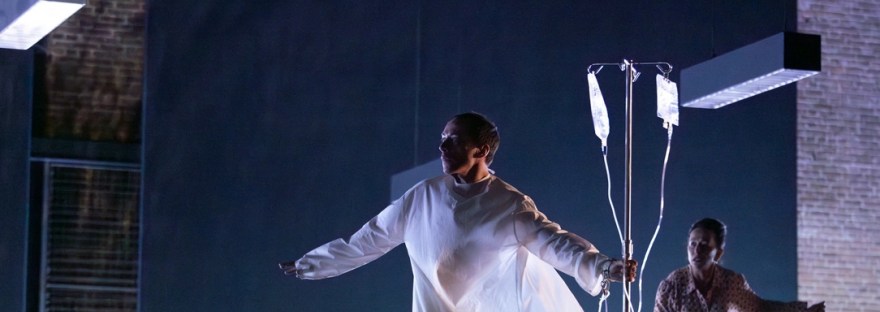
Angels in America, Edinburgh International Festival, Review

**** (4 stars)

“Absolutely First Class!”

A standing ovation greeted the cast at the end of this eagerly anticipated production from Internationaal Theater Amsterdam.  I really wanted to be as enthusiastic but simply couldn’t.

Make no mistake, the acting was absolutely first-class: huge credit to Marieke Heebink, Hans Kesting, Minne Koole, Jesse Mensah, Eefje Paddenburg, Felix Schellekens, Krisjan Schellingerhout and Eelco Smits for creating memorable characters and believable situations, even ones taking place in another reality [possibly under the influence of medication and/or other substances].

Angels in America centres on four characters during the Reagan presidency.  

Long before The Book of Mormon, two Mormons – Joe and Harper – take centre stage.  Joe is a lawyer in New York city who’s trying to rise up the ranks: he’s taken under big-shot lawyer Roy Cohn’s wing, and is being urged to move to Washington in order to further his career.  He’s reluctant to do so because of his wife, Harper, with whom he exchanges ‘buddy kisses’.  She’s obviously not happy, both in herself and in their relationship, and is dead set against the move.  Joe keeps going out ‘for long walks in the park’ – one of the first intimations that he’s possibly not being the good heterosexual happily married Mormon boy he appears to be…

Prior and Louis are lovers.  Prior is an ex-drag queen: Lous is a Jewish boy who has an enormous chip on his shoulder about just about everything.  Prior has been diagnosed with AIDS and is convinced he is going to die.  Louis, rather than supporting him, is angry with him – even blames him – and simply cannot cope with the imminent prospect of a messily sick and dying partner.  Prior’s bestie Belize, another ex-drag queen who now works in one of the big hospitals, is a constant source of support for Prior and antagonism towards Louis.

We meet Roy Cohn at his doctor’s – he’s been sick for a while but is telling everyone it’s liver cancer.  His doctor is very blunt – it’s not.  Cohn is a high-ranking lawyer whose main preoccupation, it becomes very clear, is not, as one might expect, the pursuit of justice: rather it’s the pursuit of power by any and every means available.  He’s very comfortable with the fact that it was through his behind-the-scenes actions that Ethel Rosenberg was sent to the electric chair as a communist and a traitor despite strong evidence to the contrary. 

Cohn’s energies are now concentrated on maintaining his hold on power while concealing his illness – Americans have no use for the sick.  He finagles his way onto the experimental ward treating AIDS patients, sets up his own supply of the experimental drug AZT, and is brought into contact with Belize, who works there.  Louis and Joe meet each other and embark on a physical relationship: Prior and Harper meet in some other reality, sharing a relationship of the mind.  Ethel Rosenberg starts appearing in Cohn’s life, watching with interest the progress of an inquiry into his past dealings which may well result in his debarring as a lawyer.  A shining angel appears – is it from heaven, or from hell?  Does it come to accompany Prior to paradise, or to add to the physical and mental torments he’s already suffering?

What emerges from this drama is a picture of an America which bears little or no relation to the ‘American dream’ but has many striking parallels with today’s USA.  Greed, substance misuse, the pursuit of power, the discarding or overlooking of the poor and weak, the worship of ‘success’, whatever that is… the list is endless and deeply depressing.  It also shines a harsh light on the struggles of gay people to access proper medical care, and the lengths to which ordinary human beings would go to try to help.

It’s a very moving piece, especially for people who remember those times and the huge numbers of friends who died after immense suffering and often neglect.  The men are very believable: I wish the women had received equal treatment. – but mostly they The female rabbi who opens the show, Joe’s mother, even Esther Rosenberg, are pretty two-dimensional.  The doctor, while played by a woman, could equally well have been played by a man.  Even Harper, who is a central figure, is portrayed as mentally unstable and unable to stand on her own two feet – though it becomes increasingly clear that this stems from her addiction to Valium.  The central male characters are much more real, whole and rounded figures, even if none of them are particularly loveable.

The acting, as I’ve said, is superb, but the characters [with the exception of Prior’s bestie, Belize, who is a sweetie] failed fully to engage me.  Part of the problem is, I’m sure, that the actors were speaking Dutch.  Angels in America, even in this shortened version, is a very wordy play, full of important ideas, and the supertitles were essential to enable a grasp of them.  Alas, this meant that at least half my attention was on them rather than on the stage, so I missed some of the action and couldn’t focus fully on the emotions swirling around.  Had the dialogue been in English, I would have been able to engage more deeply… 

Even so, it was a superb performance by all concerned, rightly saluted with a standing ovation.

Angels in America, Edinburgh International Festival, King’s Theatre, Run Ended for more information go to: Angels in America | Edinburgh International Festival

Mary Woodward at the Festivals

Kleio Quartet and Sheku Kanneh-Mason, Edinburgh International Festival, Review

***** (5 stars)

“Gorgeous!”

I’ll be honest: I asked for a ticket for this concert because I’m a great fan of Sheku Kanneh-Mason and really enjoy his visits to the International Festival.  Add to this the inducement of hearing a Schubert quintet [the one in C, D.956] and what’s not to like?  Yes, there was also a Bartók piano quintet [the one in C, Sz.23] on the programme, and I’m less keen on his music – but it’s good to be challenged aurally, yes?

Oh gosh I’m so glad I got a ticket for this recital – it was a joy from the first note to the very last.  I was familiar with the Schubert but didn’t know the Bartók at all.  I’m so very glad the Kleio Quartet approached Nicola Benedetti with the idea of putting these two works together – both are in C major, but sound quite different.  There’s less than a century between them [1828 and 1904]: the Schubert is one of his last works, the Bartók his first piano quintet, written in his early 20s.  What links them both is the passion that surges through both of them – which today’s performers gave us in full measure.

A string quartet consists of two violins, a viola and a cello – so what’s the fifth instrument here?  In this case, Yume Fujise, Katherine Yoon, Jaren Ziegler and Gerard Flotats were joined by Sheku Kanneh-Mason the engaging and charismatic young cellist who won BBC Young Musician of the Year in 2016.  I was interested to see quite how this instrumental lineup would work – and fascinated by the way Schubert saw the additional cello as a soloist who could hold forth on his own, engage in dialogue with other individual instruments, blend seamlessly into the ensemble, and at times provide a wonderful rhythmical pizzicato backing to the quartet.

The quartet’s sound in the Schubert was warm, lush and Viennese – like a slice of Sachertorte covered in whipped cream.  Sheku’s cello got to sing, but never overpowered the Kleio quartet, who work seamlessly and delightfully together – small wonder they won the first prize and commission prize at the 2023 Carl Neilsen chamber music competition!  I know this Schubert piece well, and frequently listen to it at home – but it’s a totally different experience hearing it live, in the company of a Queens Hall full of intently listening music lovers.  Each individual line can be heard more clearly, and the emotions connect audience and musicians so much more deeply as we listen to a fascinating five-way conversation in which each individual gets a chance to shine, is listened to intently, and gives generous support to the others when it’s their turn in the spotlight.

There’s gorgeous tone, sensitive phrasing, wonderful dynamic contrast, impressively nuanced dynamics and some glorious pizzicato, especially in the first movement and moving into the second.  There’s strong emotion, even storms, and always the return to elegant, graceful melody.  A vibrantly exciting third movement in which a lively, galloping melody bounces between the players leads into a muted autumnal lament which is itself followed by such a lively dance in triple time that a very large portion of the audience, myself included, couldn’t help but burst into enthusiastic applause at the end of the movement. 

And that wasn’t the end of things – the fourth movement was equally full of delights, with a dance that seemed almost military in its precision alternating with a gleamingly golden waltz.  The pace picked up, the music became lighter and jollier, and faster and faster until a final flourish had the audience erupting with delight, their applause so loud and prolonged it was clear they didn’t want the five musicians ever to leave the stage.

In the second half the quartet were joined by pianist Makoto Ozone.  His jazz career, which spans over forty years, has earned him a Grammy nomination and seen him work with many prominent jazz musicians.  In more recent years he’s started playing classical concertos by Mozart, Bernstein and Prokofiev.

In her introduction to the second half of the programme, first violinist Yume Fujise commented that as classically trained musicians, she and her colleagues were always seeking perfection.   Working with Makoto reminded them that perfection should not be the first aim – conveying the emotions in the music should be paramount.  That was clearly the case in this performance of Bartók’s first piano quintet.

The quartet’s tone was still warm, but steelier than in the Schubert – maybe dark hot chocolate infused with chilli this time, and hold the cream…

The music was lush and romantic, but also spiky; infused with both fury and passion.  It’s another conversation, but with a different sort of dynamic – the strings sing, and the piano is more percussive: though it can also blend in and be an integral, rather than a separate, part of the conversation.  My notes say fiery and romantic at the same time, stormy, brooding, yearning, galloping, becoming menacing, with spiky harmonics: and this is just the first movement!

The second movement had some fascinating rhythmic oddities among a lot of lively dancing in triple time – there was almost a competition between piano and strings, as if they were trying to play nicely together but simply couldn’t quite manage it.  The third movement had some wonderfully sonorous chords with an almost subterranean, underwater piano sound.  A warm bath of sound, a singing romantic outpouring together, a piano solo floating like fireflies in the darkness while the strings surge underneath moving into some extremely lively folk dances which whirled into a riotous party – as the movement title says poco a poco più vivace – little by little more lively.  The pace got faster and faster, with a stunning finale to which the only possible reaction was a storm of applause even louder than that which greeted the end of the first piece.

What a treat!  What a joy!  Haste ye back, lovely musicians!

Kleio Quartet and Sheku Kanneh-Mason, Edinburgh International Festival, Queens Hall, Run Ended for more information go to: Kleio Quartet, Makoto Ozone & Sheku Kanneh-Mason | Edinburgh International Festival

Mary Woodward at the Festivals

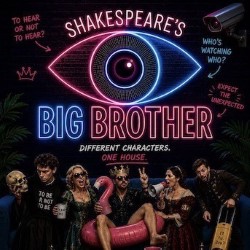
Shakespeare’s Big Brother, The Fringe, Review

*** (3 stars)

“Very Lively”

I guess it would help if I regularly watched Big Brother – but I don’t.  This aside, Big Spirit Theatre Company present a very lively take on the familiar show, populating it with some of the Bard’s best known characters.

We meet the contestants who are each given a short soundbite to introduce themselves.  Hamlet is an unmitigated, self-centred bore, considering it a done deal that he’s going to win.  Romeo looks alarmingly like Leo de Caprio, sunglasses and all: he seems a little shy and reserved, not very sure of himself.  The three witches are very outgoing, very excited about their rapidly expanding business, and looking forward to meeting the other occupants of the House.  Macbeth’s red-covered hands might give us pause – and he certainly seems very unsettled, giving us a lengthy list of things of which he’s scared…. Ophelia is quiet and unassuming, pretty certain that she’s not involved with anyone outside the House: Juliet by contrast is loud, a bit gobby, and not over-bright.  The Housemates are completed by the intriguing Puck, aka Robin Goodfellow – yes, he’s a fairy [but mercifully no nudge nudge wink wink fairy jokes, just an acknowledgement that there is life outside magic and he has quite a lot of it].

The show follows what I assume is the usual format – interactions between pairs of housemates, summonses to the Diary room, sessions in The Chair [cleverly formed from all the other Housemates] and weekly evictions.  We get occasional glimpses of ‘behind the scenes’ and the increasingly desperate link person who is the one who talks to Housemates and announces evictions.  We are introduced to last year’s winner – Cleopatra – who talks enthusiastically about the opportunities that have come her way since her success in the House.  And we watch the relationships developing between the cast members.

It’s amusing, entertaining, and enthusiastically well done by a cast of [mostly] pretty young young people.  I don’t want to spoil the fun by revealing the ultimate winner: suffice it to say that things don’t turn out as one might expect from watching the Bard’s plays, and the unexpectedly popular public choice winner doesn’t get what they expect, but I think what they richly deserve. 

As a coda, we get to find out how all the other contestants have fared since they left the house – I think it’s fair to say that all’s well that ends well…

Shakespeare’s Big Brother, The Fringe, Paradise in Augustine’s, Venue 152 run ends 22nd August for more information go to: Shakespeare’s Big Brother | Edinburgh Festival Fringe

Mary Woodward at the Festivals

Antigone 1989: A Town Hall Musical, The Fringe, Review

**** (4 stars)

“Inspiring!”

This didn’t start well for me – not only my second ‘made it by the skin of my teeth’ show of the day, but the opening number – very well delivered by, apparently, the Oracle – was setting the whole scene of the whole piece but delivered in rapid-fire American of which I could only grasp a part [and that only because I had a good idea of the plot of the original Greek drama…]

I’m happy to say things got quite a lot better.

It’s quite possible that the opening number also explained that, in addition to two brothers [Nick and Eli] dying and Calvin becoming the new Governor, deviance was going to be suppressed.  This facet of the narrative didn’t become clear until the Governor’s son Henry emerged – obviously not conforming to the pattern expected by his father, and then in flashback revealing his love for Nick.  [cue a beautiful love duet for two gorgeous voices]

Antigone [Tig], the dead boys’ sister defies the order – she’s obviously very caring and strongly pro-justice: Henry agrees with her but hasn’t her confidence, while her sister Issa thinks she can fight the injustice by recourse to the Theban legal code.  Governor Calvin thinks differently – the code is replaced with one single law – there will be peace, and anyone breaking the peace will be put to death.

There is much excellently choreographed scene-shifting, with clever use of two moveable sets of steps and a number of wooden cubes, which could be arranged in any number of combinations.  The score has a number of good melodies, though the opening number would have benefited from supertitles [or a slightly slower pace and crystal-clear diction] for those of us whose ears aren’t attuned to American accents and turns of phrase.  The mostly young audience was very appreciative of the jargon and slang used, and certainly in agreement with the final message, where all the voices start singing in rich harmony and end in unison, urging that one voice speaking out against injustice be heard.

If only.

Especially in the US these days…

There was a lot of good in this show, but Antigone it really wasn’t: rather it was ‘a musical loosely based on the original Greek tragedy with a rainbow twist’ and a great deal of poetic licence, especially with regard to Antigone’s fate – we hear two pistol shots, assume she’s been killed, but then she reappears on stage…?

The young cast were all superb singers, and really sold the story well, passionately believing what they were singing [or being extremely good actors…!]  What came over very clearly were the obvious parallels with the current political situation in America, the complete ignoring of the rule books and the total suppression of any attempt at opposition.

The young audience obviously thought this show was utterly brilliant – I hope it inspires them to take up the fight against injustice and the pressures to conform to societal values.

Antigone 1989: A Town Hall Musical, The Fringe, Gilded Balloon Patter House Venue 24, Run Ends 29th August for more information go to: Antigone 1989: A Town Hall Musical | Edinburgh Festival Fringe

Mary Woodward at the Festivals

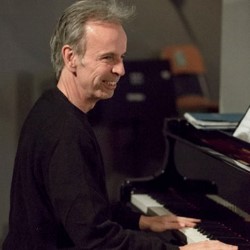
The History of Jazz Piano, and Irrelevant Topics, The Fringe, Review

***** (5 stars)

“Sheer Joy”

I’d been having a challenging day from the get-go, and the buses simply crawled when they weren’t standing still: I hirpled up Bread Street and Lauriston Street and stumbled, late, into the darkened room where Bill Cunliffe graciously welcomed me as I stumbled out my apologies.

What was going on?  It seems one Bud Powell had a time capsule in which he visited Leipzig in1720 to hear the great Johann Sebastian Bach play the cathedral’s organ.  At the end of the recital Bud spoke to the maestro, and played  for him the little minuet Bach wrote for his wife Anna Magdalena.  The beginning was exactly as written – but then began to swing, which puzzled the composer somewhat.  Is my music remembered after my death? he wondered: come with me, says Bud.

The time capsule flies off – cue flashing coloured lights and jangling sound effects – and we arrive in Salzburg in 1769, where the young prodigy Wolfgang Amadeus Mozart is giving a piano recital.  When he reaches the point in his sonata where there’s the cadenza [place to improvise and show off] the young Mozart recognises Bach in his audience, and inserts Anna Magdalena’s minuet in his own inimitable style.

Where else shall we go? is the starting point for a wonderful journey through time.  We visit one of Beethoven’s extremely lengthy concerts in 1812 – several symphonies are played and, as an encore, the Emperor piano concerto, at that time the longest in the repertoire.  Beethoven spots JSB in the audience as he’s about to launch into the cadenza – and lo!  That minuet works its way in, in Beethoven’s grandiose style, with some glorious modulations of key, and [this is where I started laughing] an even longer than usual succession of chords and false endings leading finally to the close of the piece.

By this time, Bud and Bach are hungry, so they go in search of food – and composers – with much humour and language-moderated political comment on the way.  Chopin, Debussy, Rachmaninov each in their turn recognise the master and pay him homage with their own take on Anna Magdalena’s minuet.  We then go to New York – what’s New York?  It’s in the USA.  What’s the USA – it’s in America.  What’s America?  Well, have you heard of Christopher Columbus? Yes.  Well, that’s what he discovered…

We start in Carnegie Hall, where George Gershwin is playing his Rhapsody in Blue.  He also spots the famous composer [assuming it’s someone in period costume] and pays homage by incorporating the minuet into his playing.  We move up to Haarlem to hear Fats Waller’s take on the minuet before moving to Philadelphia for a Philly cheesesteak at Gino’s Cheesesteak House, where John Coltrane’s band is playing.  When his pianist, McCoy Tyner, gets a solo spot, he launches into yet another, more fantastical, version of the minuet – still recognisably Bach, but so obviously also 1960s jazz.  We even get back to New York to hear the Toys 1965 A Lovers Concerto – that very same minuet, instantly recognisable.

Bach was safely returned home, and we came back to earth.  Bill offered us a unique opportunity: to hear a once-only, never-to-be-repeated composition blending three types of music – jazz, classical and a Beatles song.  He invited audience suggestions, and our applause showed which of three suggestions in each genre we chose to hear. 

I had been laughing delightedly most of the way through the show: this is where I really started laughing, for sheer joy at Bill’s inventive and dexterous keyboard brilliance.  Dave Brubeck’s Take Five and Beethoven’s Appassionata sonata seem unlikely companions – but oh my how they swung together and had fun!  I couldn’t begin to imagine how Yesterday could make its way into the mix but oh joy! here it came, and joyfully took its place in the mix – and then Gershwin couldn’t be kept out of the fun and his Rhapsody swung and tumbled its way through one of the most wonderful first performances it has ever been my privilege to attend.

Small wonder there was loud applause after the [very Beethoven-ly extended] finale!  There was a very tight turnaround with the next show, so I couldn’t tell Bill just how much I’d enjoyed his show – but I did manage to say to his wife-to-be that I couldn’t remember when I last laughed so loud and so long for sheer joy. 

Thank you so much, Bill!  I envy your audiences for the rest of this week…

The History of Jazz Piano, and Irrelevant Topics, The Fringe, C Arts Aurora Venue 6, Runs until 23rd August for more information go to: The History of Jazz Piano, and Irrelevant Topics | Edinburgh Festival Fringe