
**** (4 stars)
“Absolutely First Class!”
A standing ovation greeted the cast at the end of this eagerly anticipated production from Internationaal Theater Amsterdam. I really wanted to be as enthusiastic but simply couldn’t.
Make no mistake, the acting was absolutely first-class: huge credit to Marieke Heebink, Hans Kesting, Minne Koole, Jesse Mensah, Eefje Paddenburg, Felix Schellekens, Krisjan Schellingerhout and Eelco Smits for creating memorable characters and believable situations, even ones taking place in another reality [possibly under the influence of medication and/or other substances].
Angels in America centres on four characters during the Reagan presidency.
Long before The Book of Mormon, two Mormons – Joe and Harper – take centre stage. Joe is a lawyer in New York city who’s trying to rise up the ranks: he’s taken under big-shot lawyer Roy Cohn’s wing, and is being urged to move to Washington in order to further his career. He’s reluctant to do so because of his wife, Harper, with whom he exchanges ‘buddy kisses’. She’s obviously not happy, both in herself and in their relationship, and is dead set against the move. Joe keeps going out ‘for long walks in the park’ – one of the first intimations that he’s possibly not being the good heterosexual happily married Mormon boy he appears to be…
Prior and Louis are lovers. Prior is an ex-drag queen: Lous is a Jewish boy who has an enormous chip on his shoulder about just about everything. Prior has been diagnosed with AIDS and is convinced he is going to die. Louis, rather than supporting him, is angry with him – even blames him – and simply cannot cope with the imminent prospect of a messily sick and dying partner. Prior’s bestie Belize, another ex-drag queen who now works in one of the big hospitals, is a constant source of support for Prior and antagonism towards Louis.
We meet Roy Cohn at his doctor’s – he’s been sick for a while but is telling everyone it’s liver cancer. His doctor is very blunt – it’s not. Cohn is a high-ranking lawyer whose main preoccupation, it becomes very clear, is not, as one might expect, the pursuit of justice: rather it’s the pursuit of power by any and every means available. He’s very comfortable with the fact that it was through his behind-the-scenes actions that Ethel Rosenberg was sent to the electric chair as a communist and a traitor despite strong evidence to the contrary.
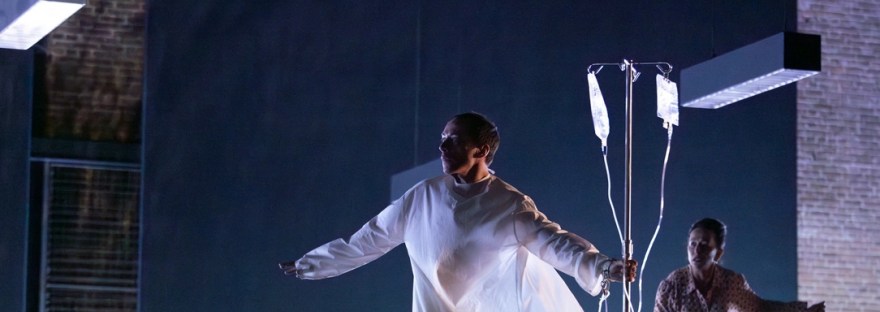
Cohn’s energies are now concentrated on maintaining his hold on power while concealing his illness – Americans have no use for the sick. He finagles his way onto the experimental ward treating AIDS patients, sets up his own supply of the experimental drug AZT, and is brought into contact with Belize, who works there. Louis and Joe meet each other and embark on a physical relationship: Prior and Harper meet in some other reality, sharing a relationship of the mind. Ethel Rosenberg starts appearing in Cohn’s life, watching with interest the progress of an inquiry into his past dealings which may well result in his debarring as a lawyer. A shining angel appears – is it from heaven, or from hell? Does it come to accompany Prior to paradise, or to add to the physical and mental torments he’s already suffering?
What emerges from this drama is a picture of an America which bears little or no relation to the ‘American dream’ but has many striking parallels with today’s USA. Greed, substance misuse, the pursuit of power, the discarding or overlooking of the poor and weak, the worship of ‘success’, whatever that is… the list is endless and deeply depressing. It also shines a harsh light on the struggles of gay people to access proper medical care, and the lengths to which ordinary human beings would go to try to help.
It’s a very moving piece, especially for people who remember those times and the huge numbers of friends who died after immense suffering and often neglect. The men are very believable: I wish the women had received equal treatment. – but mostly they The female rabbi who opens the show, Joe’s mother, even Esther Rosenberg, are pretty two-dimensional. The doctor, while played by a woman, could equally well have been played by a man. Even Harper, who is a central figure, is portrayed as mentally unstable and unable to stand on her own two feet – though it becomes increasingly clear that this stems from her addiction to Valium. The central male characters are much more real, whole and rounded figures, even if none of them are particularly loveable.
The acting, as I’ve said, is superb, but the characters [with the exception of Prior’s bestie, Belize, who is a sweetie] failed fully to engage me. Part of the problem is, I’m sure, that the actors were speaking Dutch. Angels in America, even in this shortened version, is a very wordy play, full of important ideas, and the supertitles were essential to enable a grasp of them. Alas, this meant that at least half my attention was on them rather than on the stage, so I missed some of the action and couldn’t focus fully on the emotions swirling around. Had the dialogue been in English, I would have been able to engage more deeply…
Even so, it was a superb performance by all concerned, rightly saluted with a standing ovation.
Angels in America, Edinburgh International Festival, King’s Theatre, Run Ended for more information go to: Angels in America | Edinburgh International Festival

 ScotsGay Arts