
***** (5 stars)
“Sheer Joy”
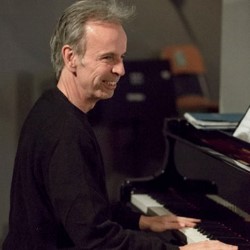
I’d been having a challenging day from the get-go, and the buses simply crawled when they weren’t standing still: I hirpled up Bread Street and Lauriston Street and stumbled, late, into the darkened room where Bill Cunliffe graciously welcomed me as I stumbled out my apologies.
What was going on? It seems one Bud Powell had a time capsule in which he visited Leipzig in1720 to hear the great Johann Sebastian Bach play the cathedral’s organ. At the end of the recital Bud spoke to the maestro, and played for him the little minuet Bach wrote for his wife Anna Magdalena. The beginning was exactly as written – but then began to swing, which puzzled the composer somewhat. Is my music remembered after my death? he wondered: come with me, says Bud.
The time capsule flies off – cue flashing coloured lights and jangling sound effects – and we arrive in Salzburg in 1769, where the young prodigy Wolfgang Amadeus Mozart is giving a piano recital. When he reaches the point in his sonata where there’s the cadenza [place to improvise and show off] the young Mozart recognises Bach in his audience, and inserts Anna Magdalena’s minuet in his own inimitable style.
Where else shall we go? is the starting point for a wonderful journey through time. We visit one of Beethoven’s extremely lengthy concerts in 1812 – several symphonies are played and, as an encore, the Emperor piano concerto, at that time the longest in the repertoire. Beethoven spots JSB in the audience as he’s about to launch into the cadenza – and lo! That minuet works its way in, in Beethoven’s grandiose style, with some glorious modulations of key, and [this is where I started laughing] an even longer than usual succession of chords and false endings leading finally to the close of the piece.
By this time, Bud and Bach are hungry, so they go in search of food – and composers – with much humour and language-moderated political comment on the way. Chopin, Debussy, Rachmaninov each in their turn recognise the master and pay him homage with their own take on Anna Magdalena’s minuet. We then go to New York – what’s New York? It’s in the USA. What’s the USA – it’s in America. What’s America? Well, have you heard of Christopher Columbus? Yes. Well, that’s what he discovered…
We start in Carnegie Hall, where George Gershwin is playing his Rhapsody in Blue. He also spots the famous composer [assuming it’s someone in period costume] and pays homage by incorporating the minuet into his playing. We move up to Haarlem to hear Fats Waller’s take on the minuet before moving to Philadelphia for a Philly cheesesteak at Gino’s Cheesesteak House, where John Coltrane’s band is playing. When his pianist, McCoy Tyner, gets a solo spot, he launches into yet another, more fantastical, version of the minuet – still recognisably Bach, but so obviously also 1960s jazz. We even get back to New York to hear the Toys 1965 A Lovers Concerto – that very same minuet, instantly recognisable.
Bach was safely returned home, and we came back to earth. Bill offered us a unique opportunity: to hear a once-only, never-to-be-repeated composition blending three types of music – jazz, classical and a Beatles song. He invited audience suggestions, and our applause showed which of three suggestions in each genre we chose to hear.
I had been laughing delightedly most of the way through the show: this is where I really started laughing, for sheer joy at Bill’s inventive and dexterous keyboard brilliance. Dave Brubeck’s Take Five and Beethoven’s Appassionata sonata seem unlikely companions – but oh my how they swung together and had fun! I couldn’t begin to imagine how Yesterday could make its way into the mix but oh joy! here it came, and joyfully took its place in the mix – and then Gershwin couldn’t be kept out of the fun and his Rhapsody swung and tumbled its way through one of the most wonderful first performances it has ever been my privilege to attend.
Small wonder there was loud applause after the [very Beethoven-ly extended] finale! There was a very tight turnaround with the next show, so I couldn’t tell Bill just how much I’d enjoyed his show – but I did manage to say to his wife-to-be that I couldn’t remember when I last laughed so loud and so long for sheer joy.
Thank you so much, Bill! I envy your audiences for the rest of this week…
The History of Jazz Piano, and Irrelevant Topics, The Fringe, C Arts Aurora Venue 6, Runs until 23rd August for more information go to: The History of Jazz Piano, and Irrelevant Topics | Edinburgh Festival Fringe


