Mary Woodward at the Festivals

Verdi’s A Masked Ball, Edinburgh International Festival, Review

*** (3 stars)

“Some Fabulous stuff!”

I found this sadly disappointing – though many in the Festival Theatre audience obviously found much to applaud.  Yes, Verdi’s Masked Ball isn’t the most intricately plotted of operas – it’s basically a love triangle with political overtones – but the music is full of emotion, and the situations not uncommon but none the less heartrending for those concerned. 

Verdi’s original intention was to write an opera based on the assassination of King Gustav III of Sweden, but he was forced to take the plot across the pond and base it in Boston.  Governor Riccardo is very popular, but also has enemies.  He is in love with Amelia, the wife of his best friend and loyal supporter Renato.  Amelia is torn between her illicit love for Riccardo and her loyalty to her husband.  Ulrica, an uncannily accurate fortune-teller warns Riccardo that his life is in imminent danger, but he laughs it off.  Ameila consults Ulrica, wanting to know how she can overcome her feelings: she is told to go to the haunted graveyard and pick a certain flower.  She obeys – but is followed by Riccardo, who confesses his love for her.  She in turn confesses her feelings, but begs him to help her be strong.

The pair are discovered by the group of conspirators who are plotting the Governor’s assassination.  Renato is also there, and gladly agrees to escort the unknown lady safely home.  He is appalled to discover that this woman is in fact his wife, and refuses to accept her protestations of innocence.  He joins the conspirators and gladly agrees to be the one who will kill Riccardo at tomorrow’s masked ball.  Amelia tries to warn the Governor, but in vain: he is shot by Renato.  Before he dies, he tells Renato of his wife’s innocence: Renato is horrified, and all present praise the generosity of the dying man.

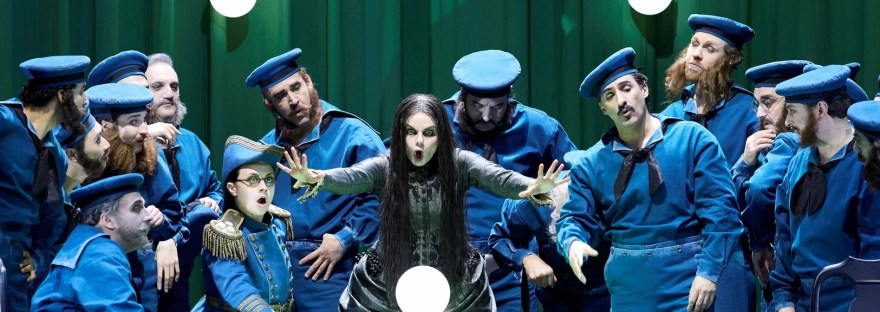
This production from Zurich Opera updated the action to America’s ‘Gilded Age’, when the upheaval of the recent civil war was being replaced by a surge of economic and political activity.  The production was very busy, with [an excellent] corps of dancers who were also active players in the drama, waving hands, arms, and legs most distractingly even when nowhere near a dance floor.  Right from the start there was busyness – we couldn’t listen to the overture in peace, but had to witness an autopsy [of the dead Governor] which both Amelia and Renato gatecrashed.   The plot was set up against a background of waving arms and election materials; Ulrica’s séance was invaded by an unlikely group of supposed fishermen [Riccardo’s compatriots] who played catch with her crystal ball; Amelia kept glugging from a hip flask, while her plea to her husband for mercy was overridden by Renato’s whisky consumption and pistol-waving.  Even the ball scene was so crowded with distraction that it was only too easy to miss the main points of the plot.

The overall result was that the music got completely sidelined – a great pity, since there’s some fabulous stuff in the score.  I couldn’t help but contrast this production with Maxim Emelyanychev and the Scottish Chamber Orchestra’s latest contribution to their Mozart opera series – the minimum of action from the cast told the story very simply and allowed the music to envelop the audience in its magic.  Yes, there were laughs – but arising from the text, not put in to amuse the masses who couldn’t possibly cope with listening to the music without constant visual distraction.

The singing was [mostly] very good: ditto the orchestra – though there seemed to be rather a number of moments when the two were not in synch with each other.  The set made clever use of the revolve to transition from interior to exterior settings – but it was unfortunate that Riccardo’s huge emotional outpouring had to put him in front of the red velvet curtain while the ball scene was being set up.  The lighting was mostly sombre, with rather too much use of ‘oh it’s a dramatic bit, or it’s boding again – let’s get the lights to flicker’.  The costumes were almost entirely in shades of grey – very dismal: I had hoped the ball scene would be a riot of colour but this was not to be.

Like I say, others in the audience obviously thought the whole thing was splendid: I just wished Verdi had been allowed to be heard.  Technically it was [mostly] very good – but it really didn’t move me: and there’s plenty in the score of A Masked Ball to tug at the heartstrings and bring tears to the eyes.

Such a pity.

Verdi’s A Masked Ball, Edinburgh International Festival, Festival Theatre, Runs until 30th August for more information go to: Verdi’s A Masked Ball | Edinburgh International Festival

Mary Woodward at the Festivals

In Her Hand, The Fringe, Review

*** (3 stars)

“An unvarnished account”

Yet another brilliant anti-war show.  No visible wounds, blood or guts on stage but they’re there throughout the performance as Edith and Frances struggle to maintain their sanity and their compassion as they work in a Scottish-run field hospital just behind the front line in the Balkans in the First World War.

Drawing on material from journals and letters and archive material held by the Royal College of Surgeons of Edinburgh, we get a clear and horrific picture of the conditions the women were working in and the struggles they faced every day – lack of basic equipment and medical supplies, cramped conditions, unrelenting gunfire clearly audible, and an unending stream of wounded and dying men, many of whom need limbs amputated and many who will die before they can receive the care they need.

Small wonder Frances relies on gallows humour to keep her going: Edith has loftier ideals and talks about the noble cause and the warrior queens of old, desperate to make it clear to her male colleagues that a woman surgeon can and should be as much a part of the medical team on the battlefield as any man.  Frances points out that women have been dealing with blood, broken bones and shit since the first man needed his bum wiped: who can be better fitted than they to do this exhausting work?

Edith recounts in graphic detail the steps taken in the amputation of a limb.  The clinical terms serve to heighten the horror of the process – difficult enough in a clean and sterile operating theatre in a city-centre hospital: unimaginably stressful in a field hospital where there is barely enough anaesthetic or stuff to dress the wound.  How on earth does she keep going?  At the end of a 14-hour shift her hands are shaking – and there is very little chance of rest.

Frances keeps a journal, which Edith sneaks peeks into – and is surprised at the quality of the writing coming from someone whom she would doubtless only encounter at home if she needed a cleaner – and when would she speak to her cleaner??  The class difference is never clearer than here…  Frances is justifiably angry at the invasion of her privacy – but despite this, the two women become good friends, supporting each other through all the horrors they have to face.

In her hand is unvarnished account of the suffering caused by war, the primitive nature of medicine in war zones, and of the struggles women have had almost since time began to be able to realise their full potential in a mainly male-dominated field.

Massive credit to Joyce Falconer [Frances] and Clare Yuille [Edith] in this moving and thought-provoking show.  They were both splendid in their portrayal of women doing what women do: just getting on with things as best they can in the most appalling of conditions, trying to alleviate suffering in others without counting the cost to themselves.

Huge credit, too, to the creative team – Jordanna O’Neill, Christopher Silver, Michelle McKay, Kate Stamoulis, John Kielty and Laura Hawkins.  In her hand is part of a two-year Women in Surgery project, which explores and celebrates the remarkable history of women in surgery.  It’s clear from the play that women had continually to fight the idea that a woman’s place is in the home and that women were too delicate to do a man’s work – an idea that still won’t go away.

And more than a century after that first disastrous world war, men still think that killing each other is the way to settle arguments and make the world a better place.

When will they ever learn?

In Her Hand, The Fringe, The Space @Surgeons Hall, Venue 53, Runs until 29th August for more information go to: In Her Hand | Edinburgh Festival Fringe

Mary Woodward at the Festivals

Haribo Kimchi, Edinburgh International Festival, Review

***** (5 stars)

“Such a joy! “

As a K-drama addict, I simply had to see this show: I was not disappointed, even though demons, spirits and idols failed to appear.  As anyone who has watched Mystic Pop-up Bar will know, the small orange tent-live structures [pojangmacha] that appear in the evenings and are gone by morning are a feature of night life in Seoul and many other cities in that part of the world.

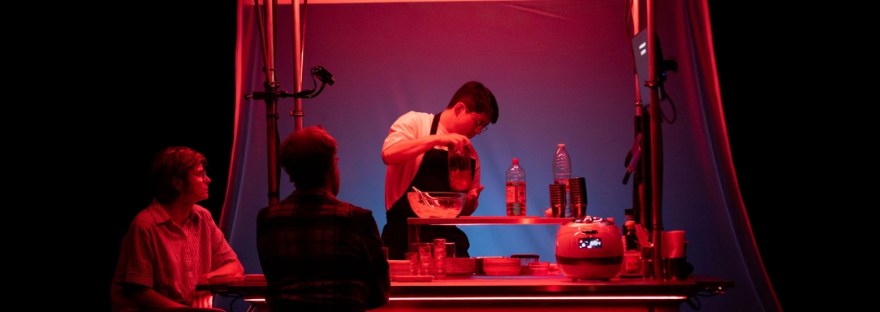
There is, in truth, a small orange tent waiting for us as we come into the Studio Theatre: it’s lit up inside, but we can’t see through the awnings that stretch down to the floor.  Screens each side of the stage show us a panorama of Seoul – the masses of high-rise buildings, some offices, many flats – we can even see people at the windows of some of them.  We look down on the multi-lane highways, thronged with cars, and then swoop down to street level.  We leave the wide streets and dive into a network of tiny alleys, all startlingly clean and free from rubbish, devoid of people but thronging with tiny businesses: most of the signs are in Korean, but I spot Guinness high on a wall, and would like to slow down and browse, but no – on we must go.

And then, finally, we see a pojangmacha in front of us, slightly larger than the one on stage, but unmistakeably the same.  Jaha Koo comes on stage and silently starts getting his little bar ready for business – removing the awnings, putting the stools back on the floor, cleaning the surfaces – ready for the first customers of the night. 

The house lights go up, and Jaha comes towards us, inviting two audience members to be his customers: oh lucky Kirsty and Hugo!  They sit on the two stools and are introduced first to soju [a clear liquid not unlike vodka, 60% alcohol] and maekju, Korean beer [about 4.5%] which are mixed to create a cocktail which they sip while watching Jaha preparing their appetiser – cucumber with ssamjan sauce.  Oh how I wished I were a customer at that bar, as Hugo and Kirsty are introduced to more Korean dishes…

But this is not a Korean cooking show!

It’s a multidisciplinary meditation on home, family, memory, diaspora and displacement, adaptation and unconscious protest.  Music, song, film, animation, recorded voices, and spoken narrative intertwine to create a multilayered explanation and exploration of Jaha’s family history and personal experience of voluntary and involuntary displacement. Kimchi [including exploding kimchi] features largely, as do snails, eels, and gummy bears.  There is kindness and cruelty, friendship and ‘othering’: and so much to think about.

Food is a constant presence in Jaha’s story – familiar food reminds us of who we are and where we come from; sharing food with others can be sharing part of one’s history; and in so doing, one can feel less alone.  Going back home can simply point out how one doesn’t belong there either: perhaps almost all of us are perpetually displaced – routes have become our roots.

It’s a gentle, fascinating show which gives one much to think about.  If you knew nothing about South Korea before the show, by the end you would have had a much better idea of the country and its culture.  For me, it was a delight to spend time ‘in’ a country I’ve come to know and love. 

But the best things of all were the amazingly cute singing snail and the illuminated, animated eel…

Such a joy!  Gamsahamnida!  Thank you, Jaha Koo!

Haribo Kimchi, Edinburgh International Festival, Festival Theatre’s Studio Theatre, Runs until 24th August for more information go to: Haribo Kimchi | Edinburgh International Festival

Mary Woodward at the Festivals

Aderyn / Bird, The Fringe, Review

**** (4 stars)

“A superb performance”

I’m so glad I caught the last night of the run – it was such an enjoyable show, on so many levels.  I thought we were getting a storyteller and a musician: we got two of each!

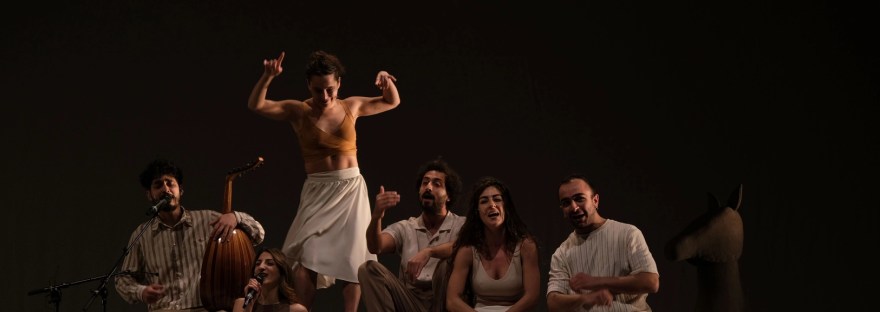
Ailsa Dixon and Ffion Phillips are playing as we enter the library: Ailsa on the cello, Ffion on the guitar – a lively dance tune that invites us to take part in, rather than simply looking at, the performance that’s about to begin.

Back when time began…there was the old woman [cailleach] and the old man [bodach] at the mouth of the cave beside the rippling lake: she milks the deer and makes the crowdie which he shapes into tiny figures and together they carry them in the creel to the top of the mountain…

And the birds [aderyn] come: the gentle little songbirds, which take the crowdie figures from the bodach’s right hand and carry them off to the sleeping people for their dreams, and the birds of the battlefield, the eagles, crows and suchlike, who take the crowdie figures from the bodach’s left hand and carry them off to be the nightmares of the people who are tossing and turning in their beds…

Birds fill all the tales – birds big and small, noble and cunning – the tiny wren, the massive eagle, the iridescent starling and kingfisher, the subtle colouring of the wise old owl, the skeins of geese calling to each other as they cross the sky, and the redstart, now colourful but once the drabbest of the drab.

Words and music fill the tales – Welsh, Scots Gaelic and [thankfully] English – I have a tiny bit of Welsh courtesy of Duolingo and a friend who lives in Dolgellau, and much much less Gaelic thanks to a friend who lives on Islay.  The languages glint and flicker like the flames on a hearth round which the storytellers gather, flow one into the other in speech and song, adding to the richness and colour of the narrative even when you don’t know what each word means.  The music and song flow through the stories, weaving their own gentle magic too.

Birds argue who should be king; boys go hunting the wren; seven brothers turn into wild geese; news of a Welsh princess’s ill-treatment at the hand of her husband, the king of Ireland, is brought to her brother by the princess’s only friend, a starling; and the redstart gains its colourful plumage when it brings the gift of fire and warmth to humankind.

Ailsa and Ffion don’t simply take turns to tell their tales; they sell them together, swapping phrases, languages, and music as they weave their magic and hold us spellbound for the hour.  There is light and darkness, joy and deep grief; and at the end of it all the redstart returns to the cailleach and bodach, bringing warmth and light to the cave beside the rippling lake back in the day when time began…

A superb performance from both women – I’m so glad I caught their show, and wish them the very best as they move south to tell their tales elsewhere: and haste ye back to Edinburgh for next year’s Fringe, please!

Aderyn / Bird, The Fringe, Scottish Storytelling Centre, Venue 30, Run Ended, for more information go to: Aderyn / Bird | Edinburgh Festival Fringe

Mary Woodward at the Festivals

Mark Thomas: 40 in Standup Years, The Fringe, Review

***** (5 stars)

“An explosive combination”

‘Twas well over twenty years ago, dear reader, that I was a volunteer at the Fringe, helping to run venue 40, aka the Quaker Meeting House.  I was sharing a room with Kathie, who said I simply had to come with her to a performance by a comedian, one Mark Thomas.  I had no idea who he was, but agreed to accompany her…

If you’d told me beforehand that I’d nearly wet myself laughing at a show about the wall the Israelis were building in Israel-Palestine, I wouldn’t have believed you: but that’s exactly what happened.  Mark, while not disguising his anger at the situation, was able to find love and life and humour – real belly-laugh humour – in the people and places he visited as he walked along that wall.  He brought the Palestinians’ plight to our attention not simply by ranting but by bringing them and their situation alive while making us laugh at its absurdity.

Ever since I started reviewing, I’ve tried to catch Mark’s shows.  I’ve not always managed it, but when I have, it’s been a memorable occasion.  Trespass; The Red Shed; Bravo Figaro!, the piece about his dad; and so many more.  And then the amazing England and Son in Summerhall a couple of years ago, in which his gobsmacking acting skills left his audiences stunned and ecstatic…  These were all masterclasses in getting your message across while wrapping it in a coating of humour which did nothing to sugar-coat the underlying truths.

Forty years on stage and how is Mark doing?  Still as angry, still as outrageous, still as funny; still as passionate about the causes he’s championing and the injustices he’s spotlighting.  He warms us up with Trump and gentrification and moves on to Farage, political parties, and so much more – all wrapped up in both a rant and a celebration of his mum’s life and a deep appreciation of the double-bind in which carers, himself and his sister included, find themselves.

As ever, there’s a lot of laughter masking a great deal of both hurt and anger: an explosive combination which makes an evening with Mark both achingly funny and deeply memorable.  I hope that many of his audience will have felt moved to do something to improve the injustices and inequalities he’s so passionate about.

Here’s to the next forty years, Mark!

Mark Thomas: 40 in Standup Years, Stand Comedy Club 1, Venue 5, Runs until 30th August for more information go to: Mark Thomas: 40 in Stand-Up Years | Edinburgh Festival Fringe