Blog

Brett Herriot Review

Christmas Carol Goes Wrong, Festival Theatre, Edinburgh, Review:

“A comedy pathos masterclass!

**** 4 Stars

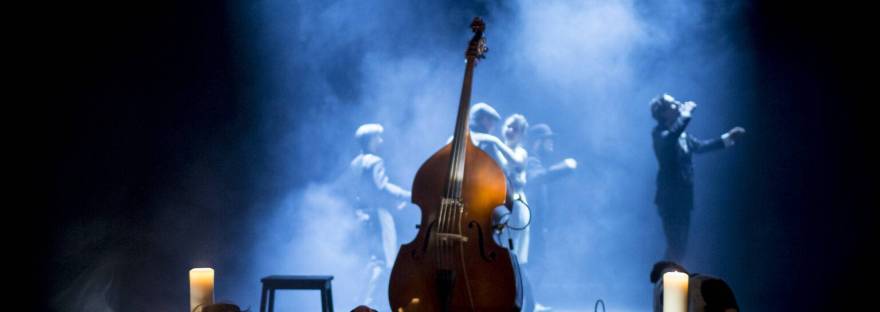
Marking a decade since the inception of Mischief Theatre Company which debuted with the global hit “The Play That Goes Wong” which spawned “Peter Pan Goes Wrong” comes the third in the trilogy as the Cornley Drama Society return to the Cornley playhouse for “A Christmas Carol” which goes very wrong indeed to hilarious effect.

Based on Dickens classic tale of redemption of the titular “Scrooge” who is visited by the three ghosts of Christmas on the evening of Christmas eve Mischief deploy their comedy “Gone Wrong” formula, but this time rely on comedy of words as opposed to slapstick although the show does have its slapstick moments. It’s the reliance on word comedy as opposed to over the top visual slapstick that does give the show its own unique flavour but equally give rise to moments that sail close to repeating itself.

Written by Henry Lewis, Jonathan Sayer and Harry Shields with both Lewis and Sayer taking to the stage as Robert and Dennis respectively. The Christmas Carol story is present but wrapped up in the aft seething world of jealousy that often pervades the amdram world and that’s what drives the comedy. A perfect blend of university players (think that was the week that was) meeting fringe theatre in a comedic masterclass.

The 10 strong ensemble company shine without ever overplaying their roles Henry Lewis is stellar as Robert his booming voice reminiscent of Brian Blessed is pitch perfect as the ghost of Christmas present along side Robert the wannabe “Scrooge”. Daniel Fraser is also a delight as “Chris” who takes the role of Scrooge and acts to a great extent, as the straight man to the companies’ jokes, he has sublime physicality and his moment where he breaks the fourth wall are genius. The entire performing company do deliver in spades. What sets Christmas Carol goes wrong apart from its sister shows in the trilogy is this show has a gorgeous touch of pathos weaved through it which is touching and makes the show sparkly just that little brighter.

Director Matt DiCarlo has mined the script and rung every comedic moment out of it and ensures his well-drilled company deliver the play at a cracking pace that feels perfect for the 2 hour and 15 minutes run time. Libby Todd’s set design walks the line of professional theatre and amdram perfectly to the point the show would feel equally at home in a church hall as does the environs of the beautiful Festival Theatre. This is boosted by David Howe’s Lighting design and Alexandra Faye Braithwaite’s sound design. Both Lighting and Sound design cleverly blur the lines of professional and amateur theatre peppering the designs with enough technical niggles that add to the comedy but give the overall show a sense of realness. Special mention must go to Roberto Surace and their inspired Costume Design that add the cherry to top of this comedy cake.

Christmas Carol Goes Wrong delivers everything it should and makes a laughter filled treat on these dark late winter nights and proves there is still much that can wrong in the funniest of ways for a company whose star is still very much on the rise! So, head to the Festival and grab those last tickets and may god bless us! Everyone!

Mischief presents Christmas Carol Goes Wrong, Festival Theatre, Edinburgh runs until Saturday 14th February, for more information go to: Christmas Carol Goes Wrong – Capital Theatres

Christmas Carol Goes Wrong UK Tour continues until Sunday 1st March 2026 and the production will call at the King’s Theatre Glasgow from 17th to 22nd February.

Mary Woodward Review

Memoir of a snail, Manipulate Festival, Film House Edinburgh, Review

***** (5 stars)

“Gloriously life-affirming”

Australian stop-motion artist Adam Elliot is new to me – somehow I managed to miss his previous animation, Mary and Max.  Oh my goodness what a talent!  What an imagination!  And what a splendid collection of characters, settings and props – every one of which is hand-made.  It’s visually stunning, brilliantly created, and a real emotional roller-coaster [insider reference to a significant moment fully intentional here].

Grace Pudel is a twin.  She and her brother Gilbert live with their father: their mother died at their birth – just as snails do – and their father, a French street performer who moved to Australia when he married their mother, is severely disabled after an unfortunate accident.  Their life is hard, but not without its joys, until the father dies.

Heartless Child Services separate the children and place them the opposite sides of the continent.  Both are extremely unhappy, but have no way of being re-united: all they can do is write to each other.  Gilbert is lodged with apple farmers who practice a very extreme religion – this is so horrifically well-portrayed I couldn’t laugh at it.  Grace is simply neglected by her incredibly toothily smiling ‘parents’, who follow one extreme fad after another.  The only things that make Grace’s life bearable are her growing collection of live snails and snail memorabilia   

– until she comes across the indomitable Pinky, who brings life and colour into her drab existence.

You wouldn’t think things could get any worse, but they do.  I was beginning to wonder whether there would be any relief in this catalogue of disasters – but be reassured, dear reader: there is light at the end of a very dark tunnel, but I’m not going to share any spoilers!

Memoir of a snail explores the strength of human connections, the extent to which people will go in pursuit of what they firmly believe to be right regardless of its effect on others, and humans’ reactions to extreme stress and unhappiness. 

Surrounding oneself with a snail shell of Stuff creates an impermeable barrier to any sort of relationship with other humans or the world outside: it can take a great shock or an immense amount of courage to leave the safety of the shell and dare to risk being alive, to live rather than simply exist.  Thank heaven for Pinky’s final utterance – “potatoes”…

This is a gloriously life-affirming film – which is available on the BFI website if you weren’t able to be at the FilmHouse last night.  There’s a lot of humour [though some of it made me wince rather than laugh].  It’s an exploration of the perils of hoarding and keeping guinea pigs, and a very strong warning about the dangers of extreme religion [and possibly apples]. 

I am definitely going to add it to my ‘when you’re feeling really bad and need to know there’s hope somewhere’ list.

I hope you’ll discover and enjoy it too.

Memoir of a snail, Manipulate Festival, Film House Edinburgh, RUN ENDED

Mary Woodward Review

The Raft of the Crab, Manipulate Festival, The Studio Theatre, Edinburgh

**** (4 stars)

“An honest and courageous show”

Created and performed by Ninon Noiret, The Raft of the Crab uses words, music, puppetry, contemporary dance and the Chinese pole to explore Ninon’s relationship with the cancer which might have destroyed her performing career and taken her life.

The fact that Ninon was in front of us, displaying a breathtaking ability with said pole among her many other talents, could perhaps have indicated that neither of these fates came to pass – but still the audience was gripped by her narration.  From the beginning, where she sadly sings ‘happy birthday’ to herself, to the final quizzical introspection – ‘what will you do with the rest of your life?’ we are drawn into the confusion and challenge of her world, into which the dreaded crab – cancer – so rudely erupted.

She puts a brave face on it – but the fear is there too, the rage, the loneliness, the despair: the insensibility of others and the black humour with which she attempts to survive when at her lowest.  The words flow out – sometimes English, sometimes French, and sometimes inaudible: the really important pieces of information and comment, however, are delivered with a microphone and a dazzling smile, even when the message is grim.

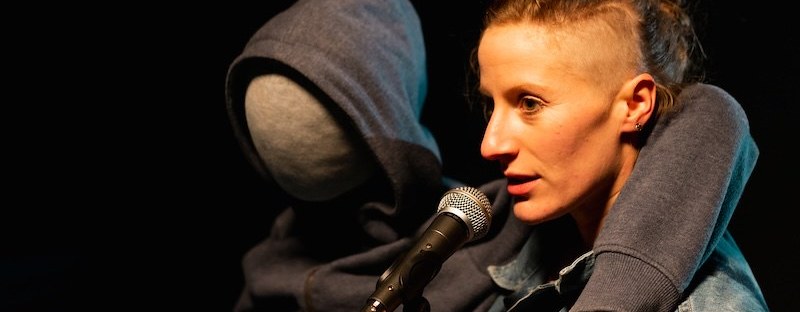
Two puppets assist her.  One is life-sized – the self to whom she speaks when she is pondering how the crab first came into her body.  The other is half her size, a shrunken and virtually bald image of the self she becomes through chemotherapy, constantly tugging at her inadequate hospital gown, smoothing it down, ‘making herself decent’ – heart-breaking.

There’s also a large blue crab: the cancer, with whom she has a love-hate relationship – a friend as well as an enemy, something both inside and outside her, something which takes away a part of her but is also at times her whole identity.

This is an honest and courageous show in which Ninon reveals a lot about herself and those around her.  Sometimes the battle isn’t with the cancer but with the people she has to deal with – even her family, at times.  She questions herself – even in this dreadful time, the artist/ performer part of her is thinking about how she can put her experiences into a show…  The graphic physicality of her struggle to regain mobility, confidence, the courage to fly up the pole is striking.

So too is her final question: what will you do with the rest of your life?

It’s a question we could all ask ourselves, whether or not a crab appears to ruin our birthday celebrations.

The Raft of the Crab, Manipulate Festival, The Studio Theatre, Edinburgh, Run Ended

Mary Woodward Review

KAR, Manipulate Festival, Festival Theatre Studio, Edinburgh, Review

***** (5 stars)

“Totally absurd anarchy”

KAR is a show which makes me wish I had a completely new vocabulary with which to describe it: ordinary words seem utterly inadequate.

As we enter, we are thanked for coming and for our condolences.  If we wish, we can take a small red nightlight holder whose candle is lit and place it in front of a rectangular plinth on which a man is lying.  Two black-clad men, one on roller skates, are in attendance on him – one attends to the cigarette in his mouth, removing it and tapping its ash off when required.  The other joins him when it becomes clear that the recumbent man needs a drink [which appears to be either whisky or vodka].  All this time, the [very poorly looking] man wheezes out a short musical phrase on the small piano accordion on his chest…

Having ushered us all in, the third man leaves his post at the door and scrutinises us all, checking against a long list in his hand.  Suddenly “Where’s Anya?” – utter chaos ensues but she doesn’t appear.

At last the dying man speaks – “I’m leaving” – a violin lament accompanies his last tortured wheezings

“He’s dead”…

Respectful silence.

Suddenly the man sits up, pronouncing “Not yet….. later…. Tomorrow….”  It’s both a shock and a huge relief

And we plunge into an hour of totally absurd anarchy, which is virtually indescribable!  Five extremely talented artists keep us immersed in their surreality.  It might help if you have a nodding acquaintance with Tolstoy’s Anna Karenina [which I read quite a few decades ago] and possibly understand Russian – there are some haunting folk-like songs weaving through the show. 

But quite honestly, all you really have to do is sit and silently admire the staggering virtuosity of the performers – Anna Bubníková, Jiří N Jelínek, Ivo Sedláček, Pavol Smolárik and Matija Solce.  Not only are they accomplished singers and musicians – violin, cello, double bass, piano accordion and a jaw-dropping array of percussion implements, including at one point a scythe – but also puppeteers, mime artists and comedians with very impressive physical dexterity and an impeccable sense of timing.

There’s a lot of vodka, some tea, two tiny steam locomotives, glasses of all shapes and sizes, an urn, a Eurasian woodcock…

And among it all, an irrepressible zest for and celebration of life

Yes, we will die

But later…tomorrow…

Not today!

Fekete Seretlek: KAR, Manipulate Festival, Festival Theatre Studio, Edinburgh, Runs until 5th February for tickets go to: Kar – Capital Theatres

Mary Woodward Review

Nutcracker in Havana, Festival Theatre, Edinburgh, Review

***** (5 stars)

“A wonderful winter warmer!”

Carlos Acosta’s Nutcracker in Havana is the perfect antidote to the winter blues, and a packed Festival Theatre was loud in its appreciation both during and at the end of last night’s performance.  Rhythm, passion, fire and fun infused a sunny, joyful celebration of simply being alive.

The basic Nutcracker story was all there – the Christmas celebration; Clara’s nutcracker doll – broken by her brother Fritz, who believes his sole purpose in life is to torment his sister, and mended by the magician Drosselmeyer; the midnight fight between rats and soldiers, brought to an end by Clara; her reward when the nutcracker, now a handsome prince, takes her to the magical Kingdom of Sweets, where she meets the Sugar Plum Fairy and is entertained by a series of dances.

So often Nutcracker can simply be an almost sickly-sweet confection danced by talented but slightly unreal and generally white dancers.  [I must say that Scottish Opera certainly don’t come into this category, but are very much alive!]

Carlos Acosta, by moving the setting to Havana, and using his own childhood experience of growing up in a humble Cuban home in a country where the celebration of Christmas was illegal, has produced a lively, energetic celebration of both the Christmas spirit and the sheer joy of dancing.

A very meagre Christmas celebration is underway when suddenly Tio [uncle] Elias appears in his classic Chevrolet Corvette.  He brings three life-sized dolls with him – two of the many Yoruba gods, Changò and Oshùn, and a Tin Soldier.  With a wave of his hands, the humble hut and sparse decorations are changed into a mansion with glittering ornaments on a suddenly taller tree.  The dolls dance, the families dance; there is a wonderful clog dance, with everyone wearing [or in one case continually losing] chancletas; a maypole’s ribbons come down from the ceiling and are joyfully woven and unwoven.

Peace returns as everyone goes to bed: but life-sized rats emerge and are engaged in battle by Mambises, soldiers who fought to free Cuba from the Spanish.  Clara appears when things are looking desperate, and despatches the Rat King.  The Nutcracker transforms into a handsome Prince, and dances with Clara.  Snowflakes appear and dance round them: as snow falls, Tio Elias appears with his car and takes Clara and the Prince for a magical ride.

Clara, the Prince, and Tio Elias are in the Kingdom of Sweets, where cooks present a dazzling display of confectionery for their delight.  They are welcomed by the Sugar Plum Fairy, and under Tio Elias’ direction a succession of dancers entertain Clara – who is so delighted that at times she can’t resist joining in with the dancing, and is very reluctant to go back to her seat.

All good things must come to an end, and Clara is taken home, falling asleep clutching her nutcracker doll, where her family find her and lead her back to her bed… was it all a dream???

The Cuban flavour didn’t only colour the action, but infused and energised Tchaikovsky’s already wonderful score.  Some of the music was presented more or less ‘straight’, simply with more exotic orchestration: some of it was really boogied up, and infectiously – at one point I really, really wanted to get up and join the dancing.  I’m sure I wasn’t alone in this!  Pepe Gavrilondo and Yasel Muñoz have created a singularly uplifting and energising score which I’d love to hear again and have on tap for when I’m feeling blue.  I defy anyone to feel down if they could dance around to this engaging and appealing treatment of the Nutcracker score.  Yunet Uranga’s costumes were a wonderful mix of ‘everyday’ and ‘wow! spectacular!’ with a special shoutout for the Arabian, Chinese and Russian dancers’ costumes.

The dancers were all brilliant – even one small Oops! moment was gone in a flash, making me wonder if I’d dreamed it.  Thalia Cardin lit up the stage as Clara [reminding me a bit of Emma Raducanu when she’s really glowing with happiness].  Alexander Varona was an impressively magical Tio Elias, taking delight in his own cleverness while also bringing joy to everyone else.  Most of the rest of the amazingly talented cast were double- treble- and even quadruple-cast, and it was lovely to see that members of the Acosta Advanced Training Hub in Woolwich were on stage in a couple of the large group numbers – what a joy and privilege to take part in such a vibrant and joyful production!

Applause and cheers were loud and prolonged not just at the final curtain but throughout the performance as the packed house showed its appreciation of the talent displayed for them.  I’m sure many of the audience were experienced balletomanes, but I’m hoping that a large proportion were people who’d never seen live ballet before.  My, what a treat for them, which I hope will lead them to come to more ballets and discover a box of delights which is not just for Christmas.

Thank you, Carlos Acosta, for devising this sparkling production, and for bringing it to a dismally dreich Edinburgh last night.

Carlos Acosta’s Nutcracker in Havana, Festival Theatre, Edinburgh, runs until Wednesday 4th February for more information and tickets go to: https://www.capitaltheatres.com/shows/nutcracker-in-havana/

The Production completes its current UK Tour at the Theatre Royal Norwich from 10th to 11th February.