Blog

Brett Herriot at the Festivals

Thank you! The curtain falls on the 2026 Edinburgh Festivals Season!

“Time for the Society to Listen!”

Three weeks and four weekends spanning August 6th through August 31st has seen the annual cultural explosion that is the festivals season taking over the Scottish Capital as Edinburgh welcomes the globe and re-establishes itself as the greatest platform for the arts in the world!

The two-person team here at Scotsgayarts.com received thousands of emails from companies performing across the Edinburgh Fringe, The international Festival and the Book Festival.  These were whittled down to the hundred or so reviews that have been published on the site across the duration of the festivals.

Our coverage has spanned all the August Festivals including the International Festival, The Fringe and the PBH Free Fringe.

The 2026 and 79th Fringe has been especially challenging with the late kick of date that saw audience figures fall off a cliff in the last week and given that Scottish Schools went back just one week into the festival applied a significant amount if pressure. For those venues based in the new town the devasting fire at the former Debenhams building meant the closure of the George Street temporary garden with the gardens bar and venues including the Bijou moving along to St Andrew’s Square and George Street remaining open to Traffic.

For the city council to defend a seven-week closure of Princes Street and the associated chaos that was the diversions is somewhat galling and made significant dent in the footfall of Potential Audience members for those show’s housed across the new town.

The Fringe Society now ensconced in their multi-million-pound new home have issued media statements claiming sales have increased yet its reflected on one soul Saturday (17th August) yet most companies and producers struggled with low ticket sales or hemorrhaging money with the society once again asking for public money the question has to be asked, where was the society’s support this year? There was no additional signage in the town, just the usual mix of privately funded show advertising, where was the TV and radio advertising or even harnessing the media to try and boost audience figures?

The Fringe Society are clinging steadfastly to the misguided fact that the Fringe must finish on the end of August English Bank Holiday? Why? Who is paying the society to enforce this decision? The Society is supposed to listen to the companies but it’s happy to do nothing but acquire a brand new home and put the begging bowl out for more money.

The one thing that is clear is the formula isn’t working for far too many and can’t continue, discussion is needed across the festival organizers going forward and more importantly the city council and the citizens of this great city to secure the cultural phenomenon for both performers, producers, venues, the city and its people on a shared equal footing for generations to come. If the Fringe Society are listening, they must pull the 2027 and 80th Fringe Forward by a week to allow for recovery from this years festival.  

As the curtain falls on this year’s festivals, we at Scotsgayarts.com offer our profound thanks to all those who shared their work with us, each and every moment spent in venues that spanned small intimate theatres to the grandeur of the tattoo arena at Edinburgh Castle provided magical theatrical magical moments that will stay with us for a lifetime.

The Arts matter and Scotsgayarts.com is indebted to the creatives who shared their work and themselves and make the festivals just what they are! We now move forward into the autumn and winter season of work from across Scotland, but we are already pondering with excitement what the 2027 Festival season will bring our way!

For now, rest well, thank you and haste ye back!

Brett

Editor

Scotsgayarts.com
Mary Woodward at the Festivals

Al-Sirah Al-Hilaliyyah, Edinburgh International Festival, Review

**** (4 stars)

“Courageous”

Gosh I’m glad we weren’t presented with the whole 150-or-so-hours of the entire narrative of this Arabic epic.  It’s a long tale that used to be told at weddings and celebrations, and would be spread over many days in which the basic saga would be embellished with many diversions and flights of fancy.  Palestinian and Arabic theatre makers Khashabi Theatre kindly reduced the main tale to its bare bones – but even so, there was much to tell.

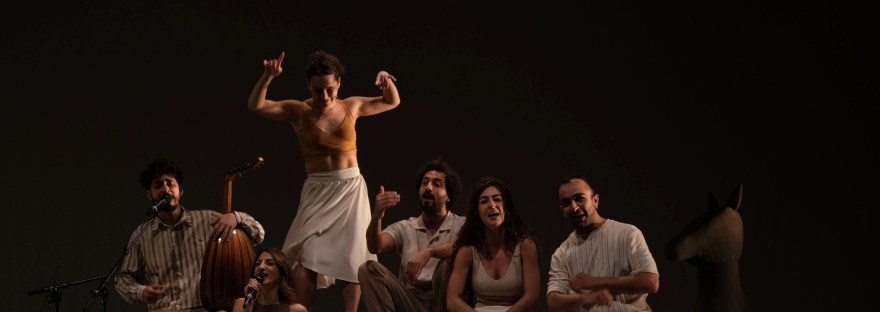
We entered the Lyceum’s auditorium to find Rana Baransi, Maya Omaya Keesh, Rami Nakhleh, Adan Rabos, Misan Miso Samara, Atallah Tannous and Abed Zoabi already on stage, waving to us and saying hallo – Marhabbah – as we made our way to our seats on whichever level they were.  Thus we were, as with all good storytelling, instantly engaged in and with what we were going to hear: not invisible and silent observers, but people willing to be a part of whatever unfolded on stage.

There’s no way I can summarise Al-Sirah Al-Hillaliyyah [the epic of Bani Hilal] – even its barest bones took up two pages of the programme.  It’s a long, heroic saga full of misunderstandings, fighting, jealousy, plotting, revenge, and above all blood and slaughter.  My Arabic is non-existent and I, like many others, was grateful that both short plot summaries and translations of much of the dialogue were screened on the back wall of the stage – a necessary distraction but at times a real hindrance to trying to keep alert to the many things going on in front of us.

There was music – wonderfully haunting singing from Rana Baransi and Abed Zoabi in particular – with fascinatingly complex instrumental and percussion accompaniments and mood-setting.  There was shadow play and shadow puppetry and very clever use of gels and spotlights to provide backgrounds; there were ‘real’ giant horses; there was movement and dance; there were solo and chorus scenes.  All this combined to enable masterly storytelling – face, voice, gesture, body language and movement all working together to draw us in, provide strikingly beautiful visual moments, and keep us engrossed in the narrative.  The flexibility and versatility of all the artists was deeply impressive: at times it was enough simply to watch, listen and enjoy without trying to keep track of what exactly was going on.  And it wasn’t all doom and gloom – there was much humour along the way.

It’s no mean feat to keep an audience engaged when speaking to them in a language with which most of them are not familiar.  Yes, it happens in opera – but then the singers spend a lot of time repeating the same thing, which helps a lot!  When both the story and the language are unfamiliar, it’s much harder [just as with Angels in America in Dutch last week].  All credit to Khashabi Theatre, playwright Bashar Murkus and creative producer, dramaturg and visual artist Khulood Basel for creating a magnificent piece providing a window into a world of which I knew very little.  Though I have to add that, reflecting on the major motives driving the action, it’s depressing that current world events are often being driven by exactly the same motives…

In these troubled times, it’s all the more important that Khashabi Theatre are preserving Palestinian culture when attempts are being made to erase the entire nation and its heritage.

It’s not surprising that the performance was greeted with a standing ovation, both for the quality of the show and for the courage and determination of the performers.  Thank you, International Festival, for bringing Al-Sirah Al-Hilaliyyah to us and inviting us to engage with a world so very different from Edinburgh in 2026.

Al-Sirah Al-Hilaliyyah, Edinburgh International Festival, Royal Lyceum Theatre, Run Ended for more information go to: https://www.eif.co.uk/events/al-sirah-al-hilaliyyah

Mary Woodward at the Festivals

Our Martin in the Background, The Fringe, Review

***** (5 stars)

“Beautiful” 

A quiet, gentle, understated and deeply moving account of a young man’s first love interwoven with an account of the filming of Noël Coward’s Brief Encounter at Carnforth railway station in Lancashire, towards the end of World War Two.

Our Martin grew up in Carnforth, always painfully conscious of not fitting in to his family – the total

opposite of his dad, who doesn’t understand him and makes fun of his use of ‘big words’.  Mum and sisters Beryl and Muriel are there, but don’t seem to play a big part in this quiet lad’s life.  He tries to enlist but is rejected on account of his flat feet: not quite eighteen, what is he to do with his life?

It’s his mum who spots the advert for ‘background artists’ in a film to be made locally: Martin applies, and his life out of the spotlight begins.  It’s fascinating to see the filming of this iconic movie through the eyes of someone who doesn’t know what an enduring success it will be, and is surprised to be seeing Trevor Howard and Celia Johnson as real human beings, not celluloid idols.

In my pre-Edinburgh days I did some ‘walk on work’ as it was then called: there was an awful lot of waiting around, very little excitement, and virtually no contact with the stars of the pieces.  Martin, to his surprise, developed a good relationship with Celia Johnson, who felt it necessary to apologise to him for her London-eyes dismissal of Carnforth as ‘the back of beyond’ – and ends up playing the part of fairy godmother…

But it’s not Martin’s relationship with Celia that holds our attention, but the tentative one that develops with one of his fellow background artists, Hugh.  It’s sweetly and tenderly described – and flourishes largely thanks to the intervention of Miss Johnson herself…. But I don’t want to reveal everything – you’ll have to come and see this bittersweet story for yourself.  Suffice it to say that the parallels with Brief Encounter’s story line are subtly drawn and, if possible, even more moving.

Mark Kydd has written, and performs, a superb show which tugs at the heartstrings without ever becoming saccharine or predictable.  The way he creates the atmosphere of the time, bringing in details from stage, screen and real life, is masterly, and we follow Martin’s career in theatreland [always in the background] with great interest.  The cheeky lad from Carnforth may not hit the headlines, but his life is quietly satisfying – and the show’s final moments are both melancholy and comforting.

Mark gives a truly memorable performance as the quiet man who is happy to live in the background and who manages to make a good life for himself, even if it’s not the stuff that dreams are made of.

The run ends on Sunday – put yourself out to go and see this, it’s both seriously good and potentially eye-opening for those of the rainbow community who’ve never had to live in the shadows, watch their pronouns, and constantly have one eye looking out for potential trouble.  

What a lovely way to end my Fringe 2026!

Thank you, Martin: I’m glad you came into the foreground to present this show.

Our Martin in the Background, The Fringe, Scottish Storytelling Centre, Venue 30 , Run Ended, for more information go to: https://www.edfringe.com/tickets/whats-on/our-martin-in-the-background

Mary Woodward at the Festivals

Verdi’s A Masked Ball, Edinburgh International Festival, Review

*** (3 stars)

“Some Fabulous stuff!”

I found this sadly disappointing – though many in the Festival Theatre audience obviously found much to applaud.  Yes, Verdi’s Masked Ball isn’t the most intricately plotted of operas – it’s basically a love triangle with political overtones – but the music is full of emotion, and the situations not uncommon but none the less heartrending for those concerned. 

Verdi’s original intention was to write an opera based on the assassination of King Gustav III of Sweden, but he was forced to take the plot across the pond and base it in Boston.  Governor Riccardo is very popular, but also has enemies.  He is in love with Amelia, the wife of his best friend and loyal supporter Renato.  Amelia is torn between her illicit love for Riccardo and her loyalty to her husband.  Ulrica, an uncannily accurate fortune-teller warns Riccardo that his life is in imminent danger, but he laughs it off.  Ameila consults Ulrica, wanting to know how she can overcome her feelings: she is told to go to the haunted graveyard and pick a certain flower.  She obeys – but is followed by Riccardo, who confesses his love for her.  She in turn confesses her feelings, but begs him to help her be strong.

The pair are discovered by the group of conspirators who are plotting the Governor’s assassination.  Renato is also there, and gladly agrees to escort the unknown lady safely home.  He is appalled to discover that this woman is in fact his wife, and refuses to accept her protestations of innocence.  He joins the conspirators and gladly agrees to be the one who will kill Riccardo at tomorrow’s masked ball.  Amelia tries to warn the Governor, but in vain: he is shot by Renato.  Before he dies, he tells Renato of his wife’s innocence: Renato is horrified, and all present praise the generosity of the dying man.

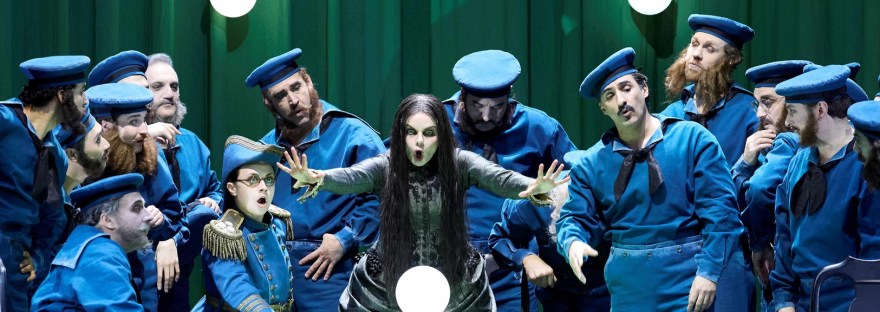
This production from Zurich Opera updated the action to America’s ‘Gilded Age’, when the upheaval of the recent civil war was being replaced by a surge of economic and political activity.  The production was very busy, with [an excellent] corps of dancers who were also active players in the drama, waving hands, arms, and legs most distractingly even when nowhere near a dance floor.  Right from the start there was busyness – we couldn’t listen to the overture in peace, but had to witness an autopsy [of the dead Governor] which both Amelia and Renato gatecrashed.   The plot was set up against a background of waving arms and election materials; Ulrica’s séance was invaded by an unlikely group of supposed fishermen [Riccardo’s compatriots] who played catch with her crystal ball; Amelia kept glugging from a hip flask, while her plea to her husband for mercy was overridden by Renato’s whisky consumption and pistol-waving.  Even the ball scene was so crowded with distraction that it was only too easy to miss the main points of the plot.

The overall result was that the music got completely sidelined – a great pity, since there’s some fabulous stuff in the score.  I couldn’t help but contrast this production with Maxim Emelyanychev and the Scottish Chamber Orchestra’s latest contribution to their Mozart opera series – the minimum of action from the cast told the story very simply and allowed the music to envelop the audience in its magic.  Yes, there were laughs – but arising from the text, not put in to amuse the masses who couldn’t possibly cope with listening to the music without constant visual distraction.

The singing was [mostly] very good: ditto the orchestra – though there seemed to be rather a number of moments when the two were not in synch with each other.  The set made clever use of the revolve to transition from interior to exterior settings – but it was unfortunate that Riccardo’s huge emotional outpouring had to put him in front of the red velvet curtain while the ball scene was being set up.  The lighting was mostly sombre, with rather too much use of ‘oh it’s a dramatic bit, or it’s boding again – let’s get the lights to flicker’.  The costumes were almost entirely in shades of grey – very dismal: I had hoped the ball scene would be a riot of colour but this was not to be.

Like I say, others in the audience obviously thought the whole thing was splendid: I just wished Verdi had been allowed to be heard.  Technically it was [mostly] very good – but it really didn’t move me: and there’s plenty in the score of A Masked Ball to tug at the heartstrings and bring tears to the eyes.

Such a pity.

Verdi’s A Masked Ball, Edinburgh International Festival, Festival Theatre, Runs until 30th August for more information go to: Verdi’s A Masked Ball | Edinburgh International Festival

Mary Woodward at the Festivals

In Her Hand, The Fringe, Review

*** (3 stars)

“An unvarnished account”

Yet another brilliant anti-war show.  No visible wounds, blood or guts on stage but they’re there throughout the performance as Edith and Frances struggle to maintain their sanity and their compassion as they work in a Scottish-run field hospital just behind the front line in the Balkans in the First World War.

Drawing on material from journals and letters and archive material held by the Royal College of Surgeons of Edinburgh, we get a clear and horrific picture of the conditions the women were working in and the struggles they faced every day – lack of basic equipment and medical supplies, cramped conditions, unrelenting gunfire clearly audible, and an unending stream of wounded and dying men, many of whom need limbs amputated and many who will die before they can receive the care they need.

Small wonder Frances relies on gallows humour to keep her going: Edith has loftier ideals and talks about the noble cause and the warrior queens of old, desperate to make it clear to her male colleagues that a woman surgeon can and should be as much a part of the medical team on the battlefield as any man.  Frances points out that women have been dealing with blood, broken bones and shit since the first man needed his bum wiped: who can be better fitted than they to do this exhausting work?

Edith recounts in graphic detail the steps taken in the amputation of a limb.  The clinical terms serve to heighten the horror of the process – difficult enough in a clean and sterile operating theatre in a city-centre hospital: unimaginably stressful in a field hospital where there is barely enough anaesthetic or stuff to dress the wound.  How on earth does she keep going?  At the end of a 14-hour shift her hands are shaking – and there is very little chance of rest.

Frances keeps a journal, which Edith sneaks peeks into – and is surprised at the quality of the writing coming from someone whom she would doubtless only encounter at home if she needed a cleaner – and when would she speak to her cleaner??  The class difference is never clearer than here…  Frances is justifiably angry at the invasion of her privacy – but despite this, the two women become good friends, supporting each other through all the horrors they have to face.

In her hand is unvarnished account of the suffering caused by war, the primitive nature of medicine in war zones, and of the struggles women have had almost since time began to be able to realise their full potential in a mainly male-dominated field.

Massive credit to Joyce Falconer [Frances] and Clare Yuille [Edith] in this moving and thought-provoking show.  They were both splendid in their portrayal of women doing what women do: just getting on with things as best they can in the most appalling of conditions, trying to alleviate suffering in others without counting the cost to themselves.

Huge credit, too, to the creative team – Jordanna O’Neill, Christopher Silver, Michelle McKay, Kate Stamoulis, John Kielty and Laura Hawkins.  In her hand is part of a two-year Women in Surgery project, which explores and celebrates the remarkable history of women in surgery.  It’s clear from the play that women had continually to fight the idea that a woman’s place is in the home and that women were too delicate to do a man’s work – an idea that still won’t go away.

And more than a century after that first disastrous world war, men still think that killing each other is the way to settle arguments and make the world a better place.

When will they ever learn?

In Her Hand, The Fringe, The Space @Surgeons Hall, Venue 53, Runs until 29th August for more information go to: In Her Hand | Edinburgh Festival Fringe