Mary Woodward at the Festivals

An Ode to The Casting Director, The Penny Gilded Balloon Patter House (Venue 24), Review.

***** (5 stars)

“Simply Brilliant”

Life, the universe and Lothian buses conspired to make me miss this show yesterday: I am SO glad I was able to get to it today – it’s brilliant!

As one who’s spent a moderate amount of time auditioning for singing jobs, I was prepared to offer some sympathy to Sophie Fisher during her Ode to a casting director.  I wasn’t prepared for this acutely observed and superbly acted show, which had the audience in fits and at times, I suspect, suppressed sobs.  Certainly the applause at the end demonstrated appreciation both for the artistry of the show and the emotional rollercoaster ride its protagonist experienced.

Life as a struggling artist is bad enough if you have a loving, supportive family and dear ones.  If you don’t it’s total hell…. It’s a miracle our aspiring actress has continued to turn up for anything and everything for which she gets an audition, while shelling out a small fortune on coaching sessions of questionable value.  Her parents are eternally underwhelmed by all she is doing, convinced that she should have continued her law degree and become a solicitor, or at the very least an accountant.  Her boyfriend of eight months has no interest in her career or her as a person.  Her saccharine-voiced [and totally incompetent] agent can’t be bothered to ensure she has the script she needs for an audition: and as for offering any form of support or sympathy – forget it!  We are rooting for her every inch of the way – but will she continue with her resolve to be an actor, or will the mounting tsunami of criticism and discouragement drown her?

The auditions and acting classes themselves are continual exercises in maximum humiliation with minimum return,  every excruciating minute making us cringe still further.  Crisps, screaming Viking warriors, riding a rainbow to land on a sofa, non-drumming, ‘ordinary person’ dancing…

You’d think it couldn’t get any worse – until you encounter the partner exercises with what must be the world’s most un-giving, un-supportive, most self-obsessed wannabe actors.  And there is, of course, the boyfriend’s ‘caring and concerned’ ending of their relationship…. Sophie’s renditions of her acting partners [and the boyfriend] are absolutely spot-on: her co-star [and director]’s Method Acting á la Brando is priceless.

I don’t want to give anything away, but I must give a huge shoutout for the final two scenes – an absolute masterclass in transparent emotional sincerity.

Today’s show was a sell-out.  Don’t delay, get your tickets today!

An Ode To The Casting Director, The Penny Gilded Balloon Patter House (Venue 24), for more information go to: https://www.edfringe.com/tickets/whats-on/an-ode-to-the-casting-director

Mary Woodward at the Festivals

EIF, Gluck: Orpheus and Euridice, Edinburgh Playhouse, Review

***** (5 stars)

“A Triumph”

Utterly astounding! Brilliant, breathtaking, beautiful beyond belief…

Here the Orpheus legend was pared down to its very bones:  Euridice is dead on her wedding day, Orpheus is inconsolable.  Amor, the god of love, is moved by his grief, and permits him to go to the underworld to bring her back to life – but he must neither look at her nor speak until they are once more in the land of the living.  Orpheus braves the tormented spirits in Hades and arrives in the realm of the blessed spirits, where he finds his beloved, and tells her to come with him.  She cannot understand why he will neither look at her nor speak to her – does he no longer love her?  Her anguished pleading eventually overcomes his resistance: he turns, speaks – and she drops dead.  Even more grief-stricken, he longs for his own death.  Amor consoles him and rewards his great love by bringing Euridice back to life.  Cue general rejoicing.

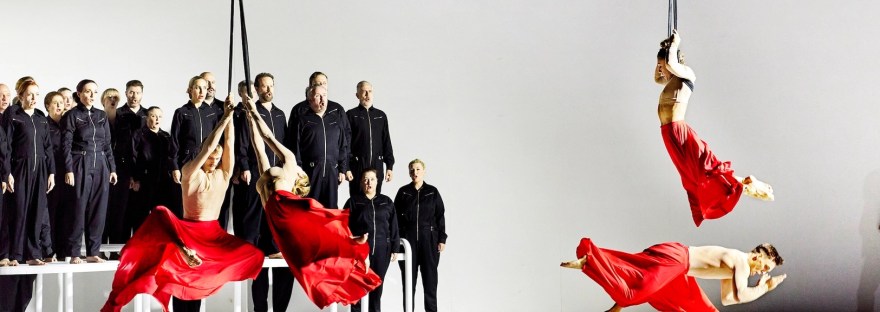
Only in this production, it doesn’t quite turn out that way…  As the curtain rises, we see Orpheus manacled to a bed in a sterile white environment: what follows suggests that everything we see on stage is a product of his grief-stricken madness.  In a stark black and white environment, the only note of colour is the shocking red of Euridice’s dress – the colour of blood, of life itself.  Can love triumph over death, or is death the only certainty in this world…?

Superbly supported by the brilliant Scottish Chamber Orchestra under Laurence Cummings, Samantha Clarke and Iestyn Davies are joined on stage by a chorus of artists from Scottish Opera and Circa, an Australian-based ensemble of circus artists.  Their extraordinary display of acrobatics, tumbling, and aerial work bring involuntary gasps of amazement and apprehension from the audience. 

Orpheus is surrounded by bodies leaping, tumbling, writhing around his bed.  People build themselves into towers and the topmost members fall like stones to the floor, being caught, or curling themselves to safety at the last possible moment.  There’s a mesmerising piece of aerial work with two immensely long bands of cloth, and innumerable other feats both on stage and in the air that leave one’s jaw hanging open in disbelief. 

Even Orpheus is drawn into the action as he climbs ever higher over a pile of bodies on his journey to the realm of the blessed spirits, while Samantha Clarke in her role as Amor sings suspended in mid-air, as befits the god of Love.  The chorus are superb as they interact with Orpheus and moving the plot forward: thankfully they remain for the most part at stage level.

And weaving around all this is Gluck’s sublime music, expressing the deepest human emotions pared down to their basic essence.  Iestyn Devies is an incomparable Orpheus, his voice ringing clear and true and so full of pain it hurts to witness it.  And there’s the rub: while such anguish is being poured out, should there be the distraction of extraordinary feats of Circa?  Much of the time, it’s completely appropriate, giving physical shape to Orpheus’ torment – but in the most intense moments, it was an unwelcome distraction.

That aside, the production is a triumph.  Visually stunning, lit to perfection, shocking in its simplicity, small wonder the 3,000-strong Playhouse audience erupted in a storm of applause at the final curtain.

EIF, Gluck: Orpheus and Euridice, Edinburgh Playhouse, for more information go to: https://www.eif.co.uk/events/orpheus-eurydice

Mary Woodward at the Festivals

EIBF, The sound of movie music, Courtyard theatre, Edinburgh Futures Institute

***** (5 stars)

“Utterly fascinating!”

Mark Kermode and Jenny Nelson have worked together for a number of years on a movie music radio show for Scala station [alas, no more] and it’s obvious from the way this hour goes that they know each other well, and complement each other superbly.  Mark is the consummate presenter, able to talk  easily, fluently, and simply about things that interest [or engross] him: Jenny is the gentle reminder-er, the ever-present context person who’ll say ‘I know you’re wildly enthusiastic about this particular film or piece of music, but tell us why it’s so important/ good / adjective of your choice”.

Together they’ve co-authored a book.  Although its title is Mark Kermode’s Surround Sound: The Stories of Movie Music, Mark is very clear that it’s a joint production which grew out of a book on movie music that he was commissioned to write a fair number of years ago.  He kept getting very enthusiastic about his subject, finding many people to interview, but realising that the material he amassed was impossible to put into a coherent shape.  It wasn’t till, some years into his radio collaboration with Jenny, that he realised that she was the person he’d been looking for for years, the one with whom he could create the book he’d always had in mind.

It really is a book for people who know nothing about music or the processes involved in creating a film score.  Mark read us a very early passage in the book, where his firm belief that recordings of movie music included the whole of the dialogue as well is shattered by an assistant in a record store.  It’s well-written, and doesn’t need a music degree – or indeed any prior musical knowledge – to understand and enjoy.

Mark and Jenny’s conversation is fascinating and very wide-ranging, and the questions at the end of the session add to our enjoyment.  They referenced many films, directors and composers, virtually none known to me – but that didn’t matter in the slightest.  Directors and composers probably have as many ways of working, separately and together, as there are stars in the sky… 

It’s very interesting to ex-musician me that with modern technology you don’t have to have a recording studio with a one-hundred piece orchestra to create movie music – though this still happens.  You can do in any number of ways, some extremely low-tech.  And silent movies were never actually silent: there was always some sort of music being played, even if only one instrument was involved.  Equally importantly, silence can, at the right point in a film, speak louder than a thousand notes, however well-played.

There are chapters on the history of film music; on influential [though not necessarily famous] composers who’ve made significant contributions to film music; on the different genres of film and music; and so much more…

A fascinating hour, from which many people set off intently for the book-shop and book-signing tent, taking with them all the other questions they were dying to ask Mark and Jenny.  I’m looking forward to laying my hands on a copy of their book just as soon as I’ve finished rushing round Edinburgh like a mad thing reviewing all manner of fascinating things!

EIBF, The sound of movie music, Courtyard theatre, Edinburgh Futures Institute, RUN ENDED for more information go to: https://www.edbookfest.co.uk/the-festival/whats-on/mark-kermode-jenny-nelson-the-sound-of-movie-music

Mary Woodward at the Festivals

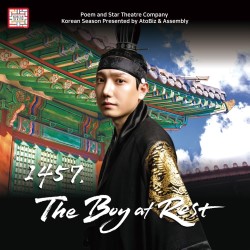
1457, The Boy At Rest, Studio 1 at Assembly George Square (Venue 17)

***** (5 stars)

“Haunting and Heartwarming”

Over the last few years, courtesy of my bonus granddaughter Maddy, I have become addicted to Korean drama on Netflix.  Imagine my delight, therefore, when I came across the listing for this show!

I’m very happy to say it lived up to all my expectations and more.  It was a joy to see and hear live actors speaking and singing Korean – and with subtitles projected on to the back screen, there was no problem understanding what was going on.  [I even got to recognise familiar words and phrases…]

The Joseon dynasty ruled in Korea from 1392-1910, and has been a source of many period dramas, or ones where contemporary characters discover that they lived previous lives in that period.  The costumes are gorgeous, the manners very elegant; there’s a lot of fighting with swords, and a huge amount of intrigue and skulduggery.

1457, the boy at rest contains gorgeous costumes, but no sword-fighting.  There is, however, a very wicked plot surrounding the young king Danjon.  His father died when he was only ten and his uncle, whom he greatly loved and admired, desired the throne for himself.  Danjon stepped down from the throne, hoping to lead a quiet life with his beloved wife Jeongsun.  His uncle, fearing that the young man would always be a focus for rebellion, banished him to a far away province.  The new king still did not feel safe, even after torturing and executing anyone who opposed his rule: finally he sent his nephew the order to take poison.

This sounds as though the show is unmitigated misery – far from it!  There is superb acting, wonderful music, lively dancing, drumming and singing, audience involvement, a lot of fun along the way, and the opportunity to reflect on concepts of fate and mortality.

The comic humour in the piece largely comes from three very lively Dokkaebi – day goblins – who live in the area to which the young king is exiled, and whose duty is to protect the area from bad humans.  They come to investigate the humans in the audience – are we bad, in which case they can do terrible things to us?  They are pranksters at heart, but principled ones…. They encourage our participation, narrate the story and add their own goblin commentary – how can these humans be so awful to each other?  [How indeed?]

There is a magnificent confrontation between the young king and his uncle: the boy loves his people but the uncle says love is not enough in a king – he must have power.  He demonstrates this when, later on, some of the boy king’s loyal ministers refuse to accept the man they see as a usurper.  They must all be destroyed – there must be no more support for the exiled king.

The music is a brilliant and constant presence.  There are some wonderful love songs and haunting songs of longing for the young king and his wife.  I wish I could credit them by name, because they are both superb.  The nobility of the young king is impressive – he rebukes anyone who calls him ‘your majesty’ because he doesn’t want them to suffer on his account.  Even the official bringing the ‘gift’ of poison is treated with loving courtesy.  His young wife, Jeongsun, refuses to accept help from the usurping king, preferring instead to support herself by dyeing cloth.  She cherishes Danjon’s memory all her life, even when news of his death reaches her and she realises there is now no hope of meeting him again some day.

All this sounds very miserable – but it isn’t, even though it’s very sad.  There are many moments of humour, and there are decent people who refuse to denounce the young king, and show him their love.  The young couple’s sorrow is heartfelt and deeply moving to witness; we too feel sorrow at the loss of people we love.  The show ends with a Requiem in which we are reminded that our loved ones who have died live on in our memories, and that by thinking of them we can help them reach a place of peace.

This is a superb show from Poem and Star Theatre Company, part of the Korean Season at the Fringe.  Come and enjoy, be moved, and carry its haunting atmosphere and heartwarming affection with you as you go through this crowded city and into the rest of your life.1457, The Boy At Rest, Studio 1 at Assembly George Square (Venue 17) for more information go to: https://www.edfringe.com/tickets/whats-on/1457-the-boy-at-rest

Mary Woodward at the Festivals

Mrs Roosevelt flies to London, Drawing Room at Assembly Rooms (Venue 20) Review

**** (4 stars)

“An impressive piece of writing

A good show,well delivered, well presented, well acted.  The audience was deeply appreciative – for me, it just went on a bit too long…

Insomniac, indefatigable worker, organiser, and champion of the underdog, wife and fifth cousin of president F D Roosevelt, human dynamo, chair of the United Nations Commission formed to draw up the Universal Declaration of Human Rights, and so much more, Elinor Roosevelt’s life motto might well have been what was a constant refrain throughout the show – “So much more to do”.

We first meet her towards the end of her life, at the time of the Cuban missile crisis in 1962.  A stand-off between Russia and the United States, it seemed for a few days that the world was on the brink of a war that could destroy it.  “If only Mr Kennedy and Mr Khrushchev would talk to each other, maybe at my cottage”, she says – after all, they’ve met there before…

Looking back over her life, she wonders whether it has achieved anything…. Cue a fascinating excursion through her life, seen through the framework of a visit she made to the United Kingdom in 1942.  America had joined the war and she flew across the Atlantic to represent her husband on a non-stop succession of conversations, meals both informal and exceedingly formal, with visits to everything from Buckingham Palace to a pig club.  Everywhere she went she talked to people, spoke encouragingly of all she saw, did her best to boost morale in the UK and kept people at home informed and engaged by a constant stream of newspaper columns and letters.

Her memory could be called elephantine, as she tells us about the people in her past and her present, people she meets on occasions separated by many years, statesmen and royalty, those engaged in the fight with weapons and those who fight in other ways – workers [mostly women], both paid and unpaid, and even children.  Her care and concern seem boundless – nothing is too small for her attention.

Alison Skilbeck has crafted this show well, with extensive use of Eleanor’s diaries and writings [and probably listened to a fair number of recordings of broadcasts, too].  She is very adept at creating instant portraits of the people she engages with – we particularly appreciate her portrayals of Elizabeth, Queen Consort of George VI [who became known as the Queen Mother after her husband’s death], and Queen Mary, George’s mother.  We see Churchill [and Mrs Churchill] alongside many other statesmen, heads of government, factory workers, Women’s Voluntary Service and Land Army people, and many more.  

The narrative jumps backwards and forwards in time, giving an increasingly broad picture of a woman who had a miserable start in life, a pretty horrific mother-in-law, and a definitely less than perfect husband.  It’s good to know there were loving women in her life too – something probably less well known about Eleanor – one of whom was a major influence in enabling her to grow into being First Lady.

It’s an impressive piece of writing, and an equally impressive feat of acting.  The production, direction and lighting are good – though I could wish there had been a lot less dry ice – I had to hold my hankie over my nose and mouth throughout the show.  And, as I’ve said, it went on a bit too long for me…

At the end of the show, Eleanor is looking back, remembering the bombs that ended World War Two.  “Truman had to bomb to end the war”, she said earlier in the show – but I couldn’t help thinking that all that had happened since then simply shows to serve that, no matter the size of the bomb you use, someone will build one bigger and more powerful: the arms race and the threats will simply go on and on.  And for all the UN has achieved and still [hopefully] continues to do, the UN declaration of human rights is not taken seriously or adhered to by so many governments and nations around the world today.

Did Eleanor Roosevelt’s life achieve anything?  I leave it to you to see the show and decide for yourself.Mrs Roosevelt flies to London, Drawing Room at Assembly Rooms (Venue 20) for more information go to https://www.edfringe.com/tickets/whats-on/mrs-roosevelt-flies-to-london