Mary Woodward at the Festivals

Bear Girl, The Fringe, Review

**** (4 stars)

“a brilliant exploration”

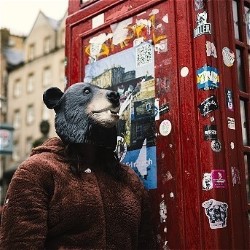
A young woman enters the stage and climbs into an all-enveloping bear costume.  Jake is dead, and she’s not handling it well.  She and Jake saw the costume in a – well, she didn’t call it a junk shop – and wondered whether it would ever be bought.  She’s got it now – the shop owner said Just take it, I’ve been trying to get rid of it for years…. No, she didn’t wash it, yes, it’s dusty and no, this isn’t normal for her and she’s not okay…

It looks as if this is going to be yet another “I’m grieving for my lost beloved, angry at the loss, my life will never be the same and somehow I’ll get through this and become a better, stronger person” sort of show.

It’s not.

Jake’s dead, but he keeps making his presence felt, and not just in the flashbacks which reveal his and Bear Girl’s history.  He comes across as some sort of demigod who raises his wife’s life out of the ordinary and fills it with magic and laughter – but was he?  Did he?  Really?? 

Rachel De Fontes gives a consummate performance as a grieving widow who can’t keep herself together and whose anger at her loss bursts out in the rage of an angry bear – bears don’t think: they do.  We are led to believe that this anger is ‘simply’ because she’s lost the love of her life, but as the show progresses we and Bear Girl come to understand things very differently – the rage she can’t even admit to herself is for something else entirely.

Jimmy Kavanagh is brilliant as Bear Girl’s Best Friend, Andy, who’s doing his utmost to be supportive but is reaching the end of his tether.  Jimmy is even more brilliant as Jake and the other ordinary and extraordinary characters in this narrative, switching accent and body language in a millisecond and remaining credible throughout.

Emery Schaffer’s play, directed superbly by Kate Stamoulis, never lets the dramatic tension flag.  It’s a brilliant exploration of grief, loneliness, frustration, thwarted ambition, love, friendship, and the kindness of strangers.  It’s also a powerful warning against allowing one’s self to be eclipsed and devalued while accepting other people at their face value and jumping into deep water without checking for hidden dangers…

Bear Girl is sure to be a sellout: hurry and get your ticket now!

Bear Girl, The Fringe, Assembly Roxy (Roxy Boxy) Venue 130 Runs until 31st August for more information and tickets go to: BearGirl | Edinburgh Festival Fringe

Mary Woodward at the Festivals

Madame Chandelier’s Grand Theft Opera, The Fringe, Review:

**** (4 stars)

“a sparkling show! “

Another amazing show, with massive respect and credit to Madame herself for creating an energising and energetic participatory show from a motley collection of parents and smallish children who were mainly extremely reluctant to get involved…

As some of my readers will know, I have a background in opera, and am firmly of the opinion that it can and should be enjoyed by anyone and everyone – it’s not snobby elitist stuff but full of emotions that everyone will recognise and identify with.   Madame Chandelier obviously thinks the same, and has set out to produce a show which I hope will speak to both adults and children this August, and create new generations of opera fanatics!

I have to confess to being hampered in my appreciation of this show by a complete ignorance of gaming and gaming consoles – sad, I know, but there you are.  Maybe in another lifetime I’ll be able to become completely addicted and spend my entire life staring at a screen as I work my way through the heaven-knows-how-many levels of a game to reach the ultimate reward?  This means that the game jargon completely passed me by…

But.

I DO know my opera, and particularly my operatic heroines – and these we had in plenty!

Madame Chandelier is herself obsessed with opera – this is why she’s named her daughter Pamina, the heroine from Mozart’s Magic Flute.  Problem is, Pamina’s spending way too much time playing Guitar Hero instead of practising her actual guitar…. And what she doesn’t realise is that the evil Queen of the Night is sucking children into her game, feeding off their blue light energy, and ultimately trapping them in the game for ever.

Help! What is Madame C to do????

Call upon operatic heroines, of course

Brunnhilde, one of Wagner’s Valkyries, comes flying in to assist Madame C, singing a list of instructions.  Find the wizard; enter the game; collect a load of useful stuff; fight and defeat the Queen and sieze the means of getting safely home.

Simples, yes?

Well… it would help if the audience were willing to participate… Blessedly, although the children were stricken with shyness, their adults proved more willing to join in, and slowly at first but with increasing enthusiasm they assisted Madame C in her quest, with the help of more operatic heroines. They had to contend with constant interference from the Queen of the Night, who was determined to save the children from their parents and allow them as much screen time as they wanted – why not, when their grownups were spending all their time with their own screens…???

We had started with Mozart and had a wee bit of Wagner.  Now we visited Bizet and then settled determinedly with Puccini – three fabulous heroines in Carmen, Tosca, and Madam Butterfly.  Potted versions of their stories were woven into the action – but Madame C was determined that, with a bit of help from the audience, their fates could be changed – Carmen would not be stabbed by Don José, Tosca would not have to jump from the battlements of Castel’ Sant Angelo, and Butterfly would have a happy ending – and Madame C herself would collect everything she needed to complete her quest and rescue Pamina.

Did this happen?  Well, gentle reader, I’m not going to tell you – you have to come and find out for yourself….

What I will say is that Madame Chandelier’s heroic efforts to galvanise her audience into action-packed participation were not in vain, and by the final curtain, everyone was on their feet, dancing in celebration and having a great party.

Wonderful invention, witty costumes, a staggering display of star-catching while playing the piano accordion, lots of jokes for both adults and kids, and a canter through a surprising amount of opera [and a brief can-can too] together make a really enjoyable way to introduce even the most sceptical to the delights of opera.  If it also induces people of all ages to spend less time on a screen and more in a theatre, this can only be a good thing!

Thank you, Madame Chandelier, for a sparkling show!

Madame Chandelier’s Grand Theft Opera, Pleasance Courtyard (The Green) Venue 33, Runs until 16th August for more information and tickets go to: https://www.edfringe.com/tickets/whats-on/madame-chandelier-s-grand-theft-opera

Mary Woodward at the Festivals

Hamlet (an experience), The Fringe, Review:

***** (5 stars)

“Completely Immersive”

What an experience!  I can’t quite believe that this is my fourth five-star performance of the four Fringe shows I’ve seen so far this year…

Hamlet, prince of Denmark, is grieving the death of his father and inconsolable because his mother, Gertrude, has married the king’s brother Claudius a mere month after she wept bitterly at her husband’s funeral.  Hamlet’s father’s ghost appears to him, telling him that he was murdered by his brother.  Hamlet devises a way to confirm the ghost’s accusation: he will arrange for some actors to act out the king’s death, and see whether Claudius and Gertrude’s reactions show their guilt or their innocence.  Hamlet is in love with Ophelia, daughter of Polonius and sister of Laertes: crazed with grief, the prince rejects Ophelia, who goes mad.  By the end of the play, the only person left standing is Hamlet’s friend Horatio, who remains to tell the sad story of the Prince of Denmark.

This Hamlet takes place in the George Mackay Brown library upstairs in the Storytelling Centre.  We enter the lovely intimate setting and find our seats in the ring of chairs round the edges of the room.  There’s a skull on one chair – do I sit beside it, or keep a respectful distance?  In the middle of the floor a black hooded figure sits silently, head bowed…

The figure rises to their feet and invites us to take part in the performance.  People are invited to take a named role and given their script; and everyone does so very willingly [though I feel sure there would be no compulsion if one really didn’t want to].  The rules for the session are made clear: all weapons are imaginary and will cause no harm and the casting is gender-blind.  Almost all lines and stage directions are on the script, though there will be a place for some improvisation of action and maybe even dialogue.  Script still in hand means that the character is still alive.  Some characters are asked to keep their final directions hidden from the rest of the cast.  We are all invited to join in any singing that might happen.  There is a brief rehearsal of a stage fight, cleverly adapted to the left-handedness of the willing performer who cheerfully declares their complete ignorance of sword-fighting of any kind.

And so begins a completely immersive and interactive performance that has us gripped from the opening lines, where Hamlet directs his newly-cast fellow-players in the delivery of their lines – speak the speech trippingly, I pray you – and goes on to describe graphically the many appalling ways in which actors can mangle, distort, and otherwise ruin the playwright’s words.

Hamlet is a very long play.  This version is cunningly edited to include all the essential bits while leaving out quite a lot. It’s instantly clear what’s happening in each scene, and what the context is – at least, it is to me: but then I’ve been watching performances of the play for quite a number of decades now…. [I miss Rosencrantz and Guildenstern – but don’t particularly miss the comic gravedigger…]. The ghost scene is particularly impressive, as Hamlet plays both himself and his dead father: from behind a skull mask he delivers his father’s lines at an incredible speed and without drawing breath – an impressive display of breath control.

Emily Carding is outstanding in this gripping performance which I can guarantee you will be quite unlike any other Hamlet you’ve ever seen.   One of the enormous joys of their performance is hearing so many incredibly well-known lines as if they are just coming to Hamlet’s mind as he is speaking them.  Lightning-swift changes of volume, tone, attitude and behaviour reflect the tortuous tumult of the prince’s emotions – all the time delivered with intense feeling and compelling eye contact: we are all witnesses to, and partakers of his torment.

All the volunteer performers give laudable and believable performances, but the shoutout must go to the Ophelia, whose wordless mad scene was truly memorable.  At the end, only Horatio is left standing, surrounded by corpses: Hamlet disappears from the acting area, leaving us to laud ‘his’ performance with prolonged and heartfelt applause.

Kolbrun Bjort Sigfusdottir directs a wonderful, vibrant performance by Emily Carding – don’t miss this extraordinary experience at this year’s Fringe!

Hamlet (an experience), Scottish Storytelling Centre, Venue 30, runs until 17th August for more information and tickets go to: https://www.edfringe.com/tickets/whats-on/hamlet-an-experience

Mary Woodward at the Festivals

A Ghost Among the Living, The Fringe, Review

***** (5 stars)

“Gripping”

Congratulations, Noel and Antonia, that was brilliant!

I have to confess that I was somewhat apprehensive when I saw what Box Tale Soup were offering this year…. They scared me almost witless with a chillingly effective 1984 last year from which it took several hours to recover!

When I saw the show’s title and realised that this year’s offering would be drawn from the works of Edgar Allen Poe, I knew that those of you who love to be horrified and/ or terrified would be in for a treat.  I well remember as a teenager being terrified by chilling movies from the Universal Studios’ black and white series of Poe adaptations.  I feared I might have to bring along a cluster of cuddly toys to see me through the show…

Fear not, gentle reader: I emerged in one piece, and not so severely traumatised that I couldn’t go about my Fringely business afterwards… <Phew>. As with most of Poe, the chill effect comes in the mind, and after the event: I’m sure the themes that run through the show will continue to occupy me, though hopefully in daylight hours rather than the wee small hours of the night!

Box Tale Soup have done it yet again, producing a show which focuses on the author’s text, brings it to vivid life and invites one to engage with the work itself as soon as possible.  Even with some intermittent bodymike problems, the audience was gripped.  There were obviously some Poe aficionados in the audience – the reference to the orangutan brought some knowing reaction, and the raven’s quothing was also very familiar.

In this show, rather than sticking to one narrative we are treated to what seems to begin as a lecture about Poe, a discussion of his writings and the ways in which they draw the reader in from the author’s very first words.  The tell-tale heart plunges straight into the mind of a madman who insists that he is sane, even while we doubt his veracity.

This alone would be a masterly piece of storytelling, with some really inventive puppetry and scenery – but almost immediately we become aware that all is not well with the lecturer/ storyteller.  Can he hear the unearthly song?  Can he see the black-clad figure singing a heartrending lament?  What is preying on his mind as he keeps losing the thread of his lecture?  To whom does he keep protesting that he hasn’t forgotten?

By the end of the show we have heard some of Poe’s poetry and visited a remarkable number of his stories, some of which I knew, some of which I thought I knew but didn’t, and some which were completely new to me.  There’s some wonderful original music from Dan Melrose, hauntingly sung by Antonia as part of an inventive soundscape and accompanied by superbly atmospheric lighting. 

Above all we have Box Tale Soup’s consistently inspired use of recycled and reclaimed materials to create their exceptionally versatile puppets, costumes, set, and props, and a wonderful choreography as Neil and Antonia weave their way around, among, and through it all to create the magic that they do so well.  I particularly loved long walk through the catacombs and the seemingly unending glass of Medoc, while Ligiea herself  was bewitchingly memorable, and the Ligeia/Rowena transformation ingeniously managed.

Guilt, revenge, loss: all these surface again and again in Poe’s writings – and he writes so graphically, with such a masterly understanding of all these emotions and motivations.  We are frequently reminded that there are 26 different theories about the cause of his death in 1849, with the implication that any or all of the above could have been the cause…. There’s a lot to ponder in this show, a lot that will continue to haunt me [though blessedly I hope not to lose any sleep over it!] and so much to admire and applaud in this latest fabulous creation from Box Tale Soup.

Will we forget A Ghost Among The Living? Nevermore!

Hurry and get your tickets now!  The first ‘night’ audience was very good for a Fringe show and word of mouth will only serve to make the tickets increasingly sought after…

A Ghost Among the Living, Pleasance Dome (Queen Dome) Venue 23 runs until 31st August for more information go to: https://www.edfringe.com/tickets/whats-on/a-ghost-among-the-living

Mary Woodward at the Festivals

The BBC’s First Homosexual, The Fringe, Review

***** (5 stars)

“Utterly superb”

Wow!  What a start to my Fringe – two absolute crackers on my first day, and they could hardly be more different if they tried…

The Elves and the Shoemaker at the Scottish Storytelling Centre on the Royal Mile is a delightful combination of masterly storytelling and magically inspired puppetry, with something to please everyone – and should not be missed.

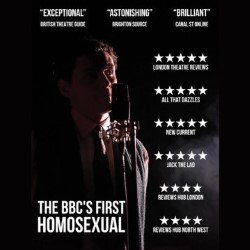
The BBC’s First Homosexual is a brilliantly crafted play which everyone over the age of approximately twelve – though probably one should say sixteen – should see.  Created from material held in the BBC’s archives – including extracts from the original radio broadcast, draft scripts, and internal BBC discussions – the play brings to life the process by which the first-ever broadcast documentary on the subject of male homosexuality – Homosexuality: The Condition, The Cult and The Crime – was brought to homes all over Britain and wherever else the BBC’s Home Service could be heard.

Stephen M Hornby has done a brilliant job of dealing with what the programme notes call “basically a load of outdated and offensive claptrap” and producing a nuanced and multi-layered picture of life and attitudes in Britain in the 1950s.  The process by which the BBC documentary came into being, the guarded language used, the careful strategizing, the choice of approach geared towards countering the objections within the BBC itself, the challenges of finding ‘experts’ willing to speak out on what was both a controversial and a ‘not nice to speak about in decent homes’ subject, and extracts from the documentary itself, are interwoven with the story of young man, Tom, who is struggling with the conflict between his feelings and the expectations of society.

Three actors – Jolyon Benson, Max Lohan, and Andrew Pollard – between them play goodness knows how many parts.  Jolyon is superb as the young, ardent, hopeful Tom, who works in Burton’s the tailors in Manchester.  Max and Andrew between them play a wonderful range of characters ranging from the perfectly RP fairly high-up BBC man to the extraordinary trio of young women Tom’s mother invites round for tea on consecutive weekends.  Judging from the murmurs of recognition, the widely differing characters and situations Tom encounters when he ventures into various gay haunts in London were all extremely accurate and well-remembered…

Scenes and characters change in split seconds and with the minimum props.  The action is played behind and around a desk, in a very small and low-ceilinged acting space.  Lightning-fast adjustments to costume and accent present a fabulously rich gallery of portraits, quite wonderful to behold.  Lighting and sound underline the action and assist the rapid transitions of time and place.

It’s probably hard for younger people today to have the slightest idea of quite what it was like to be gay in the second half of last century.  I was born in 1950 and didn’t really realise I was gay till the 1980s but, being a girl, didn’t have quite the same struggle as men did, since Queen Victoria apparently refused to believe that such things as lesbians could exist…  However, I well remember having to watch my back and my pronouns and never being able to talk about my home life or really be myself apart from two hours once a month with the Nottingham group of the Lesbian and Gay Christian Movement!

It’s appalling to hear the 1950s attitudes towards homosexuality; the language used to describe us, the concept of its being a curable ‘disease’, or a matter of choice.  Groans of recognition met the revelation of the name of one ardent protester against homosexuals – Mary Whitehouse – who chose to regard us as “crippled individuals, a filth we must clean up”…  Things have changed a lot since then, and life is considerably easier for some of us – story lines don’t have to end with us dying miserably alone, and public figures and presenters on TV can be openly part of the rainbow community. 

But.

Part of me wonders if things are indeed so very different today, especially in Africa and south Asia where discrimination and oppression are on the rise again…  How many Toms are there all around the world, feeling isolated and unsupported and, when they hear the equivalent of that 1950s BBC documentary, believing that their only option is to try to be ‘cured’ so that they can live the life of love and raise the family they yearn for?

Grab all the young rainbow people you know, and all the old-and-grumpy [and not so old] homophobes you may encounter, and insist that they see this show!  May some of them, at least, be changed by it and appreciate just how hard it was to be different in ‘the old days’…

And may some of them determine to ensure that people never have to suffer such appalling treatment in future!

Thank you to all concerned in such a brilliant production!

The BBC’s First Homosexual, Assembly George Square (The Crate) Venue 8, The Fringe, Runs until Sunday 16th August for more information and tickets go to: The BBC’s First Homosexual | Edinburgh Festival Fringe

**NOTICE: Assembly George Square THE CRATE is not in George Square itself but on Buccleuch Street just behind the Square!!  Allow yourself plenty of time to find it, or miss an outstandingly good show…