Mary Woodward at the Festivals

Giselle: Remix, Forth at Pleasance Courtyard (Venue 33), Review

**** (4 stars)

“Extraordinary experience”

Well, that really was something unimaginably different…. I kind of wish I’d noticed the 18+ age warning before booking this show, but then I wouldn’t have had this extraordinary experience.

Giselle is one of the cornerstones of the classical ballet repertoire.  Giselle, a young peasant girl, is seduced by a nobleman, rejected by him, goes mad, and dies of a broken heart.  She becomes one of a group of vengeful female spirits who force her betrayer to dance himself to death – but intervenes at the last minute to save his life.

I’m not sure how I thought this typically romantic narrative was going to be re-imagined, but I wasn’t prepared for the outrageously flamboyant spectacle that unfolded before me.  

A typically upbeat, Jolly Overture To A Musical segued into a wonderfully silvery and sparkling lipsynch Stormy Weather, Judy’s pain-wracked voice plucking at our heartstrings.  First surprise – a slow strip, accompanied by enthusiastic cheers from the audience.  Music from the original ballet score brought a veiled figure on stage, who tried to give a soul-filled rendition of Crystal Lullaby, but was continually upstaged by four superb dancers, whose versatility and enthusiastic audience engagement were outstanding throughout the show.

Our heroine [Jack Sears]’s ability to lipsynch perfectly while her face expresses wildly contrasting and opposing emotions is little short of miraculous – as is the writing in the monologues in which she expresses the trajectory of her life.  At first overjoyed in the first rapture of love, in an idyllic rose-petalled and icing-sugared world, the shock of betrayal sends her into a descending spiral of self-flagellation, both mental and, in graphic detail, physical.  

I can’t begin to describe what was represented on stage – completely outwith my sheltered experience! – but I am totally gobsmacked by the dancers’ ability [and enthusiasm] to go to the limits of what might reasonably be depicted in a public performance on an Edinburgh stage.  Today’s four dancers realising Hannah Grennell’s wildly inventive and jaw-droppingly graphic choreography were Elle Fierce, Harri James Eiffert, Naia Bautista and Spike King whose sinuous bodies and wonderfully expressive faces have to be seen to be believed.

Degradation, humiliation, despair, rage, self-destructive behaviour of every kind, self-hatred, nihilism: a seemingly endless, hopeless downwards spiral which will end in suicide was brilliantly portrayed in words and movement to an increasingly demonic, screaming soundtrack.

But there is hope, the possibility of coming back from the edge of the pit.  This show pays tribute to the chain of role models and elders in our lives, people both famous and intensely personal to us, stretching back into the past.  Giving us someone to aspire to, we realise that we too are inspiration to those who follow us.  There is hope, there is something to live for.

Small wonder in these dark times that this show was greeted with a loud and prolonged standing ovation.

Giselle: Remix, Fourth at Pleasance Courtyard (Venue 33), for more information go to: https://www.edfringe.com/tickets/whats-on/giselle-remix
Mary Woodward at the Festivals

EIF, Faustus in Africa!, Royal Lyceum Theatre, Review

**** (4 stars)

“An extraordinary show!” 

The stars are for the visuals, the wrapping paper rather than the content.  On my way out of the theatre, two friends each separately expressed total bewilderment at what Faustus in Africa was trying to say – which comforted me, as I’d spend the whole evening trying to work out quite what was going on.

I wanted to see the show simply because Handspring Puppet Company, who created the unforgettable horses in Michael Morpurgo’s War Horse, were performing in this show, created by William Kentridge.  The Faust legend is familiar to me from both theatre and opera, but I have to say it was hard to follow quite what was being said in this version of the narrative, which had us travelling by seaplane around the continent of Africa.

Faust is extremely learned and successful, but totally dissatisfied with his life.  He makes a deal with the devil, promising his soul in exchange for unlimited knowledge, wealth and power.  The devil grants his every wish, but Faust is never satisfied, constantly seeking some new sensation.  At the last minute, as Mephistopheles is about to collect his soul, he is thwarted and Faust’s soul goes to heaven.

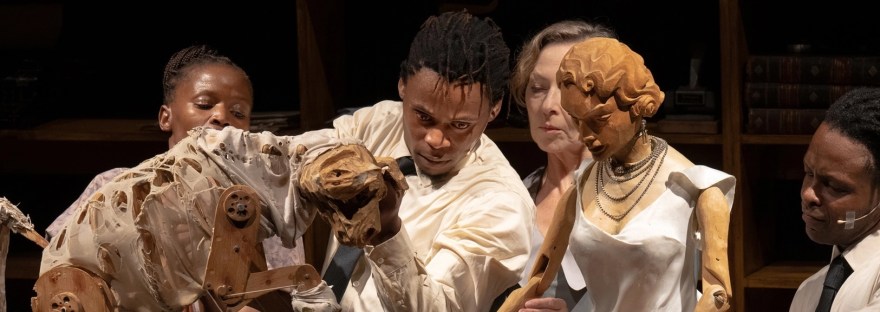
In this production, Mephistopheles was played by a human actor, while the puppeteers not only voiced and brought the other characters to life but also played all the minor, human characters.  A clever, multi-layered set representing Faust’s extensive library led the eye to a screen at the back of the stage on which were projected an almost incessant and frequently bewildering series of images.  Information, commentary, illustration continually demanded our attention, while supertitles overhead added further to the visual distractions as we struggled to work out who was who – and quite when the action was taking place – on the stage below. 

Faustus in Africa was first performed in South Africa in 1995, and the audience there would have understood many of the cultural references that were not clear to me last night.  My greatest source of confusion was the superb animal puppet [that perhaps represented the spirit of native Africa] which seemed to be meant to be a dog, but appeared to have a horse’s tail and hooves and behave at times much more like a cat.  The significance of the rulers and politicians was also to some degree lost on me, not the most politically clue-up person on this earth…and the locations on Faust’s whistle-stop tour of the continent also failed to resonate with any great significance.  A pity.

What came over very clearly was a rising tide of anger at the exploitation of the continent by European colonial powers.  Gradually every asset was being stripped from the land, rulers were replaced by puppet governments, and the wealth accrued by Faust continued to increase.  Faust was about to lose his soul – but was redeemed by Mephistopheles, who needed him and all the corrupt officials to maintain the status quo and continue bleeding the continent dry.

The puppetry was exactly what I’ve come to expect from Handspring – so accomplished that I was confused not to see Faust in the curtain call, and had to tell myself ‘but that’s because he was represented by a puppet’… The actors who give voice and movement to the figures are beyond words brilliant and deserved every moment of the thunderous, if confused, applause which greeted the end of the show.

Thirty years on, has anyone learned anything?  I fear not…

EIF, Faustus in Africa!, Royal Lyceum Theatre, for more information go to: https://www.eif.co.uk/events/faustus-in-africa

Mary Woodward at the Festivals

EIF, DunedinConsort and John Butt, The Queen’s Hall, Review

**** (4 stars)

“What a delight!”

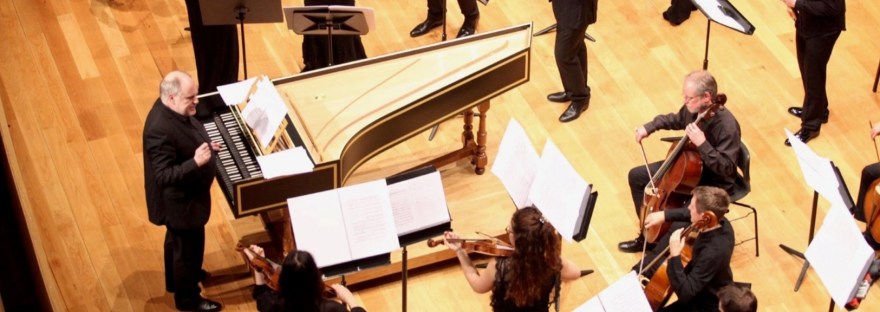
What is described in the programme as “an early comic cantata” from Handel was a real treat, with the expected superb playing from the Dunedin Consort under John Butt being joined by some equally superb singing from Julie Roset, Nardus Williams and Reginald Mobley.

The plot is simple.  Tirsi and Fileno are both in love with the lovely shepherdess Clori.  Tirsi is in anguish because he knows that his love is untrustworthy: it causes him intense grief and pain but still he can’t help loving her.  Fileno is also aware of his love’s inconstancy, but seems a little more resigned to it.  Clori seems simply to love playing up to both of them, promising constancy, saying she loves whichever one she is talking to, and promptly flattering and seducing the other when the first one’s back is turned.

This seems like the recipe for disaster – shouting, screaming, bloodletting at least, murder at worst: but this is a Handel comedy, not a tragedy, and it all ends happily – in the supertitle translation we were offered, the two lovers agree that to live and not to love is impossible, so they must accept the pain that comes along with this.  Clori certainly seemed perfectly happy with this arrangement, but I don’t know if Tirsi and Fileno were quite so sure…

Tirsi was the first to take the stage.  Sung by English soprano Nardus Williams, Tirsi was somewhat self-pitying.  It’s vain to hope that her heart will be as faithful as mine, he sings – and then berates himself because, despite the pain he feels, his heart continues to forgive Clori.  She enters, and Tirsi hides to watch her – knowing that he’s going to suffer yet again.

French soprano Julie Roset’s Clori is really pleased with herself and her situation.  Her opening aria has a pair of recorders providing the birdsong accompaniment as she tells the nightingale to sing to her lover.  Fileno [African-American countertenor Reginald Mobley] enters and Clori tells him how sorry she is to reject him, while not really meaning it at all.  Tirsiis a helpless and increasingly irate witness as Fileno begs Clori to swear to be faithful – but even when she has done this, Fileno still doesn’t feel confident or safe.  There’s a wonderfully fiery trio of conflicting emotions before Fileno and Clori smilingly sing a duet anticipating future bliss to conclude the first half.

Tirsi rebukes Clori, and [my notes say] ‘they have a right spat’.  Tirsi can’t take any more – do you want to kill me? he sings as the two vocal lines beat furiously against each other before uniting again.  Alone, he rages: there’s no wild beast – nor anything in the underworld – more ferocious and cruel than you, he sings.  It’s Handel at his fiery best, with Tirsi’s furious streams of notes cascading everywhere and trumpet-like oboes ringing out against them.  Clori does her melting ‘ooh, little me: how can you be so cruel as to disbelieve me?  I love you, Tirsi’ act utterly brilliantly, and the heartrendingly beautiful violin and cello interjections convey the truth of the emotions that I fear Clori herself simply cannot, or doesn’t want to feel.

Fileno asks how anyone can trust the promise of a girl.  Poor fidelity, he sings: how rare you are.  Cello and theorbo alone accompany this aria – it’s an utterly gorgeous accompaniment.  Tirsi pours out his grief to Fileno – I heard her promises to you, and my grief is like yours.  His aria is a wonderful description of the excellence of her deceitful ways – her sighs, her pale lips, her sidelong glances can all soften a heart of stone.  He suggests the two of them let go their jealous anxiety and instead be friends.  Toby Carr then has the most wonderful theorbo solo before Jonathan Manson’s cello and Matthew Truscott’s violin join in the interjections to Fileno’s aria – the swallow, even though wounded, rejoices to be back in its nest in Egypt: better the pain that’s known than the impossibility of life without the beloved object.  A lively trio closes the cantata.

The singers were all new to me, and I look forward to hearing them again.  In the first half Reginald Mobley sounded as though the arias lay in the wrong part of his voice, making his bottom notes forced and disconnected from the rest: the second half’s arias were a much better fit.  Nardus Williams’ rich golden voice and fiery outbursts were a delight to listen to, making me keen to hear her sing Partenope with ENO later this year.  But the crown has to go to silvery-voiced Julie Roset – utterly incomparable both vocally and visually, enjoying every second of her manipulation of her two lovers, and seemingly completely indifferent to the pain her duplicity causes them.

The Dunedin Consort delight me every time I hear them play – and this was no exception.  Their mastery of their instruments, and their deep understanding and enjoyment of what they play, is always a joy to witness.  The music, too, was a marvel – early Handel, already showing such deep understanding of the human heart and all its emotions.  It also demonstrates his green credentials – his ability to re-use and recycle music written earlier: several of the movements in this only recently re-discovered cantata were familiar to me from later operas.

Small wonder the Queens Hall audience erupted into loud and prolonged applause at the end of the performance: another triumph for John Butt and the Dunedin Consort.

EIF, DunedinConsort and John Butt, The Queen’s Hall, for more information go to: https://www.eif.co.uk/events/dunedin-consort-john-butt

Mary Woodward at the Festivals

False Tongues, Lime Studio at Greenside @George Street (Venue 236) Review

**** (4 stars)

“Sombre”

False Tongues is particularly apposite in an era when ‘fake news’, aka lies, can spread swiftly round the world and result riots, injustice, persecution and worse, all without the slightest justification or basis in truth.  Why is it so easy to swallow such garbage just because ‘I saw it on the internet’?

In 1692 social media hadn’t been invented, but another means of spreading lies and causing untold harm to innocent people had been around for millennia – gossip.  Whispering behind your hand “I’ve heard that…”, “They say…”, “did you know…?”  All this was rife in Salem, Massachusetts, where people started making accusations of witchcraft against people, mostly but not all women.  People were arrested and imprisoned, trials were held, and executions ordered.  Much of the evidence against the accused came from reported visions – so-called ‘spectral evidence’.  In just over a year, more than 200 people were accused, 30 were found guilty; others died in the foul prison conditions without coming to trial.  Some time after this, various of the young women who’d made the accusations confessed that they’d made up the evidence ‘for a prank’.

Such accusations were not particularly unusual.  A century earlier, James VI of Scotland had written the definitive book on how to recognise and dispose of witches.  Anywhere where women were old, wrinkly, tended to mutter to themselves, kept a cat, were slightly different… other people would be quick to point a finger and make the accusation.  Neighbours would become fearful that the same thing would happen to them: easier to join in with the pointing finger, look for something odd or different, accuse before you are accused…

Not so very different from today, it seems, where people are quick to attack anyone who dares to be different, or speak out in support of marginalised people, or criticise the Establishment.  Earlier this Fringe I watched Box Tale Soup’s spine-chilling rendition of George Orwell’s 1984: today Britt FIshel & Artists presented this moving meditation on the unjust fate of so many people through the ages.

Focusing on Salem, and using footage shot in and around Salem and its graveyard, three dancers embodied both persecutors and the women they persecuted.  Moving to a compelling soundtrack, menacing figures clad in black writhed and juddered, singly and in unison, weaving around each other, feeding off each other, working themselves up into a silent frenzy.  Removing their sombre costumes they emerged clad in white, dancing their pain and suffering, their isolation and their togetherness before falling to the ground, dead.  Throughout the show accuser and accused were sometimes the same person – the one whom you trust today may tomorrow turn on you and betray you.

At the end we saw listed the names of the women and men who were executed, and those who died in prison.  Saddest of all was the infant, name and age unknown, of Sarah Goode, who’d been hanged a few weeks previously.

Will we ever learn?

False Tongues, Lime Studio at Greenside @George Street (Venue 236) for more information go to: https://www.edfringe.com/tickets/whats-on/false-tongues

Mary Woodward at the Festivals

Blooming, Fern Studio at Greenside @George Street (Venue 236) Review

**** (4 stars)

“Delightful”

Another queer love story! No-one dies at the end!  Hoorah!!

There are a lot of flowers – we are offered one as we enter the bijou theatre: I’m sorry to have to leave it behind when I exit, but sadly it would not survive a busy day in Edinburgh in August…

The beauty of flowers, the thought behind a gift of flowers, the Victorian secret language of flowers all play a part in this delightful lesbian romance: and there’s wonderful baking, too!

Ophelia and Zaria have a flower shop: they are both stressing about the fantastic opportunity they have.  A friend who is marrying an amazingly wealthy man has asked them to do her wedding bouquet.  If they can make a good impression, their fortunes could be made…but Ophelia can’t keep her mind on creating the perfect bouquet: she keeps being distracted by the thought of Dera, a local baker and newcomer to the area, whose wonderful cheesecakes and pastries are simply heavenly.

If the truth be told, though, it’s not the pastries but Dera herself who has Ophelia in a constant daydream.  It’s patently obvious how much she fancies the baker, but she’s incapable of saying anything…. Despite Zaria’s encouragement, she is silent: all she can do is make Dera a new bouquet every day and pretend that it’s one that didn’t sell the previous day.

Dera appears, bearing a box of Ophelia’s favourite raspberry cheesecake that somehow ‘didn’t get sold yesterday’ and it’s instantly clear to everyone that Dera is equally besotted with Ophelia, and just as incapable of saying so.  Will the two ever get together?  Will Zaria ever realise her secret dream of going to Paris?  Will the perfect wedding bouquet ever get made?

The awkwardness of seemingly unrequited love, the difficulty of confessing feelings when I don’t think the beloved could possibly love such an unloveable person as myself, the frustration of a friend to whom it’s perfectly obvious that there’s a strong current of feeling between the two of you: all these are perfectly portrayed in this charming comedy.  It also underlines the need for clear communication, which has been a theme in a number of shows in this year’s Fringe.

Manon Lavastre’s Ophelia shines as brightly as her strawberry-coloured hair.  Chloe Horne’s gentle, supportive, silently dreaming Zaria is the perfect bestie.  CJ Adebayo Omoaka is wonderful in her exuberant clumsiness.  The actors’ energy and enthusiasm are a joy to watch, and the songs that punctuate the action perfectly chosen.  It’s unfortunate that the sight lines in the little theatre are poor, meaning that those not on the front row miss out on much of the action: and sometimes the smallness of the room means the actors forget to project their voices and lines are not heard.  Despite this, the show is charming, a wonderfully colourful and heartwarming antidote to the gloom and doom that threaten to engulf us if we are not careful.

Blooming, Fern Studio at Greenside @George Street (Venue 236) for more information go to: https://www.edfringe.com/tickets/whats-on/blooming