
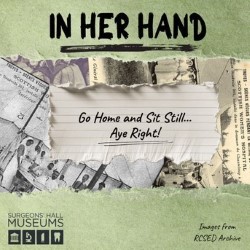
*** (3 stars)
“An unvarnished account”
Yet another brilliant anti-war show. No visible wounds, blood or guts on stage but they’re there throughout the performance as Edith and Frances struggle to maintain their sanity and their compassion as they work in a Scottish-run field hospital just behind the front line in the Balkans in the First World War.
Drawing on material from journals and letters and archive material held by the Royal College of Surgeons of Edinburgh, we get a clear and horrific picture of the conditions the women were working in and the struggles they faced every day – lack of basic equipment and medical supplies, cramped conditions, unrelenting gunfire clearly audible, and an unending stream of wounded and dying men, many of whom need limbs amputated and many who will die before they can receive the care they need.
Small wonder Frances relies on gallows humour to keep her going: Edith has loftier ideals and talks about the noble cause and the warrior queens of old, desperate to make it clear to her male colleagues that a woman surgeon can and should be as much a part of the medical team on the battlefield as any man. Frances points out that women have been dealing with blood, broken bones and shit since the first man needed his bum wiped: who can be better fitted than they to do this exhausting work?
Edith recounts in graphic detail the steps taken in the amputation of a limb. The clinical terms serve to heighten the horror of the process – difficult enough in a clean and sterile operating theatre in a city-centre hospital: unimaginably stressful in a field hospital where there is barely enough anaesthetic or stuff to dress the wound. How on earth does she keep going? At the end of a 14-hour shift her hands are shaking – and there is very little chance of rest.
Frances keeps a journal, which Edith sneaks peeks into – and is surprised at the quality of the writing coming from someone whom she would doubtless only encounter at home if she needed a cleaner – and when would she speak to her cleaner?? The class difference is never clearer than here… Frances is justifiably angry at the invasion of her privacy – but despite this, the two women become good friends, supporting each other through all the horrors they have to face.
In her hand is unvarnished account of the suffering caused by war, the primitive nature of medicine in war zones, and of the struggles women have had almost since time began to be able to realise their full potential in a mainly male-dominated field.
Massive credit to Joyce Falconer [Frances] and Clare Yuille [Edith] in this moving and thought-provoking show. They were both splendid in their portrayal of women doing what women do: just getting on with things as best they can in the most appalling of conditions, trying to alleviate suffering in others without counting the cost to themselves.
Huge credit, too, to the creative team – Jordanna O’Neill, Christopher Silver, Michelle McKay, Kate Stamoulis, John Kielty and Laura Hawkins. In her hand is part of a two-year Women in Surgery project, which explores and celebrates the remarkable history of women in surgery. It’s clear from the play that women had continually to fight the idea that a woman’s place is in the home and that women were too delicate to do a man’s work – an idea that still won’t go away.
And more than a century after that first disastrous world war, men still think that killing each other is the way to settle arguments and make the world a better place.
When will they ever learn?
In Her Hand, The Fringe, The Space @Surgeons Hall, Venue 53, Runs until 29th August for more information go to: In Her Hand | Edinburgh Festival Fringe


