Blog

Mary Woodward at the Festivals

Iliad: The song of Thetis, The Fringe, Review

**** (4 stars)

” extraordinarily difficult piece to watch “

An extraordinarily difficult piece to watch – I can’t begin to imagine what it must be like to perform it, to go over and over the horrors we visit in passing, to relive them every evening and to live with them every day, knowing they have to be repeated the next night.

Thetis, mother of Achilles, the renowned Greek warrior, lover of Patroclus and major player in the Trojan war.  Zeus, Athena, Hera, Aphrodite, Paris, Hector, Agamemnon, Menelaus – the list of names is endless and familiar to anyone who’s ever read any of the great Greek stories.  All these and many more characters are brought vividly to life as we watch, horrified and powerless, as the gods of Olympus play with the lives of men, and in their own petty jealousies and rivalries cause swathes of violence and destruction to sweep across the earth.

The story starts slowly, and in the middle: it works outwards, forwards and backwards through the names and the stories – everything is interlinked, and everything ends in death.  Wars are fought, men, women, and children slaughtered in the pursuit of one individual’s lust for revenge or pursuit of a desired object.  Is this right? Is this fair? Is this just?

It’s not hard to see, so very clearly, the parallels with our own world today, where millions suffer because of the desires or even the whims of a few powerful men [and isn’t it nearly always men?]. At the end of this piece Paola Balbi and Davide Bardi remember friends of theirs, storytellers, currently experiencing untold hardship and living in fear in parts of the world where today one group of people is trying to wipe another group off the face of the earth.

There’s some very powerful storytelling here – mixed, thank goodness, with a lot of wit and humour, some very earthy reality and a near-constant tapping/drumming/thunderingly percussive and at times haunting accompaniment. 

What comes over to me, loud and clear through it all, is the sheer stupidity of war, which doesn’t solve any problems but adds to them while furnishing the reason for the next war, and the next, and the next…

Iliad: The song of Thetis, The Fringe, Scottish Storytelling Centre, Venue 30, Runs until 18th August for more information go to: Iliad: The Song of Thetis | Edinburgh Festival Fringe

Mary Woodward at the Festivals

Did you hear what I saw?, The Fringe, Review

*** (3 stars)

“Inspired!”

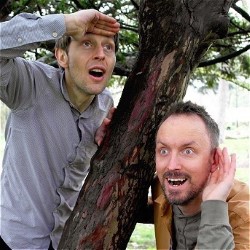
It’s very easy to remember the performers’ names for this show – they’re both called Tom!  The sound man’s called Ben, but we won’t hold that against him.

This show is an exploration of friendship, the most important thing in the world, and how that makes it possible to do what might otherwise seem completely impossible.  Tom Gk and Tom Skelton have been friends from one Tom’s first day at school and supported each other through thick and thin despite such fundamental differences as supporting different football teams – and not just two different teams, but the two top English teams of their day: Arsenal and Man United…

The show begins with some audio description for the blind and partially sighted – each Tom describes himself, with the occasional exaggeration or wishful thinking corrected by the other…. One Tom has only very partial peripheral vision, the other has extremely limited hearing in one ear; but together they combine to make a very lively show despite the small audience present in Buttercup.

Neither Tom was disabled as a child: their loss of sight and hearing came on later in life, and at different times for each of them.  We journey with each Tom through important stages in their lives, and are with them as they finally get a diagnosis.  Each Tom is there for the other as they learn to negotiate their now different lives.  Each has difficulties on their own: together they make a brilliant partnership as one Tom can see what the other hears, or hear what the other can see…. Their strong friendship has enabled them to travel the world and achieve much that they couldn’t have done on their own.

There are some bad jokes, some good ones, silly sound effects, much very good-humoured and good-natured audience participation, two Penguin biscuits, and a number of lively songs accompanied by Tom and sung by Tom, Tom, and both Toms. 

Together is the important word: that, and friendship – without which life would be so much harder.  Our friends can laugh at and with us, hold us up through the tough times and rejoice with us in the good ones.  Come, be inspired, and celebrate the power of friendship with the Toms!

Did you hear what I saw?, The Fringe, Underbelly George Square (Buttercup) Venue 300 runs until 16th August for more information go to: Did You Hear What I Saw? | Edinburgh Festival Fringe

Brett Herriot at the Festivals

Divas: From Stage To Screen, The Fringe, Review

***** (5 stars)

“The Finest Concert Production!”

Big Band Does Productions have become a Fringe Festival staple over the last 5 year or so with there hit show Divas: From Stage to Screen, the concept is simple enough, take eight incredibly talented female performers from the world of musical theatre and pop, mix in a stellar live band and a selection of music that pays tribute to the world’s greatest Diva vocalists. From Dame Shirley Bassey to Judy Garland to Madonna and Whitney every great lady gets a look in, during this show which is the finest concert production you will see at the festival this year.

Each show features four Divas drawn from Danielle, Jorgey, Sarah, Nicola, Jessica, Flick, and Rosie In a show that’s the perfect late-night music review very much in the vein of the legendary supper clubs of New York. Featuring a plethora of songs and the odd mash up, it’s a crowd-pleasing program that’s anchored by a polished four piece on stage band who work from some inspired musical arrangements.

There is not a weak performer amongst the Divas who deliver peerless vocals and performances that cannot be matched anywhere else in the festival Simply staged and beautifully directed this is the perfect way to round out a day at the Fringe.

For the last couple of Festivals, the Divas have been more tucked away in the basement of St Augustine’s on George IV Bridge. 2026 Fringe sees the Diva’s, revived, refreshed with added glitter and sparkle including a fabulous lighting and sound design that lifts the show to whole new level taking to the stage of the Ballroom in the Heart of the New Town and its clear these ladies mean business.

Endlessly engaging, musically stunning, this is truly the best concert show to be seen this year, so pop along to the assembly rooms and grab a glass of wine or indeed the tipple of your choice and be prepared get lost in some incredibly performed music!

Divas: From Stage to Screen, The Fringe, Ballroom @ Assembly Rooms runs until 30th August for more information go to: DIVAS: From Stage To Screen | Edinburgh Festival Fringe

Mary Woodward at the Festivals

The Galloping Cure, Edinburgh International Festival, Review

**** (4 stars)

“A very powerful piece indeed”

Scottish Opera have done it yet again!  As ever, my initial apprehension about Another New Opera was rendered pointless as I watched the second-ever performance of The Galloping Cure, the second collaboration between composer Missy Mazzoli and librettist Royce Vavrek. 

Based on a short story by their friend Karen Russell, the opera opens in a struggling industrial town – we never know its name, and have to assume that it’s somewhere in the middle of the USA.  It’s dark, it’s grey, and a mass of people lurch silently towards us before bursting out in a chorus of sound describing in graphic detail the mysterious and painfully debilitating illness that is afflicting them.  Local doctor Theresa is powerless to help them – all I can do is listen – while the townspeople continue to insist that the doctor is always right.  Theresa’s daughter, Noy, is less sure – she not only sees Theresa’s crippling migraines but also feels that Theresa is useless as a mother.

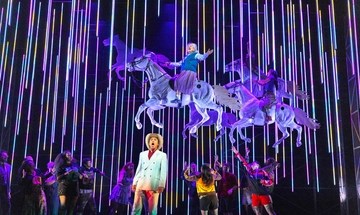
Into this atmosphere of hopelessness comes the mysterious Lucky Mack, bringing his carousel of galloping horses.  The first ride is free!  Everyone who tries it experiences joy and a freedom unlike any other – not just from their illness but from everything that is wrong in their lives.  Noy tries a ride, but Theresa can’t be persuaded – her attention is on baby Rosa, who we learn is actually her granddaughter.  The townspeople become increasingly addicted to the rides, and tensions arise as those who have plenty of money are able to jump the queue… even perennially grumpy Ivona Kowalski is eventually persuaded to try a ride and revels in her new-found joy and freedom from pain.

Meg and Sam, Theresa’s dogs, are watching TV [fortunately, the supertitles can translate canine for us].  They are very excited to see their mistress talking to someone – it’s a TV interviewer, questioning her and Mack about the wonderful carousel.  Theresa endorses its therapeutic powers – it appears to be holistic, treating the whole patient rather than just the symptoms of illness.   Everyone in town is increasingly swept up in the addictive euphoria – even the sheep who accompany Rosa’s nighttime lullaby stop baaing and burst out in the near-universal chorus of I’m flying, I don’t know where I end and everything else begins.

Only the dogs still know – even though they too can now converse in human – that something is very, very wrong.  They try to tell Theresa, but she can’t hear them – she too is sucked into the mass euphoria engendered by Mack’s gift of a Home Horse – your very own hobby horse which has the same magical properties as those on the carousel.  It’s only when Noy reveals to her mother the price you have to pay once you run out of money that the whole horrible truth starts to become clear – but by then it’s far too late…

This is a very impressive piece, an excellent fusion of music and drama, superbly delivered by a very talented cast.  The chorus in particular are to be commended for their mostly crystal-clear enunciation – I hardly needed the supertitles much of the time, clearly showing the amount of hard work done by chorus director Susannah Wapshott.  The supertitles were helpful with the soloists’ lines – and, of course, for the dogs’ and sheeps’ contributions!

The staging and lighting were simply stunning – the carousel scenes were magical in every sense of the word: full marks to everyone involved in this!  The fluorescent tubes hanging from the ceiling were a glittering indication of the emotional atmosphere, increasingly colourful as the carousel’s spell spread ever-wider: a stark monochrome when it’s deadly undercurrent was revealed.  And the gory horror of Ivana Kowalski’s payback [you’re helping others] was superbly managed – implying the gruesome is so much more effective than putting it under the microscope…

It’s always hard to comment intelligibly on music heard for the first time while one is also listening to the words and watching the action – but I can say with confidence that it sat well with and clearly created the atmospheres that illustrated and underlined the drama, which is what one most hopes for in opera.

It’s an engrossing story.  But the punchline bugs me..

Mack’s pointing out to Theresa that the carousel would not have been the ever-expanding phenomenon it became is akin to Adam saying ‘but the woman tempted me and I did eat’ – i.e. “it’s not my fault you can’t pin it on me” – refusing to admit guilt in any form, when it’s completely Mack’s creation that is causing so much pain and devastation. 

The Galloping Cure is a typical story of addiction – first the pleasure, the repeated euphoria: and then the obsessive addiction.  Nothing else matters, you’re willing to pay any price: the price ultimately being, in this case, a hideously mutilated body and finally a painful death.

I even began to question – was Mack also responsible for the initial plague afflicting the town?

There’s fine storytelling, and a gradual building of characters as the action progresses.  The dogs are a blessed relief [as are the sheep] – and the horses themselves are magnificent, both on the ground and when they take to the air.  The excellent cast includes a number of Scottish Opera’s current or previous Emerging Artists – a special shoutout for Catriona Hewitson and Edward Jowle as the unforgettably engaging dogs, Meg and Sam.   There are new voices I’d love to hear again, especially the three main protagonists – Daniela Mack as the exhausted but still caring Theresa, Gabrielle Turgeon as her ‘typical teenage daughter’ Noy, and Justin Austin as the lethally charming Lucky Mack.  Susan Bullock also deserves a special shoutout, not just for her superbly realised chronically grumbling Ivona but for her courage in joining the two aerialists [Danuta Ramos and Saya Yamaguchi] in rising aloft on the glittering white gallopers.

And the whole thing is supported by the ever-delightful and highly accomplished Scottish Opera orchestra under Stuart Stratford.

It’s all so beautiful…but isn’t it the case that the most beautiful things with the greatest allure can be the ones concealing the most potent poisons?

Q.E.D.

A very powerful piece indeed, which I hope will take its place among the other classics of contemporary opera.

The Galloping Cure by Scottish Opera Edinburgh International Festival, Festival Theatre runs until Wednesday 12th August, for more information and tickets go to: The Galloping Cure | Edinburgh International Festival

Mary Woodward at the Festivals

Sister Sophia Kicks the Habit, The Fringe, Review

**** (4 stars)

“Magnificent”

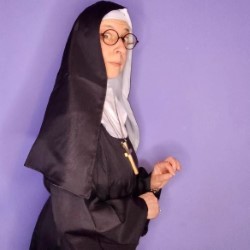
Venue 13 isn’t the easiest to find – I was very grateful for a huge banner with an arrow pointing me towards the hall as I made my way down the Canongate.  It was well worth the effort!  Sister Sophia is the product of Toronto company The Universe Over 60: Lisa Randall as Sister Sophia gives us a lot to think about as she watches through the night after the death of her dear friend Sister Beatrice.

I was born and raised a Catholic, and educated in convent schools – so I am very familiar with nuns.  Some of them are lovely, some are demons in disguise: without the diligent service of nuns of many different orders, the church would probably have fallen apart many centuries ago.  It’s certainly challenged today, when there are fewer men coming to the priesthood.  The number of nuns is also falling as those who’ve given their lives in devoted service in schools, hospitals, parishes, communities, and who knows where else finally go to their eternal rest, leaving diminishing numbers to serve an ever-greater need.

Sister Sophia is one such devoted woman who’s given her life to God – from the age of sixteen to now: fifty years of being married without ever having physical contact with her bridegroom, of conducting what is in effect a one-sided relationship.  She talks to her husband throughout the night: is it too much to ask for an answer?  Sister Beatrice was firm in her faith; it was she who encouraged and supported Sophia when she was doubting; and now she’s gone – hopefully into the arms of her bridegroom – what is Sophia to do?

Lisa Randall is magnificent as Sophia.  Her superbly mobile, expressive face speaks volumes; her speaking voice is wonderfully flexible; but it’s her singing voice that is the highlight of this piece for me.  Whether it be singing a traditional Latin adoramus te, an intriguing twist on Ave Maria, two gorgeous new compositions and an unforgettable rendition of Tom Lehrer’s Vatican Rag [which itself is worth the ticket price], it’s an aural joy and delight that brings life and colour to what could be, but most definitely isn’t, a monotonous monologue.

Sophia’s conversation with God touches on so many things it’s impossible to catalogue them all – but I resonate strongly with many of them – the serious and the incredibly funny [and there’s a huge amount of very funny in this piece!].  I’ve very happily become a Quaker – which at least means that the ‘men do all the big stuff, women pick up the pieces, grease the wheels, sweep the floor and keep the show on the road’ idea simply isn’t an issue.  But I so recognise the ‘why don’t you talk to me? Show me a sign? Give me at least a hint that you’re there?’ type of questions are always hovering – and, of course, the whole ‘oh gosh I could really do with a hug [or more] here’ issue of physicality doesn’t go away just because you’ve taken a vow of celibacy!

If you’ve never thought about nuns as human beings, make your way down the Canongate and discover the very human being underneath that habit.  Sister Sophia is very much a human being: laugh with her, empathise with her, sigh for her – and find out what she decides to do now that her bestie has gone [we hope] to heaven…

Sister Sophia Kicks the Habit, The Fringe, Main Space at Venue 13 Runs until 21st August for more information go to: Sister Sophia Kicks the Habit | Edinburgh Festival Fringe