Brett Herriot at the Festivals

Rock of Ages, Sanctuary at Paradise in Augustines (Venue 152) Review:

**** 4 Stars

a fabulously rock driven show

Edinburgh based Bare Productions really are building up acclaim for there now annual outings at the Fringe Festival in there home of Paradise in Augustines for a 9-day run in the early going of the festival. 2025 see’s the company taking on the jukebox musical “Rock of Ages” which marks its 20th anniversary of its debut in Los Angeles in 2005 at fittingly, The King King Club on Hollywood Boulevard.

Telling the story of Lonny Barnett (a fabulous comedy turn from Sam Eastop) who works at the Bourbon Room (a thin disguise for the real life Viper Room in L. A) his manager and love interest, Dennis (Will Jackson) and the clubs customers. It’s a story of love, ambition and holding onto one’s dreams all this warped up in a rock score featuring songs from Styx, Journey, Bon Jovi and Europe to name a but a few.

Bare have turned out a fabulously rock driven show with performances taking the focus from a well drilled 16 strong ensemble company who truly enjoy every moment on stage. The entire company blend powerhouse vocals with high energy Chorography. Leading the company is Joshua Scott as “Drew” whilst eternally cute also has the most magnificent rock voice that comes from his soul and nails every single song. Georgia Brennan as “Sherrie” is also a pocket rocket of talent and shines wonderfully well. Eastop and Will Jackson are comedy gold as Lonny and Dennis. Special mentions must go to Aodhan Mallon as Franz who takes straight camp to new heights and Rosie Sugrue as Justice, my word a west end worthy powerhouse of vocals that’s a pure joy to see on stage.

While the performances are excellent It was clear there were major technical issues going on with a delayed start to the evening performance. These difficulties particularly effected Musical Director Finlay Turnbull’s excellent 5 strong house band. One musician in particular clearly displayed their unhappiness so much, so it pulled the focus, especially heading off stage during a scene. Whilst that is very rock and roll its always worth remembering onstage bands are very much part of the over all production. The gremlins even got into the lighting towards the end of the show. That being said it became strikingly clear these issues were with the venue more than the performing company and with a bit of work hopefully these issues will be smoothed out for the rest of the run.

Rock of Ages truly delivers an entertaining evening of musical theatre that will have there sold out audiences rocking out to there hearts content as they embody the rock pantheon of Never Stop Believing! Wonderful Stuff!

Rock of Ages, Sanctuary at Paradise in Augustines (Venue 152) For more info go to: https://www.edfringe.com/tickets/whats-on/rock-of-ages

Mary Woodward at the Festivals

I Wish My Life Were Like A Musical!, Gilded Balloon at the Museum (Venue 64)

**** (4 stars)

“Everything a musical should be”

Oh goodness this show stirred up so many memories!

The opening number sets the tone – bright eyes and cheery smiles cover the quartet’s razor-sharp dissection of everything that can make an opening number truly appalling.  It’s greeted with such enthusiasm that it’s hard not to feel that at least fifty percent of the audience know this show by heart…

Four very talented performers – Emma Ralston, Joel Benedict, Rory Connolly and Samantha Dorsey take us on a journey through the life of an aspiring musicals performer – the thrills, the challenges, the disappointments, the highs [and lows] of stardom – in a non-stop stream of witty, punchy, satirical, whimsical, and oh-so-true-to-reality musical numbers created by the incredible Alexander S Bermange.  Aaron Renfree’s direction and choreography keep the audience engaged throughout, and designer Sorcha Corcoran and lighting designer Chris McDonnell produce a show that glitters, sparkles, and inspires us all with a desire to tread the boards and sing our hearts out.

Emma, Joel, Rory and Samantha introduce us to four young hopefuls, fresh out of music college and sure that they will instantly land a wonderfully satisfying and perfect job in a musical.  But first they have to succeed with an audition – and this is where my trip down memory lane began.  I resonated so strongly with so many of the situations: waiting what seems like forever for your turn in front of the auditioning panel; sure that you will be wonderful, that no-one else will have chosen the song you’ve picked, only to find that everyone else is singing that song too and, when you finally get on stage, the panel don’t bother to look at you and stop you before you’ve managed to sing more than a few bars.  Oh how depressingly familiar it all was!

Of course, if you don’t succeed in an audition, you could always take part in a performer’s showcase – assuming your performance isn’t scuppered by any number of things, not least the appalling quality of the piano that’s accompanying you.  And there are those who’ve maybe given up on their quest to be cast in a musical, and have turned into Superfans, whose passion for musicals takes over their entire lives. 

Should you make it on to the stage, being well aware of the many things that can mar or even ruin your performance, you need to begin with an apology – in this case, a list of ‘excuses’ so long and complex it’s a wonder the singer could make it on to the stage at all!  And then the title song – I wish my life were like a MUSICAL.  It seems as though life would be perfect: nothing would go wrong, it would be fit for a queen.   But oh dear: think of all the things that go wrong for characters in a musical – is this really what I want, after all?

Then joy of joys, you get cast!  But – now you have to learn the dance routine created by a choreographer who’s a masochist – it’s all a step too far.  You think things are looking up – you get cast in a leading role: but it’s as the understudy.  Every day living in hope, every day disappointed as your star turns up at the very last moment: is this to be your life forever, always standing by?

And that star – maybe their talent is undeniable.  Or maybe they are there simply because of their name, and the reality is that their talent is most definitely on the wane.  They love to sing, but goodness me they could give Florence Foster Jenkins a run for her money!

Then you get cast in an actual role.  An extensive period of preparation is needed each day if you are to bring your best to this role: is it really worth the effort?  Things are looking up – you are now the co-star in a romantic role: but that, too, is fraught with danger as you lead up to the dramatic/ traumatic climax of the show…   Even reaching the top of the bill, taking the starring role, so much is demanded of you – social media duties take up so much time as you let everyone know just how humble and unspoilt you are.  They also bring you the attention of equally media-savvy fans…

There are, of course, ardent fans of musicals who nonetheless have to keep this part of their lives hidden, as their friends would never dream of exposing themselves to such a frivolous art form.  And then there’s the DIVA, who makes life hell for everyone around them.

During a career in musicals, you’re going to come across any or all of these situations – you’ll either work with, or turn into, one of the awful people we’ve seen on stage this evening.  So why do it, why put yourself through all that misery?  The honest answer is it’s who I have to be – the magic, the elation of creation, the joy of performing make it all worthwhile. 

And thus the show ends.

Or does it?

Oh no, we have to have an ENCORE, which like all the other numbers is greeted with a positive storm of applause from an audience who have loved every minute of the performance and will, quite likely, be back for a repeat  performance tomorrow.

I wish my life were like a MUSICAL was everything a musical should be – bright, funny, witty, colourful, realistic, fantastical, barbed, loveable and loving.  And, as every good musical should, it sent us out into the realities of life with a spring in our steps and a song in our hearts.

I wish my life were like a MUSICAL, Gilded Balloon at the Museum (Venue 64) for more information go to: https://www.edfringe.com/tickets/whats-on/i-wish-my-life-were-like-a-musical

Mary Woodward at the Festivals

Not my grandmother’s daughter, Gilded Balloon at Appleton Tower (Venue 140) Review:

*** (3 stars)

“Heartwarming”

This show is an interesting blend of shadow puppetry, shadow play, and very personal storytelling.  Harley Brooke Walter remembers their grandmother’s influence on themself growing up, and contrasts their relationship with Harley’s one with their birth mother. 

It’s obvious from everything that they don’t say, rather than what they do, that Harley didn’t have a good parent-child relationship, but had, and still has, a brilliant one with their grandmother, whose voice we frequently hear in snippets from recorded conversations.

Harley begins by saying that they are not their grandmother’s daughter – and I guess that, biologically speaking, they are not.  What comes through over and over again is how much Harley admires Noonie’s warmth, humour, kindness: her skills with her hands, her affinity with the birds that come to her back yard, the way she faces up to and deals with difficult situations, instead of hiding from and denying them.  As one who themself ‘learned to be quiet, learned to be small, not to be an inconvenience’, they have nothing but admiration for how their grandmother found a way not to be quiet, not to be small, and to deal with, accept and move on from situations which might have destroyed a lesser woman.

Years of therapy, of introspection, and continued and continuing observation of their grandmother have enabled Harley to arrive at the realisation that they may not be technically her daughter but that this is how they want to be, how they can be if they allow themselves to be, and to let go of the connection with their birth mother and her expectations of how a daughter should be.

Harley’s show was dogged with misfortune – losing all the equipment for the show shortly before its opening, though happily being reunited with it in time for today’s performance.  Today a malfunctioning lamp [which decided to work halfway through the show] meant that she had to use a flashlight for the closeup shadow play, resulting in somewhat clumsier than usual transitions and effects. 

But there was also much to enjoy.  A hummingbird puppet which came and nestled on my hand at one point, was an unexpected delight, as was a red cardinal puppet which brought life to grandmother’s story about the red bird in her yard which didn’t fly away when she came out to put food down in her yard.  And Harley’s connection with their audience is immediate and warm: and they allow their vulnerability to shine out without in any way asking for our sympathy or pity.

What emerges in the course of the show is a heartwarming account of a lovely, loving, hospitable and strong Southern woman, through which Harley is finally able to realise they have so much in common with her that they can write a love letter to themself in the writing of this show.

Not my grandmother’s daughter, Gilded Balloon at Appleton Tower (Venue 140 for more information go to: https://www.edfringe.com/tickets/whats-on/not-my-grandmother-s-daughter

Mary Woodward at the Festivals

ScotlandsFest: Wanton Women Running Amok, St Columba’s by the Castle (Venue 367)

**** (4 stars)

“Brilliant

What a splendid way to start a full day at the Fringe!

But before I do, just a word about accessibility for the venue for ScotlandsFest.  If you approach St Columba’s from the Royal Mile, a notice directs you down a steepish flight of steps and then a few more.  There is an accessible entrance, but you have to carry on to the church to access it.  You can also go along Victoria Terrace to what looks like the end, and you can turn right and reach the venue that way – though you will still have to navigate the short flight of steps.

Now, back to the Wanton Women…

Mary Craig does a brilliant job of explaining the hows and whys of the explosion of witch trials in 17th century Scotland, without herself bursting into flames of rage at the treatment accorded to ‘wanton women’ of that time. 

Prior to the 17th century, all European cultures have a tradition of witches; in Scotland it goes back to pre-Christian times.  Witches were [mostly] women who were healers and charmers and claimed to have their power from the fairies.  St Columba brought Christianity to Scotland and didn’t seem to have much of a problem with witches, who might now claim to have their powers from God rather than the fairies, but went on much as before.

The 16th century brought the Reformation to Scotland and a particularly unpleasant form of Calvinistic Protestantism began to take over.  There were no fairies, just God and the devil: witches’ powers couldn’t possible come from God, so they must be from the devil.  People started writing crazy things about this, spreading the equivalent of conspiracy theories far and wide via the recently invented printing press – the equivalent of social media today.  The most influential book was one Malleus Maleficarum [literally ‘the hammer of the witches’], which Mary Craig describes as ‘a Boy’s Own Annual’ tirade against women, their demonic powers and, would you believe, their habit of keeping nests of penises up in trees…?!!

Prior to the 17th century, witches trials were ecclesiastical affairs, which generally involved healers, herbalists and charmers, and resulted mainly in ‘don’t do it again’.

The 17th century saw James VI of Scotland hot-footing it down to England, along with most of his Scottish nobles, leaving a power vacuum in Scotland, into which the Kirk stepped, with its Kirk Sessions acting as a ‘court of morality’ with lists of rules from women’s behaviour.  ‘Break one, and you’ll break them all’, was the prevailing moral view: and thus the accusation of “wanton woman” could be applied to a woman who is a bit mouthy, a bit independent, or simply a bit more brightly-dressed than most.

Mary Craig is always very fair, not excusing the Kirk’s behaviour but, by putting it into context, at least providing an explanation.  In the Calvinistic world of predestination, there was only God and the devil, who was very real and a constant threat.  The Kirk was full of God’s soldiers waging a constant war against Old Clootie.  Wanton women were the devil’s handmaids: they be sought out and destroyed before they proved the vessels through which the devil would enter and emperil the whole of Scottish god-fearing [ie Calivinistic] society.

The University of Edinburgh has a database listing the occupations of the occupations of women brought to trial for witchcraft in the 17th century.  Suddenly there are very few midwives, healers or charmers: the accused are often women with some social standing, some financial security, some intelligence.  It’s hard not to see the Kirk as simply terrified of women – not least because, despite the obvious superiority of men, it’s women who have the power to give birth…. At least 4,000 women [out of a total population of about one million] were arrested and tried during the century.

And Jamie Sext didn’t help with his hit publication Daemonologie, which Mary Craig describes as a better-written rehash of Malleus Maleficarum.  And so the wild theories and untruths circulate, proliferate, and feed the witch-hunt: and thousands of innocent women are strangled and then burnt at the stake, while any real witches keep their heads down and their mouths shut.  James adds further fuel to the fire by accusing ‘the witches of North Berwick’ – up to a hundred of them – of raising the bad weather which prevented him reaching Denmark and bringing his new bride, Anne of Denmark, back to Scotland.  It couldn’t possibly have been a freak storm, could it, it MUST have been witches.

Lady Manderson was accused and brought for trial by her own husband.  Agnes Finnie, a shopkeeper from nearby Potterrow, was the local midwife, bank and doctor in a very poor and deprived area of Edinburgh.  Selkirk Meg was accused of turning herself into a mouse and biting the arm of a neighbour’s child in the night.  Mary Craig brought these and many other women to life for us, telling their stories and making them real human beings, accused, tortured and killed simply for being different.

Some of them might simply be too old, past the age of childbearing, childless, or for some other reason unable to contribute to society any longer: being a grumpy old lady could be enough to warrant an accusation, a trial, an execution.  Did no-one complain at this outrageous behaviour?  Probably they were all too scared that speaking out might produce an accusation of ‘wantonness’ against themselves…

And I’m led to wonder if we today are any better than those terrified members of the Kirk who saw anyone who didn’t want or wasn’t able to fit the mould of ‘how you should be’?  Are women not still being accused – maybe not of witchcraft or wanton behaviour, but of not conforming to the [older, white] male version of how women should be?

After the show I asked Mary how she manages to stay calm and not explode with rage when dealing with such horror stories: she said she writes fantasy fiction in which the baddies get what they deserve.  I guess we could all fantasise about a world in which there is justice and equality for all…  Meanwhile, I’ll be very glad I wasn’t a woman in 17th century Scotland!

ScotlandsFest: Wanton Women Running Amok, St Columba’s by the Castle v367 for more information go to: https://www.edfringe.com/tickets/whats-on/scotlandsfest-wanton-women-running-amok

Mary Woodward Review

Scottish Opera: Lauder, Portobello Town Hall, Edinburgh, Review

**** (4 stars)

“Unmitigated mirth”

Previously seen in 2017 in a performance which was part of the Theatre Royal Glasgow’s 150th anniversary celebrations, this show has been revived to mark the 155th birthday of the legendary Scottish entertainer Sir Harry Lauder – and what better place to see this than in the great man’s birthplace, Portobello, on the anniversary of his birth.  Ticket sales from these performances will go to Erskine Veterans Charity, which Lauder supported in his lifetime, and of which tonight’s performer, Jamie McDougall, is an ambassador.

Born on August 4th, 1870, in humble circumstances, Lauder became the equivalent of a pop idol today, a household name with an international career, who at one time was the highest-paid entertainer in the world and was knighted in 1919 – “the first knight of the music halls”.  He started off as a comedian, but later introduced  gentle romantic songs into his performances and preferred to describe himself as a minstrel.  His only son John died in the Battle of the Somme in 1916, and Lauder spent a vast amount of time and energy entertaining the troops in France and raising over a million pounds for the care of wounded ex-servicemen by his performances around the world.  He died on February 26 1950.

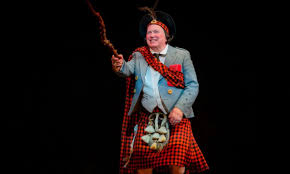
Jamie McDougall, well-known and -loved tenor whose performances with Scottish Opera are always a joy, was giving his penultimate performance of Lauder.  From the moment he stepped onto the stage of Portobello’s town hall, he had us in the palm of his hand, pouring seemingly boundless energy and enthusiasm into a succession of Lauder’s catchy songs, sentimental without being saccharine, twinkling with oh-so-slightly naughty humour, and inviting us to enjoy ourselves as much as he was in performing for us.

Filmed scenes from Harry Lauder’s funeral segued into the man himself coming through the auditorium and on to the stage to meet his rehearsal pianist [the lovely and talented Derek Clark, former Head of Music at Scottish Opera].  His very first song, Stop your tickling, Jock! had the audience applauding enthusiastically – and the applause continued all night. 

While conducting the rehearsal, ‘Lauder’ was also talking to a journalist who’d come to interview him – thus providing the perfect vehicle for him to talk about his early years and the gradual growth of his success.  One of my favourite numbers was the utterly appalling temperance song he apparently sang at a Band of Hope concert when he was only five: the song was dreadful, but his rendition thereof was priceless!

What was also apparent was the man’s professionalism and the ways he ensured he was remembered, in an age which abounded in great singers, including the opera stars Gigli and Caruso… Make an entrance, always by the front door: if it’s in New York, be driven down Broadway preceded by a piper.  Use the extra space on a recording after the song has finished to carry on speaking and become known for doing this.  Cultivate a reputation for being tight with your money. In private he was obviously a very loving and generous son, husband and father, a tender-hearted man whose wife Nancy was the rock on which he leaned.

And then there were the songs…I love a lassie, a wee deoch an Doris, it’s nice to get up in the morning, we parted on the shore, the road to the Isles, and the final Keep right on to the end of the road had most of the audience joining in, with Jamie McDougall’s encouragement because singing is the thing that makes you cheery.

It wasn’t unmitigated mirth –  the tragic news his son’s death was superbly portrayed, and immediately followed by film footage from the trenches.  It was sobering to see apparently normal landscapes and realise that they concealed soldiers and weapons, and that many, or possibly all, of the men on film would not make it back home, or only with serious injuries.  What was impressive was the way Lauder didn’t abandon himself to grief but used his fame to raise money for wounded soldiers,.

And somehow, through the grief, Harry kept the sparkle and joy in his performances, just as Jamie McDougall did so superbly throughout this evening in Portobello.  I’m sad that tomorrow night is Jamie’s last-ever performance of Lauder but so very glad I had the chance to see him remember and enjoy portraying the life of the great man on his 155th birthday.

Scottish Opera: Lauder, Portobello Town Hall, Edinburgh runs until Tuesday 5th August.