
***** (5 stars)
“Stunning! incredible! and Magnificent!”
Visually stunning, aurally incredible, musically magnificent – Scottish Opera have done it yet again!
I confess up front that Puccini is not my favourite composer, and Turandot not my favourite Puccini: so to be won over by David McVicar’s production and Scottish Opera’s performance is no mean feat… I went, expecting to be bored, and instead was gripped for [almost] the entire performance: I’d happily go and see it again tomorrow.
Turandot is the daughter of the Chinese emperor, whose ancestress was raped and murdered. Anyone who aspires to her hand must answer three riddles: failure means death. As the opera opens the most recent unsuccessful candidate, the Prince of Persia, is about to be executed. Calaf, an exiled prince, encounters his father, the deposed emperor Altoum, with his devoted servant, Liú. His joy at being reunited with them is overwhelmed by his sudden passion for Turandot, who has come to witness the execution. Many people endeavour to deter Calaf, but he is obdurate: he strikes the gong and prepares to face the riddles.
Turandot is astounded when Calaf successfully answers each riddle in turn. She is terrified, and begs her father to save her: he responds that the law cannot be broken. Calaf offers the princess a lifeline – if she can find out his name before sunrise, he will happily die. Throughout the night everyone desperately searches for the unknown man’s name because they will all die if his name is not discovered. Calaf is offered bribes, which he refuses. His father and Liú are threatened with torture: Liú declares that she alone knows the unknown man’s name. She defies the princess, declaring her secret love for Calaf: she stabs herself, willingly sacrificing her life for that love.
The crowd’s mood changes to sorrow and repentance. Liú’s body is carried away and Turandot and Calaf are left alone. He rebukes her for her cruelty: she is ashamed and tells him to leave. They share a kiss, and she begins to melt. He gives her the present of his name, accepting that this will mean his death: in front of her father and all the people she announces his name – it is Love.
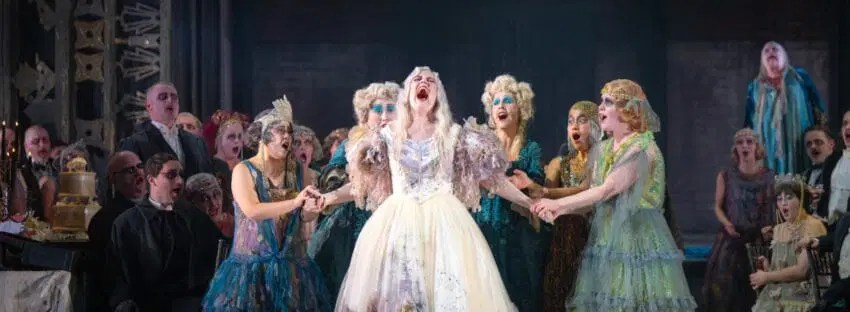
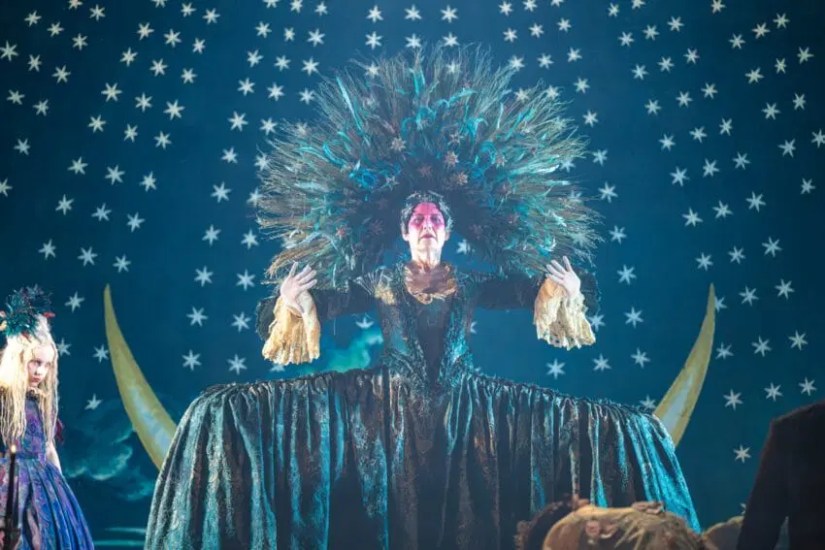
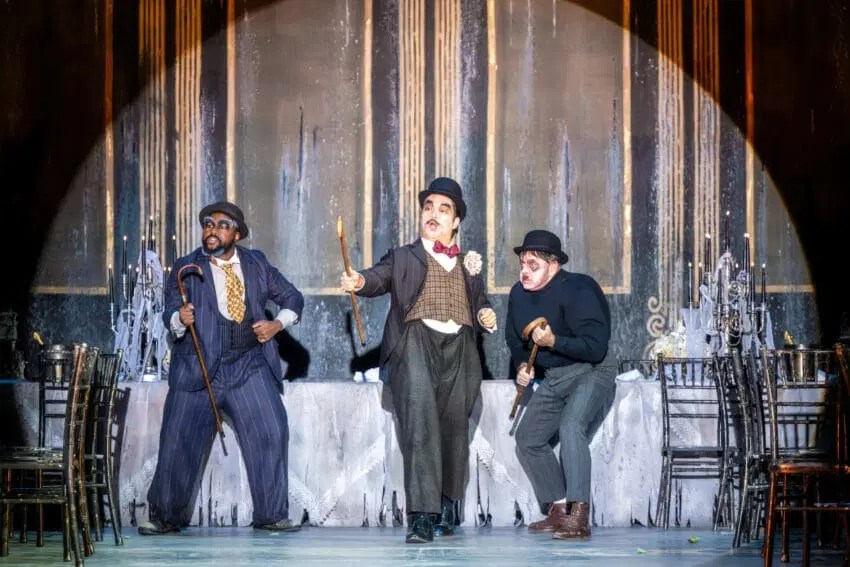
Covent Garden did a wonderfully lively and colourful Chinese Turandot: David Mc Vicar chose to set much of it around a ghastly dinner party where table and diners alike were streaming with cobwebs. In an antique and obsolete society, everyone’s attention is on the one bright spot in their lives – the next execution. The executioner seems to be the only living person amid a host of zombies, while the three Chaplinesque civil servants Ping, Pang and Pong try to inject some humour into the situation. Turandot’s appearance – on a stage overlooking the dinner party – harks back to eighteenth century opera in both costumes and hand gestures, while the backdrop and her costume when she comes to witness the Prince of Persia’s execution are a straight lift from Schikaneder’s Queen of the Night in Magic Flute: talk about power dressing! Her costume for the riddle scene is reminiscent of Miss Havisham: her frock in the final scene was much simpler – stripped of her power to terrify, what is she?
Ping, Pang, and Pong spend time smoking opium and musing on the changes they have seen. For centuries, everyone and everything followed the rules – then Turandot was born and everything changed. The table being re-set for dinner is one of the highlights of the production: wonderful choreography with impeccable timing has robotic waiters and waitresses setting everything up for the arrival of the Sages who will oversee the riddles, together with the rest of the ghostly be-cobwebbed zombies, eager for more blood. A draped coffin is brought in which discloses the mummified body of the ancient princess. Turandot’s father emerges from a crypt on to the stage from which he can observe the process: despite his gorgeous voluminous silk robe he himself is very nearly a corpse…
In the third act, the backdrop to the avenging Queen of the Night is tattered and broken; people roam the streets, desperate to find the unknown man’s name and escape the threat of death. Calaf’s nessun dorma is a triumphant hymn – he will keep silence, and at dawn he will win… He resists bribery and watches horrified as Liú sacrifices himself and his father totters away with her lifeless body, but not before Turandot has shown traces of humanity in her attention to the old man: is her armour of ice finally cracking?
The crowd’s transformation from angry mob to penitent and ashamed people is superbly managed. Less satisfactory is the final scene between Calaf and Turandot – the drama is in the words and music, and after the intense busyness of the previous scenes the tension between the two principals flags a little, and their supposedly transformative kiss passes almost unnoticed. But then the crowd and the emperor return to hear Turandot’s glowing confession of love, the emperor dies, and the young couple move forward and into the light.
Dramatically, the piece was pretty damn good. Musically, it was beyond superb – transcendent in execution and effect. The huge orchestra under Stuart Stratford was brilliant as ever, with attention to detail, wonderful gradations of volume, and supremely sensitive playing. And the voices – oh my, the voices!
Jamie MacDougall as Turandot’s father, and Insung Sim as Calaf’s father, made the most of two very different roles. Josef Jeongmeen Ahn, Aled Hall, and Luvo Meranti obviously had a ball as Ping, Pang, and Pong, and produced some very lovely sounds along the way. Daniel Barrett’s Mandarin relished his role as the person who tells everyone what the rules are, and Jamie Francis’ executioner was someone whose attention you really wouldn’t like to attract. Non-singers Max Burns as the unfortunate Prince of Persia, and Kirsty Durie as a slender, white-wigged girl alter ego of Turandot [maybe the spirit of the dead princess?] were both very watchable.
And then we had the Big Three. Turandot is a fiendishly taxing role, and Trine Møller gave it her all, soaring over the orchestra with icy passion. It’s not a voice I could warm to – at least, not in this role: but I’d love to hear her in something else. Hye-Youn Lee, by contrast, has sung many times with Scottish Opera, and it was a delight to see her in the role of Liú. Commanding the stage, and able to defy the much taller and menacing Turandot, she brought passion and pathos to the underdog role whose value is only realised after her death.
And Victor Starsky as Calaf. Words fail me. Everyone must remember Luciano Pavarotti’s wonderful nessun dorma: even my old next-door neighbours had him serenading them night and day during the World Cup…but this surpassed that. Victor’s rendition of the aria came straight from his soul – no unnecessary movement, just a solid stream of sound from his throat straight to our hearts. And the voice was no less fabulous throughout the opera – breathtaking! Please please please can he come again and SOON!!
Scottish Opera Presents Puccini’s Turandot, Festival Theatre, Edinburgh, runs until Sunday 22nd November for more information and tickets go to: Turandot – Capital Theatres


