
***** (5 stars)
“Brilliant But Bonkers.”
A comment unashamedly stolen from a fellow concertgoer. They were referring to one of the pieces this morning, but thiscould almost be the title for the whole concert.
Utterly brilliant, bursting with life and joie de vivre, and a showcase for the outstandingly talented wind soloists whom one usually sees within the band, standing out during their solos passages and then blending seamlessly into the orchestral ensemble.
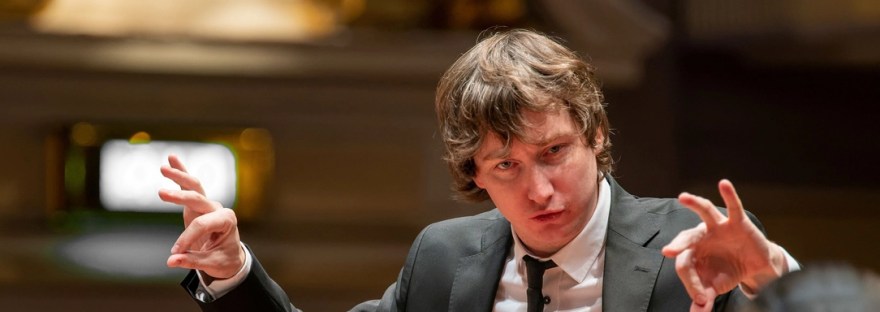
In the first half of the programme, flautist André Cebriàn, oboeist Clara Schweinberger and clarinettist Maximiliano Martin were each accompanied by the SCO principal conductor, Maxim Emelyanychev, in the sonata Francis Poulenc wrote for their instrument. The second half brought in bassoon player Cerys Ambrose-Evans and horn player Kenneth Henderson and gave Maxim Emelyanychev the opportunity to display his superb piano technique [while also allowing the five instrumentalists a brief rest].
I’ve known the Poulenc flute sonata for many years – my then partner was playing the piano part as one of the pieces in their degree assessment. It was then, and is now, a delight. The first movement cheeky, playful, sparkling with sunlight and languorously lounging; the second more wistful and yearning, with sudden outbursts of passion; and the third a mad helter-skelter dash for the finishing line where calm interludes couldn’t silence the irrepressible quirkiness which had the audience roaring their applause almost before the final note had died away.
The oboe sonata is so very different – and here we could begin to appreciate the mastery with which Poulenc showcases the different ranges, tones, and expressive qualities of each of the woodwind instruments. The melancholy, slow opening was perfect for the oboe’s plangent, reedy tones: a gently tender conversation with the piano ensued – not without its stormy outbursts! The middle movement is a perfect representation of Edinburgh in August – crowded, rushing to get somewhere, mostly good-humoured and with short oases of calm. The third movement was meditative, the oboe floating in a dreamworld, lamenting a sad memory; occasionally remembering stormy moments, but ending in melancholy. It took the audience a few moments to recover, but the applause increased in volume and energy as we came back from our reverie to the present day.
The clarinet sonata is a different beast again – and yet still unmistakably Poulenc. The irrepressibly energetic opening exploited the clarinet’s full range both of pitch and tone. The piano pushed rhythmically and the clarinet surfed the waves with a typically quirky melodic line. The two instruments tried to have a serious, grave conversation but kept bursting out playfully till everything came to a sudden stop. In the second movement, transparent floating aqueous piano chords had the clarinet sinuously emerging from the depths to soar in liquid arpeggios before the two playfully tossed fragments of melody to each other and joined in a tender conversation before the third movement’s furious fireworks, interspersed with moments of calm, led to another fabulously quirky ending which resulted in another ROAR of applause from the Queens Hall audience.
Jean Français’ L’heure du Berger, written in 1947, is a brief but witty character sketch of three of the types of customers to be seen in a Parisian café, in which all six players could let their hair down and Just Have Fun. Les beaux vieux [the old dandies], Pin-up Girls, and Les Petits Nerveux [nervous children] are delightfully lively pieces for five wind instruments and piano. The dandies have obviously been at the drink; the pin-up girls are much calmer; and the kids are virtually completely out of control in the most delightful way.
A moment of calm from Maxim Emelyanychev followed. In Ravel’s descriptive Jets d’eau [fountains] the water trembled and shimmered, the jets rose and fell, sprinkling sparkling drops everywhere, tossed by the wind and then subsiding again into a gentle calm.
We came back to Poulenc to enjoy once more his inimitable ability to create moods, his elegant, sophisticated, quirky sense of fun, and the consummate skill and exquisite phrasing of the six musicians. The Sextet for winds and piano opens with another hectic street scene – even more Edinburgh in August: seeming chaos with moments of glorious melody until everyone seems finally to work out where they’re going and jauntily set off together. A more gentle middle movement tosses phrases from instrument to instrument, giving each a chance to shine and display their individual characteristics, before another mad gallop to a finale that in typical Poulenc fashion managed to surprise us all into silence.
And another perfect storm of storm of applause breaks out – thunderous clapping, stamping of feet and loud cheers saluting a wonderfully uplifting, delightfully uproarious morning at the Queens Hall. Imagine our joy when we got an encore – revisiting those delightfully skittish petits nerveux: the perfect ending to a perfect concert.
Thank you, Maxim, and your wonderful soloists for a morning of pure joy.
Maxim Emelyanychev and SCO Wind Soloists, Edinburgh International Festival, The Queens Hall, Run Ended. For more information go to: Maxim Emelyanychev and SCO Wind Soloists, Edinburgh International Festival,

 ScotsGay Arts