
***** (5 stars)
“Graphically Portrayed”
Oh my what a visceral shocker, in the best possible way. Scott Fletcher, Scott Hoatson and Kirsty McDuff belie their age to portray to perfection kids on their very first day at ‘big school’ as well as their schoolmates and the assorted adults in their lives.
Reid’s not only dealing with ordinary first-day feelings but also with his parents’ clever idea of moving house – and across the country – during the summer holidays, meaning that he doesn’t know a soul in this vast gaggle of kids waiting to be sorted into classes. He’s trying to keep his head down, to stay unnoticed: it’s not his fault that he’s late into the first class and has to make a snap decision about which of the only two empty seats he sits in. Boy or girl? He chooses boy – and so meets Gordon.
The horrors of school are graphically portrayed – those inflicted, sometimes unwittingly, by staff and decidedly deliberately by fellow kids. The worst come from the three class bullies, well known to Gordon but new to Reid, who marvels at Gordon’s ability quietly to ignore the taunts and insults that flood out from these three, whom he calls Gorgons. Greek mythology, and especially Perseus, who rescues princess Andromeda from snake-haired Medusa and her fellow-gorgons, feature largely in the narrative and become the focus of a game Reid and Gordon develop together at home.
Things are becoming bearable: the Gorgons are beginning to tire of their taunting in the face of complete lack of reaction – but then disaster strikes. An incident – with a major cringe factor – escalates and results in a total rift between the two friends. If this were a perfect story, that would be the catalyst for a swift and supportive reaction from staff and parents – but this isn’t. The incident’s consequences blow up out of control, a well-meaning attempt at reconciliation fails disastrously, and Reid isolates himself in his misery. It takes an unconnected tragedy to bring about a movingly-portrayed reconciliation. What is unexpected is the way Reid turns his great weakness into a towering strength which makes the start of year two so much better than year one.
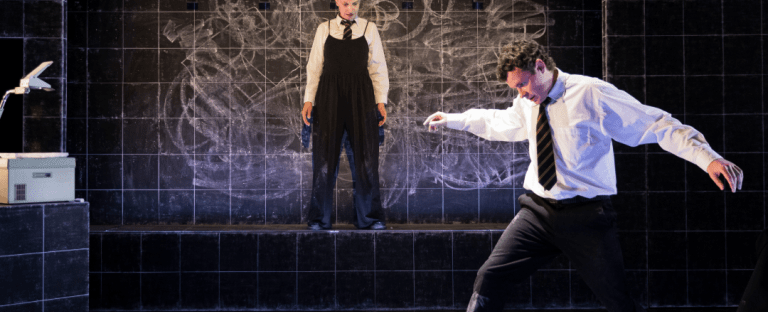
The set resembles a school’s tiled changing room [facilitating much chalk writing and drawing as the narrative advances]. Five chairs are moved, and at times thrown, around to create different settings as the action moves at a cracking pace. There’s brilliant use of an overhead projector – I loved the way it brought the Perseus game to life. A set which at first sight looks virtually closed has an amazing number of exits and storage spaces for props. The choreography and lighting are superb, and the rapid, wickedly accurate script brings the characters and narrative into vividly horrifying life.
Over two thirds of the audience were primary school leavers, and the most telling applause at the end came from them – they obviously recognised, felt with, and applauded the feelings of the characters in front of them. Cringe is a brilliant show that deserves to be widely, hopefully sparking both discussion and thoughtful action around the nature of bullying and the power of true friendship.
Imaginate children’s festival presents Cringe, Scottish Storytelling Centre, Edinburgh, Run ended


