
***** (5 stars)
“Breathtakingly brilliant”
An incredibly powerful piece, performed with passion and energy. A vitally important message, conveyed with lyricism and hopefulness.
A simple story, with strong overtones of the life of Greta Thunberg, and paying homage to the many young climate activists around the world who are fighting for the future of their – of our! – world. Lola has woken up to the climate emergency: she feels she simply can’t go to school any more, but must make her protest, alone if need be. She encounters opposition both from her family, who don’t take her concerns seriously, and from her schoolmates, who mock and deride her. It takes guts to stand alone…
Over the course of the opera, others slowly realise the importance of what she’s trying to say, and a swelling tide of protest grows from people of all ages who begin to realise This is our time/ this is happening now/ and if we don’t stand up/ answer this call/ then who will? No-one is coming to save us/ but us… Her sister is the first to support her, then her father, who is full of admiration for his daughter’s strength of conviction. Her mother is put in charge of a massive construction project – ‘improving’ a road by demolishing acres of forest: convinced that ‘progress’ must be achieved, that ‘more’ is best, and truly believing that this is all for the good of her family. Various adults try to persuade or bully Lola into backing down, but she stands firm.
The forest is destroyed, there is nothing to hold back the surge of water which sweeps away everything in its path, leaving a desert denuded of flora and fauna. But “this is progress”, says Lola’s mum –“don’t spoil my triumph” while others lament the deaths of the trees and the disappearance of all the birds.
Uprising is the vehicle for an outstanding performance from the RSNO Youth and Changed Voices choruses, without whom much of the drama could not have been so powerfully conveyed. They sing as a chorus, take individual roles as part of the narrative, and throughout it represent the forest, the birds and other creatures that live in it, and the inexorable power of the tumbling, surging waters that destroy everything in their path once the forest is not there to restrain them. Simple hand and arm movements have stunning effect: and goodness me how on earth did they manage not only to learn and perform from memory a very long and complex musical score but combine with this brilliantly simple choreography for hands, arms and bodies?? Massive credit to their directors, Patrick Barrett and Frikki Walker!
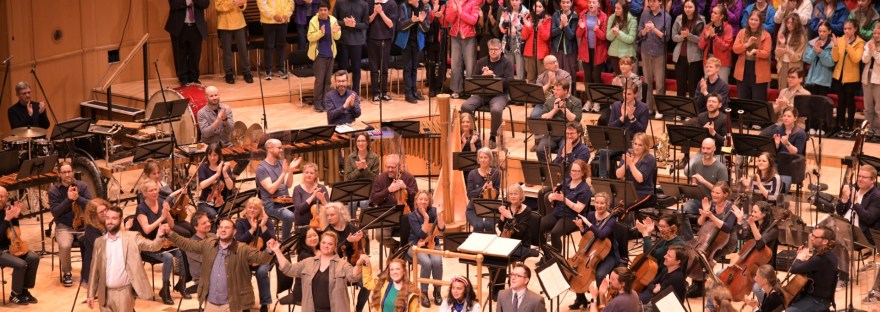
The RSNO chorus and Chorus Academy also play a major part in the action – again, not just singing, but becoming objectors, supporters, construction workers and a police squad. The RSNO orchestra, for once not in penguin suits, was magnificent, filling the Usher Hall with a rich and melodious tapestry of sound, creating a magically shifting atmosphere in which all the action takes place. Holding this all together was conductor Ellie Slorach – watching her incredibly dynamic conducting style made me think that singing or playing under her baton must be such FUN!
Riding on this sea of glorious music are the soloists. Rhys Batt as the creepy doctor wanting to use electric shock treatment to ‘cure’ Lola and Edwin Kaye as the peacocking Mayor who regards Lola’s protest as ‘a blight on our lovely town’ make the most of their roles. Edwin Kaye returns as Quercus, the mighty oak tree which presides over the forest whose inhabitants try in turn to show Lola’s mum how essential each of them is to the health and survival of the forest.
And then there’s the Green family… Mum Angela is brilliantly played by Madeleine Shaw – it’s really hard to like her at all, as her beliefs and attitudes are so diametrically opposed to mine – but she’s magnificent in her self-absorption and conviction that she’s doing the best for her family, even in the face of the disasters unleashed by the destruction of the forest. Judith Lozano Rolong was slightly overshadowed by her overbearing mother, but gave a good performance as the older sister, initially hostile and jealous of her ‘attention-seeking’ sister, but slowly changing her views and siding strongly with Lola.
Marcus Farnsworth’s subservience to his wife’s strength of conviction, his pride in her success, are slowly replaced by a growing admiration for his younger daughter’s courage and determination. At first convinced that Lola will soon see sense if the family are nice nice nice to her, he is very uncomfortable with the proposed electric shock treatment; he is amazed at the way Lola’s schoolmates begin to listen to her and join in her passionate protest; at the end, he is really sorry for what he and humanity have done to the world.
And then there’s Ffion Edwards. There really aren’t enough superlatives to describe her performance as Lola – the anguish which drives her to protest in the first place; the courage with which she continues in the face of determined opposition; the depression which hits her when she feels so alone and getting nowhere; the energy with which she responds to those people who begin to support her; the flaming passion with which she encourages those supporters and leads them to emulate young people like Greta Thunberg and the other young climate activists who are brought before us by members of the young choruses – all this pours out from her clear bright soprano which soars over the rest of the cast and inspires us to believe in her and hope that she, and others like her, will succeed in making humanity see sense and work to save, rather than destroy, the planet on which we live.
Uprising is a breathtakingly brilliant piece. It would be so easy to write a piece of gloom and doom, and leave us all thoroughly depressed – but Jonathan Dove and librettist April De Angelis offer us the hopeful prospect of rewilding, regrowth, if humans stand back and let nature repopulate the areas devastated by a blind and uncaring human race. I wish that all world leaders and heads of multinational corporations would have to attend a performance…
We want our dream – Nature first. You can join us or you can leave. Which will you choose?
Jonathan Dove, Uprising,Royal Scottish National Orchestra, Usher Hall, Edinburgh – Run Ended




 ScotsGay Arts