Mary Woodward Review

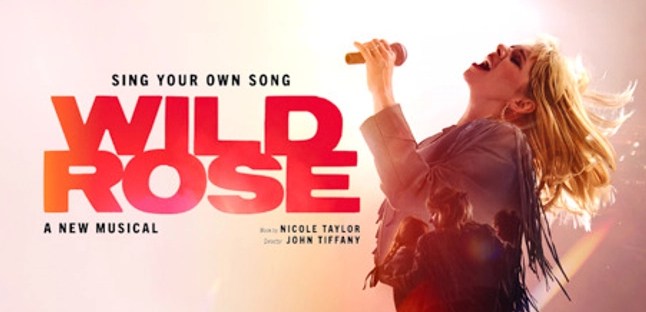
Wild Rose, Royal Lyceum Theatre, Edinburgh, Review

***** (5 stars)

“Stupendous!  Stunning! Simply not to be missed”

I’ve not seen the film on which this musical is based – which meant the full force of the drama, the emotions, and the music hit me full force and left me virtually breathless and grasping for superlatives with which to describe this tour de force which had the entire audience on its feet at the end, stamping, shouting, cheering, and applauding so wildly it’s a wonder people’s hands didn’t drop off…

In essence, the story is simple: Rose-Lynn Harlan is a young Glaswegian woman whose passion is for country music.  She dreams of going to Nashville, Tennessee, and singing her heart out: her reality is somewhat different.  A first drug-related offence has landed her a year’s prison sentence, meaning her mum has to look after Rose-Lynn’s two children, Wynona and Lyle.  Released from prison, she finds that the world has moved on, and it doesn’t seem as if there’s a place for her in it.  Her place at Glasgow’s Grand Ole Opry has been filled by a long-haired, fairly talentless man (“but at least he’s reliable”); she hasn’t a home or a job; and her children really don’t want to know her – they used to be close, have fun together, but now they just want to stay with Gran.  She is desperate to sing – but is she prepared to give up everything else in her life in order to do this?

Wild Rose is a fabulous ensemble piece, with a large cast enthusiastically providing the ever-changing and challenging world in which Rose finds herself.  Clever use of backdrops rapidly establishes the scene; furniture and props are part of a complex ballet of scene-changes, and Rose’s frequently-changing outfits are brought to and taken from her with impressively understated but brilliantly worked-out choreography.  The ensemble players turn themselves from prisoners to Opry-goers to travellers on public transport; briefly step into the spotlight to play a brilliantly-observed individual and step back to take yet another part in the kaleidoscope of humanity in which Rose struggles to find herself and her family.

The story is a vehicle for a virtually unending stream of country songs, with the exceptionally talented band of eight musicians led by Ali Roocroft at the rear of the stage providing a powerhouse of music and backing vocals throughout the night.  Everyone in the cast is extremely good – but oh my goodness what an exceptionally powerful performance comes from Dawn Sievewright as Rose-Lynn.   Her voice is the most wonderful instrument with which she expresses every nuance of the bottled-up and conflicting emotions struggling for release: her acting is incomparable – she simply is Rose-Lynn, driven to sing and at the same time shredded by her need for the love that only her family can provide.

The energy crackling and bubbling throughout Wild Rose reminds me of Glasgow Girls – another celebration of Glaswegians’ indomitable spirit.  A feisty people who will not be squashed but speak out loudly, fearlessly, and without any attempt to soften or sanitise their utterances – here they are again, lovingly portrayed on stage: and the most outspoken, gallus, wonderful one of them all is Rose-Lynn Harlan, whose closing song finally pours out everything she’s been trying to say all her life.

I could spend many hundreds, or even thousands, more words trying to capture the magic of Wild Rose.  I’ll spare you, and just say this is one of the best things I’ve seen on stage in a very long while, and you’d be extremely foolish to miss it.  Go and get your ticket now!

Wild Rose, Royal Lyceum Theatre, Edinburgh, Runs until Saturday 19th April for more information and tickets go to: Wild Rose | Royal Lyceum Theatre Edinburgh

Mary Woodward Review

Chiara Trio, The Brunton at Northesk, Review

***** (5 stars)

“Delightful and Passionate”

Yik Liang Soo, Khalil Johnson and Elze Fedorcovaite are the Chiara trio, who made their first visit to Northesk parish church as part of the ‘Music at the Brunton’ series.  ‘Chiara’ is Italian for ‘clear’: on a lovely sunny day the trio brought their clear, strong, and equal voices to their performance of trios by Haydn and Dvòrăk.

I’m more familiar with Haydn’s string quartets, which are delightful and encompass the full range of emotions – frequently sunny and joyful, occasionally moving into ‘the darker side of things’ but never really hitting the depths of anguish.  This G minor trio was written in 1794, when Haydn was 61: its jaunty start had an underlying melancholy – a cloudier day with occasional gleams of sunshine.  As the piece went on, I was aware of the constant visual communication between the three players – and, increasingly, the subservient part the cello was playing while the violin and piano took turns to shine…  Asked about this afterwards, cellist Khalil Johnson said ‘yes, but I’m really the important one – the rhythm section on which the other two build’ – and that’s very true! 

The Dvòrăk F minor trio is a considerably more substantial piece, with some fascinating key changes.  It begins and ends in F minor, with a move to the relative major, Ab – but the second movement is in C# minor – a slightly off-the-wall choice, but a most interesting one.  Written after the composer’s ‘Slavonic’ period, in which he used many folk tunes, and before the famous ‘Dumky’ trio, this is a dark, dramatic and powerful piece, possibly reflecting the composer’s emotions following his mother’s death.

Here the three musicians put their hearts and souls into the music, pouring out passionate, fluctuating emotions which tumbled and soared and wove around each other.  Rising and falling, dramatic outbursts alternated with tranquil moments and gleams of sunshine in the turbulent storms.  Elze’s piano rippled and thundered, Yik’s violin soared and wept, Khalil’s cello rumbled and grumbled and then burst out into gloriously clear and noble melodies.  There was no subservience here – each voice had its turn to shine in the spotlight and then dance with the others in an unending conversation with occasional gleams of sunshine on the crests of waves in a dark and stormy sea.

This magnificent performance was greeted with a veritable storm of applause, richly deserved, and prolonged – we really didn’t want these three immensely talented youngsters to leave us.  Our reward came with the perfect encore – a delicate, sunny, slightly cheeky fun bagatelle by English composer Frank Bridge.  It was a joy to see three friends having such fun together – I really do hope they return to Musselburgh very very soon!

Chiara Trio, The Brunton at Northesk,, Run Ended

Mary Woodward Review

Music at the Brunton: Maxwell Quartet – Bridging East Lothian, Northesk Parish Church, Musselburgh, Review

***** (5 stars)

“A Fabulous Exploration”

I’d booked for this concert by the Maxwell Quartet, looking forward to an evening of classical string quartet music interspersed with a little traditional Scottish music.

During Thursday I received an email saying that the quartet’s violinist Colin Scobie was unwell.  Someone else would be stepping in at short notice and so the programme would include rather more traditional music than originally planned.

I arrived at the church, rejoicing yet again in the prospect of sitting close to the musicians and listening to intimate music in a building with a wonderful acoustic.  The quartet came on stage and a very laid-back performance began.  Cellist Duncan Strachan began by welcoming us to the church and introducing Scott Bryant to us, thanking him for being available at extremely short notice.  Throughout the evening it was impossible to believe that Scott had only had less than 24 hours to prepare – you would have thought he was an integral and long-standing part of the group.

We were treated to a wonderful mixture of Scottish traditional music arranged by the quartet themselves, who took it in turn to tell us what we would hear next and a little bit about some of the pieces.  The Maxwells have taken their music to many schools in the area as part of their project Bridging East Lothian, and I’m sure were as well-received as they were here.  In homage to the locality, they included As I cam in by Fisher Row, after which we had a whistle-stop tour of Scotland [and a brief foray over the water to Ireland] with a glorious mixture of reels, jigs and laments and a wonderfully cheeky [but noble] pipe march.

Violinist George Smith and violist Elliot Perks took turns with Duncan and Scott introducing the music.  As well as telling us where the tunes were from we were treated to some fine tales.  Macintosh’s  Lament dates from the 1500s, a song sung by a grieving widow whose husband, in trying to nullify a prophecy, dies tragically on his way home from the wedding.   Fr John McMillan of Barra, a friendly giant of a man, hirpled gaily around the island and disappeared into the distance.  Haripol, one of the fictitious estates in the novels John MacNab by John Buchan and Andreew Greig’s ‘spin-off’  Return of John NacNab was celebrated in a fast and furious dance as three friends rushed across Scotland trying to poach a salmon, a brace of grouse and a deer without getting caught.   The long-running feud between the Campbells and the McGregors included a Romeo and Juliet-style tragedy: McGregor’s Lament bewails the plight of the young woman whose lover is beheaded by her angry family.

In all this music, the four musicians were clearly loving playing together, relishing the conversation they were having, and delighting in the music which three of them have been playing since they were young.  The jigs and reels had many of us tapping our feet, nodding our heads, and relishing the lively rhythms – had we not been sitting in pews, surely some of us would have got up to dance…  The arrangements were superb, widely varied and perfectly expressing the emotions of the widely-differing tunes – a clear invitation to investigate further the magnificent treasure that is Scotland’s traditional music.

The final piece, Hector the hero, was quieter; a fitting end to the concert which was greeted with that true silence of appreciation which is better than any amount of thunderous applause.  There was, of course, loud applause – and most especially for Scott Bryant’s superb playing – as I’ve said, you’d never have known he had less than a day to learn all the music.

We were thanked for coming, and invited both to the Maxwell’s next concert at the Corn Exchange in Haddington in April, and if we had time, to hang around and chat with the quartet after the performance.   I took them up on the offer and was delighted to spend some time with their violist, Englishman Elliott Perks.  He had remarked during the evening on the crash course in Scottish history and traditional music he’d undertaken after joining the quartet, and I had a wide-ranging conversation with him, starting with wondering about the reasons for the difference between Scottish and English folk music.  I’d spent my youth singing and playing English and American-English folk songs [and lived in the south of England] – moving to Scotland and experiencing the much wilder landscape and learning history from the Scottish perspective sheds much light on why and how the differences have arisen.

A brilliant evening!  I’m sorry that Colin Scobie was unwell and hope that he’s better soon – but at the same time I’m so glad that circumstances dictated the change of programme and brought us such a fabulous exploration of Scottish traditional music.  Rock on the next Maxwell’s concert, whatever the programme !!

Music at the Brunton: Maxwell Quartet – Bridging East Lothian, Northesk Parish Church, Musselburgh, RUN ENDED

Mary Woodward Review

Film: A Complete Unknown, The Brunton at Loretto Theatre, Musselburgh

***** (5 stars)

“Simply Phenomenal

Oh the joy of having a cinema in Musselburgh!  Since the closure of the Brunton itself, due to the ‘wrong kind of concrete’, the little theatre on Loretto school’s campus has been serving as a replacement cinema and theatre for many of the Brunton’s events.  I was delighted to go there last night to see the Bob Dylan film, A complete unknown – and also delighted to be treated by my companion to a drink from the well-stocked fridges in the theatre’s foyer.

The film itself was fascinating.  As someone who grew up in that era, learned to play the guitar and spent many many hours singing folk songs with my friends Frances and Christina, I was instantly transported back in time: it was with difficulty at times that I refrained from joining in the so-very-familiar songs….

Having learned that my guitar style needed to be pretty simple if I were to be able to remember the 22 verses of Matty Groves in the right order, I was transfixed by Timothee Chalamet’s guitar-playing.  Apparently this is an accurate representation of Dylan’s unique and complex style – and Chalamet also plays the harmonica and sings [and speaks] with Dylan’s accent and intonation, all of which are instantly recognisable.  ‘Amazing’ doesn’t do the actor justice – he’s simply phenomenal!

The narrative is not particularly accurate in its details, but the film does a brilliant job of portraying life in the mid-60s.  The growth of the folk movement, protesting the way things were and calling for change; the astonishingly rapid rise to the very heights of this completely unknown young man who was only nineteen when he met Pete Seeger; the very casual nature of life and relationships within the youth of the day; the contrast and conflict between the ‘old guard’ folk purists and those who wanted the music to move into the 20th century; the pressure on Dylan of the demands of both the public and the record companies and financial backers; the incredible self-absorption and self-belief which drove Dylan continually to move forward and change his style as he sought to express what he wanted to say; and above all the sheer genius of his song-writing; all these come over so clearly and make for a marvellous evening out.

All this joy – and then a short walk home instead of a long walk, a long wait, and a long bus journey back out of town: what’s not to love about ‘the Brunton cinema’ in Musselburgh?!

Film: A Complete Unknown, The Brunton at Loretto Theatre, Musselburgh, Run Ended

Mary Woodward Review

Lust & Laughter, National Opera Studio at Scottish Opera, Theatre Royal, Glasgow, Review

**** (4 stars)

Immensely satisfying”

I always look forward to these evenings and, as usual, was not disappointed.  Eleven young singers who are currently part of the National Opera Studio offered us an evening’s entertainment which clearly demonstrated why they have been selected to further their studies at the Studio.  Accompanied by the Scottish Opera Orchestra, conducted by Stuart Stratford, they wove excerpts from eight different operas into a multi-faceted and strongly contrasting tapestry of emotions.

Humperdinck, Verdi, Massenet, Weber, Mozart, Nicolai, Bologne and Mascagni – what a feast!  I knew half the pieces well, have sung in a couple of them, and enjoyed guessing what the others were [too dark to read my programme]…  Comedy, tragedy, menace, rapturous newly-found love: this evening had it all, in spades.

One of the joys of the evening was watching the singers tackle different roles and languages.  I think the greatest surprise was realising that the slouching, grumpy young Hansel being teased by his sister Gretel had transformed into slinky, sparkly-clad Dorabella in the magnificent sextet from Così – magic indeed from Nancy Holt.  Menace was present throughout the evening in the form of Russian baritone Egor Sergeev – tall, slender, swishing around in a black leather coat, and with a voice of power and quality that fitted equally well the threatening Don Carlo [Ernani] and the scheming, world-weary Don Alfonso of Così.

More plotting – somewhat kindlier in nature, I feel – from the Merry Wives of Windsor gave the spotlight to Rachel McLean and Sarah Winn.  Interestingly, I didn’t connect Rachel with her earlier performance as Elvira in Ernani.  Her Mistress Ford was a world away from the frightened but defiant defender of her bandit lover: full of self-confidence in her own power, most definitely not a victim, but someone who was going thoroughly to enjoy playing tricks on the ageing knight Sir John.  Her partner in crime, Sarah Winn, entered with gusto into the plotting – again a huge contrast with her previous appearance as the suddenly love-struck Prince Charmant, rendered virtually speechless by the sudden appearance of his Cendrillon.

Cendrillon herself [Ana-Carmen Balestra] – quiet, gentle and thrilled by the magical situation in which she finds herself – transformed into the volatile and quick-witted maid Despina, willing foil to the scheming Don Alfonso in Così: and then again into the hesitant, questioning Léontine from a piece new to me.  Joseph Bologne, Chevalier de Saint-Georges composed L’amant anonyme to a libretto by Desfontaines-Lavallée which had me guessing Rameau, Lully, or some such French composer.  Not having read the synopsis, I couldn’t quite get why our heroine was vacillating so regularly between hope and despair before being persuaded by all and sundry to accept as genuine the protestations of love from tenor Emyr Lloyd Jones, but I thoroughly enjoyed their singing and was very happy that it all worked out well in the end.

Surging romantic passions were well-represented in extracts from Weber’s Der Freischütz and Mascagni’s L’amico Fritz.  The former was full of agony and foreboding, the latter with quiet rejoicing which built into ecstatic rhapsody.  Both featured soprano Olivia Rose Tringham and tenor Luvo Maranti, who each sang superbly while seeming more relaxed in the joyful realisation of their mutual love than in being fearful about the outcome of the following day’s important huntsmen’s shooting match.

Ceferina Penny was a lively young Gretel, skipping and dancing around the stage and hopping on to a long table at every opportunity.  A lesser role as Äanchen in Der Freischütz had her displaying further gymnastic prowess on a ridiculously high ladder the other side of the stage.  She and Hansel were also much in evidence throughout the evening, watching the action and leading/ urging the other singers on and off stage.

Two more singers completed our talented cast: soprano Moloko Letsoalo and baritone Aleksander Kaczuk-Jagielnik.  Moloko’s Fiodiligi and Aleksander’s Guglielmo had superb voices, but were not well-served in the sextet from Così: the rest of the cast had appeared at the back of the stage and engaged in a repetitive ‘dance’ which upstaged the singers and completely distracted my attention from them – to m,e the only real disappointment of the evening.  Moloko’s soprano soared above the ensemble, but had only a tiny part in the Mascagni.  Aleksander’s warm baritone was less easy to hear in the sextet, and the other two small parts he played didn’t give him much chance to shine – a great pity.

Overall, though, it was a splendid evening, with the different extracts being cleverly linked, with the cast displaying considerable physical aptitude alongside their superb voices.  Some roles and languages were a better fit for some voices and personalities – all were extremely well performed, and augur well for the future of opera both in Scotland and the wider world.

Lust and laughter indeed, but also longing, lamentation, and of course, love: another immensely satisfying evening with Scottish Opera and the National Opera Studio.

Lust & Laughter, National Opera Studio at Scottish Opera, Theatre Royal, Glasgow, RUN ENDED