Mary Woodward Review

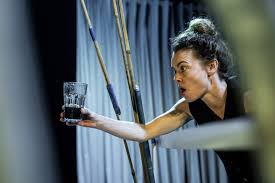
Pride and Prejudice (sort of), Festival Theatre, Edinburgh, Review: 

***** (5 stars) 

“Continues to thrill and enthrall” 

Nearly ten years since its first appearance at the Tron in Glasgow, Pride and Prejudice (sort of) continues to thrill and enthrall audiences everywhere.  [Even in London, where it picked up some awards… ]  

I’m in the happy position of having seen the show before lockdown, and several times since.  In a way, I envy the people in the audience for whom it was their first time – the thrill, the shock, the delight of encountering this cast of wonderfully witty wisecracking women.  In the interval I overheard a young woman say to her friend “I can’t work out what’s going on – I’ll have to read the book”… 

And what a book!  Jane Austen’s Pride & Prejudice definitely deserves its place at the top of the romcom list – and again, I must envy anyone who’s encountering it for the first time.  Isobel McArthur was one in 2018, when she was asked by the Tron’s artistic director, Andy Arnold, to come up with ‘a re-staged classis’ for the main slot in his summer programme.  We must all be profoundly grateful that she picked P&P… 

The cunning thing about being a playwright and actor is that you can write yourself a stunning part.  In this case, McArthur wrote not one but two – combining the roles of Mrs Bennett and Fitzwilliam Darcy gave her the opportunity to shine as two supremely contrasting characters: the empty-headed, irrepressibly voluble husband-hunting mother and the deeply thoughtful, emotionally repressed wealthy landowner.  The other members of the cast need to show equal talent in character- and costume-switching at the drop of a hat: all in all, it’s a marvellous construction of an admiring homage to a masterly storyteller. 

The basic plot line – Mrs Bennett needs to find husbands for her five daughters.  In an age where women are dependent on men for their livelihood, the Bennett family will lose their home and income when Mr Bennett dies.  The only solution is marriage to rich men – at least one daughter must oblige, in order to provide for her sisters and widowed mother.  Charles Bingley rents one of the big houses in the area, and immediately becomes a target.  His friend, Fitzwilliam Darcy, is much richer, and therefore even more desirable – until his reserved manner and unfriendly behaviour turn the neighbourhood against him.  Jane, the eldest Bennett girl, is instantly drawn to Bingley: her next sister down, Elizabeth, is slighted by Darcy at a ball and conceives an instant dislike for him.  The younger sisters, Mary, Kitty, and Lydia, do their level best to complicate the plot while displaying how unbelievably silly they are.  Can the course of true love ever run smooth, given the obstacles it has to overcome? 

Isobel McArthur chooses to tell this story from the viewpoint of the servants in the households in which the action takes place.  Rarely mentioned in the novel, they are fundamental to every action of the main protagonists, who would have nothing to eat, nothing to wear, and nowhere clean to sit without them.  These servants give a running commentary on their lives while acting out what they observe in the course of the work – and this is where the incredible shapeshifting occurs…   

Basic white smocks and black boots form the basis of all the costumes [the yellow rubber gloves are discarded].  A [generally brightly-coloured] overdress or swirling coat enables the transformation.  A cast of five actors means an amazing amount of incredibly quick offstage [and in at least one case on-stage] changes: the accents and manners change equally swiftly, and leave me, as always, amazed at the complexity of the choreography and person-ography – do they never get confused as to who they are now?? 

This alone would be sufficient to make this show outstanding.  Add to this a wonderful crafting of dialogue, some authentic Austen and some very much McArthur, and you have a play that has you laughing from the get-go.  And it doesn’t stop there.  A musical score that is by turns witty and enchanting gives the cast the opportunity to let rip vocally in a succession of songs that perfectly encapsulate each significant moment in the drama.  Will you still love me tomorrow?, Where have all the good men gone?, I need a hero, my favourite of all You’re so vain, and many, many more showcase the musical talents of four of the cast.  Much is made of the fact that Mary should never be allowed to sing in public – so when she finally gets to strut her stuff at the close of the show, the whole audience cheers. 

And these cheers and laughter accompany the whole show.  We are engaged right from the start, and forget [as do the servants] that they are merely observers of the action and have to return to their subservient roles when the party is over – the clearing up has to be done, and this is their mind-numbingly dull life.  No wonder they make the most of every opportunity to observe the goings-on of their employers, and find fun wherever they can. 

Favourite moments?  So many…  the dumpster episode; the entrance of Lady Catherine and Mr Collins’s doing the splits; Darcy’s silent, lovestruck stares; Charlotte Lucas’s poignantly hopeless longing; Mr Bennett’s total silence; Wickham and Darcy’s ability to command the heavens and create instant starlight with the click of their fingers; and so many more I can’t list them all.  Caroline Bingley’s incomparable self-absorbed rudeness.  Elizabeth’s wonderful outburst of rage at Darcy’s proposal. Darcy’s moveable portrait.  My utter delight at hearing Darcy’s confession of being in love with Elizabeth before he’d realised it, reproduced verbatim from the novel, was perhaps the best moment of all. 

Throughout all this marvellously master-minded mayhem, the cast move with sublime ease and joyful exuberance.  It would appear that they’d been acting together for ever – but last night, understudy Isobel Donkin went on for Emma Rose Creaner, and looked as though she’d been playing her characters from the beginning of the run.  Eleanor Kane, Rhianna McGreevy, Naomi Preston Law and Christine Steel completed the line up of five insanely talented, exuberant, super-energetic firecrackers, who simply have a ball on stage, and are all actors to keep a keen eye out for in future. 

If you’ve never seen Pride and Prejudice (sort of), don’t delay – get a ticket today!  You’ll laugh till you cry, you’ll be lifted out of any blues you might be feeling, and leave the theatre with a spring in your step.  It’s even possible that you, like me will become an ardent fan, hardly able to wait for the next opportunity to get your fix of Jane As You May Never Have Seen Her Before.  Aberdeen, you’re in for a treat next week! 

Pride and Prejudice (sort of), Festival Theatre, Edinburgh, runs until Saturday 26th April for more information go to: https://www.capitaltheatres.com/whats-on/all-shows/pride-and-prejudice-sort-of/2414 

TOUR CONTINUES 

Mary Woodward Review

Through the Shortbread Tin,Scottish Storytelling Centre, Edinburgh, review

**** (4 stars)

“Spellbinding!”

Imagine the stage – dominated by a huge rock set in front of a misty Highland landscape, atop of which the Monarch of the Glen proudly stands.  A giant thistle sprouts in the background, an enormous shortbread finger hovers above us, and a ‘jolly Scottish tune’ is perhaps designed to entice us to partake in ceilidh.  On to this stage strides a tartan-clad, bewigged figure accompanied by a woman in a long brown dress with a matching plaid stole over it.  We’re in Scotland, then, eh?

Martin O’Connor and Catherine King hold us spellbound as, with the assistance of Josie Duncan, Claire Frances MacNeil and Mairi Morrison, we are presented with interweaving narratives that invite and challenge us to ponder the nature of identity, language, culture, history, communication, myth, truth,  and the fact that it takes a lot ae imagination tae tell a true story…

Martin’s story starts with the ‘discovery’ in 1760 by James Macpherson of the long-lost fragments of Gaelic poetry composed by the third-century blind bard Ossian.  In what he called “the first Outlander effect”, these poems became all the rage in continental Europe, inspiring art and music, feeding into the development of the ‘Romantic’ period, and leading Napoleon to label Ossian his favourite poet.  The English, who by now had taken over Scotland and were doing their best to suppress each and every manifestation of Scottish culture, scornfully dismissed the poems – they must be a forgery, because how could these northern savages ever have produced such amazing works?

Were the works of Ossian real, or a very clever con?  Are they a part of Scotland’s history, or the invention of someone trying to write about what it ought to have been?  Martin was led to look at his own life and the total vacuum where a knowledge of Scotland’s story should have been.  When he was ten, his granda came from the isle of Lewis to live with him and his mum.  Until then, he was unaware that his mum spoke Gaelic, the only  language his granda had.   Martin must ‘get ahead’ and learn only to speak ‘properly’ [ie English] – so he could only talk with his granda via his mum, which limited communication…

The narrative is mainly in Scots, the songs weaving their way around and through this are in Gaelic.  Catherine is signing both, together with the occasional bit of English.  How does it feel to be speaking and understanding the least-used of the three languages in use tonight?  I feel blessed that twenty years’ residence in Scotland has enabled me to [mostly] grasp what’s said in Scots, but my Gaelic is non-existent [and, unlike Netflix, there are no subtitles].  How much am I missing by my lack of understanding – I can try to guess what the songs are about, but I could be wildly wrong – just as I could be if I watched K-drama without the subtitles.  How much are history, culture, and sense of identity bound up with language, how can they be understood from an outsider’s position of ignorance?  How arrogant to assume that something we don’t understand is necessarily of less value than our mother tongue, our learned way of doing things?  How isolating, how demoralising to feel that we are not understood, however hard we try to express ourselves, and that our history and culture are of less importance than that of the dominant power in the land.

It’s a brilliant script.  It’s a superb performance from all five artists.  The choreography is intricate and always an essential part of the drama.  The music is incredible.  The words tumble and spill and go round in circles, laughing, punning, crying, needling, scorning, challenging, revealing and obscuring meaning, showing the complexity of language and all its associations, assumptions and unvoiced undertones. Above all, they underline the importance, the life-enhancing essential nature of SPEAKING and, just as vital, of HEARING AND UNDERSTANDING WHAT IS SAID – not just nodding and smiling in incomprehension.  Communication requires effort on the part of both speaker and listener.

What a world is contained in a journey through a shortbread tin…

National Theatre of Scotland: Through the Shortbread Tin, Scottish Storytelling Centre, Edinburgh, Run ended but Scottish Tour continues. For more information and tickets go to: Through the Shortbread Tin | National Theatre of Scotland

Mary Woodward Review

Matthew Bourne’s Swan Lake, Festival Theatre, Edinburgh, Review:

**** (5 stars)

“Deeply Impressive

Is it really thirty years since Matthew Bourne’s Swan Lake rocked the world of classical ballet and brought joy to the hearts of the rainbow community by showing that same-sex love was deep and real and passionate and just as right and as valid as that between heterosexuals?  Goodness me: I wasn’t young even then, and am now thirty years older – and still this ballet has the power to move me deeply as I become completely immersed in its magical, painful, realistic and fantastical world.

A prince is unhappily trapped in a stiflingly conventional household in which everything takes place with mechanical, almost robotic, military-style precision.  There is no room for such messy things as feelings – dear me, no!  The prince’s mother is tightly wrapped in magnificent robes – even her incredibly flowing white satin dressing gown seems stiffly starched and speaks of ironclad self-control [though she is not averse to encouraging the respectful attentions of uniformed lackeys].  The nearest she gets to showing any signs of humanity or affection is stretching out a hand towards – but never touching – her son, even when he is writhing in agonies of despair and loneliness.  He dreams of escape, of wild swans erupting into his bedroom, but wakes to the intricately synchronised routine of allowing himself to be washed and dressed and accompanying his mother to any number of state visits, openings, and appearances…

An encounter with a seemingly brainless blonde bimbo appears to offer him an opportunity to experience human affection – but between them, the Queen and the mysterious Private Secretary [undoubtedly a close relation of Machiavelli] put paid to that.  A disastrous visit to the [hysterically funny ‘old style’] ballet is followed by a most unhappy experience in a nightclub, after which the young prince finds himself on the edge of a lake, seriously contemplating throwing himself into it.

And this is where the magic begins… Swans, swans, and yet more swans appear: virile, masculine, full of energy and power, and the biggest and strongest of them all is mesmerisingly attractive.  A tentative, wordless conversation begins; the strength of feeling between them grows, and culminates in the Prince’s first ever experience of real love.  No wonder he feels on top of the world and spontaneously kisses the old woman who comes to feed bread to the birds in the park!

At a ball at the palace, princesses try to attract the Prince’s attention – he does his duty by them but is clearly not interested.  He’s more concerned about his mother’s behaviour, especially when a startlingly attractive tall dark Stranger appears.  There’s something very familiar about him, and the Prince is heartbroken when his approaches are rejected while the Stranger pays attention to the princesses and even the Queen.  Suddenly there’s a gun in the Prince’s hand: a shot is fired and someone falls dead.  The Prince collapses and is carried out as paparazzi rush to capture shots of the spectacle.

The Prince is incarcerated in ‘hospital’.  Horrifying mechanical attempts at ‘treatment’ and ‘healing’ are attempted, while the Queen is unable even to pat her son’s shoulder sympathetically.  She really just wants him to pull himself together and act as a true royal should…. Back in his bed, the Prince curls into a tiny ball.  Swans emerge all around him.  His own special Swan appears, wounded: the others attack him while the prince reaches out for him in despair – to no avail.  The swan is gone, the Prince is desolate: his horrified mother comes into the room to find him dead.  She can’t see above the bed her son, curled round the Swan’s neck – the lovers united in death.

The superbly synchronised, multi-layered choreography of the first scene always has me wishing I could watch it again and again – so much is going on all at once that it’s impossible to comprehend it all.  The ballet in the following scene is so cringingly awful, it’s a miracle that the performers are able to keep their faces straight as they demonstrate all the ‘qualities’ that give classical ballet so bad a name – vapid arm-waving and posturing; ridiculously passionless and feeble attempts at storytelling; all the worst cliches you can imagine… such a strong contrast to Matthew Bourne’s clear, clean, straight storytelling in which every glance, every tiny movement or gesture speaks volumes.

The costumes in the nightclub and at the ball – the use of black almost throughout with the shocking pink of the Girlfriend’s very brief dress and the striking strong red of the Queen’s ball dress – enhance the impact of these scenes.  The Prince is a very lonely figure, slender in his plain white outfit over which he dons his ‘official’ uniform of a vaguely military [or naval?] nature.  The Stranger is also clad in black, but stands out by his devil-may-care nature, in strong contrast to the repressively formal behaviour of everyone at court. 

And then there are the swans… every time I see this Swan Lake, I marvel at the close attention to detail.  Mute swans don’t ‘speak’ but they do grunt and snort and hiss – and here all these sounds are used to intensify the effect of their body language and behaviour.  They are wild, inhuman, and dangerous – even when the cygnets appear to dance to their iconic tune, they are no sweet and fluffy little creatures but strong, boisterous, and potentially as dangerous as their elders.

The entire cast are to be applauded for their performances, their many costume- and character-changes, the astonishing accuracy of their ensemble pieces, especially in the opening scene and at the night club, and for still being standing at the end of what is an intense and challengingly physical marathon.  There are many outstanding cameos, too numerous to mention. 

Fronting this impressive cast were the principals.  James Lovell’s Private Secretary got everywhere, did everything, and got up to who knows what when no-one was watching.  Katrina Lyndon’s icily formal Queen probably deserved a lot of sympathy as she wrapped herself in a mantle of ice, but was impossible to feel for, given her behaviour towards her son.  Bryony Wood’s Girlfriend was a marvel of comic timing, especially in the Royal Box at the ballet.  It was hard to tell what her true feelings were, but she didn’t deserve the fate she met. 

Rory Macleod’s Swan / Stranger double act was deeply impressive: athletic, strong, unexpectedly shy and gentle at times, and so endearing when he tenderly cradled the Prince in his wings.  But for me the outstanding performance was from Leonardo McCorkindale as the Prince – his vulnerability, the fragility of the mask he dons during his public ‘performances’: feeling things deeply even when constrained by the formalities of his royal role and constantly yearning for the affection he craved but was always denied – until he met his Swan…

Small wonder the performance was greeted by thunderous applause and a standing ovation at the final curtain.  Thirty years on, the magic is still there, and the message comes across loud and clear: love is real, and strong, and powerful, no matter who the two lovers are.  Thank you, Matthew Bourne: here’s to the next thirty years of your Swan Lake.

Matthew Bourne’s Swan Lake, Festival Theatre, Edinburgh, runs until Saturday 12th April for more information and tickets go to: Matthew Bourne’s Swan Lake

Mary Woodward Review

Bite-sized concerts at the Brunton: Lark Piano Trio, Northesk Parish Church, Review

***** (5 stars)

“Deeply Moving”

Emma Baird, Helen La Grand and Anna Michels met as postgraduate students at the Royal Conservatoire of Scotland.  I for one am profoundly grateful that they decided to join together to form the Lark Trio: today’s lunchtime performance of Tchaikovsky’s piano trio moved me deeply, and I don’t think I was the only member of the audience to be so affected.

Tchaikovsky was determined that he would never write a piano trio, said Anna in her introduction to the performance. However, the death in 1881 of his close friend and mentor, the accomplished pianist Nikolai Rubinstein, deeply affected the composer.  During the following winter he wrote this trio, subtitled à la mémoire d’un grand artiste [to the memory of a great artist] and oh my goodness, it’s an utterly incredible work.

The first of its two movements sounded to me like a lament for a lost lover.  Joy and sorrow intertwined in a journey through memories full of emotion, passionate outbursts of grief and anger, overwhelming deep sadness, moments of calm resignation and acceptance, solemn lamenting, fiery, tempestuous outbursts, small gleams of glorious sunshine and happy memories, and restrained moments made all the more poignant because of that very restraint.  Three strong, individual voices sang out in brilliant melodies, singly and together, taking turns in leading and supporting each other, pouring out a torrent of feelings that swept us all along until the final slow funeral march gradually sank into silence.

How to follow that?  With a theme and variations which some think might portray incidents from the life of Rubinstein – there’s certainly a huge amount of variety of mood, character, and feeling in this movement.  A simple melody, full of feeling and with extraordinary rhythmical character is developed into a string of variations which give each instrument a chance to show off.  The piano begins,  having great fun while the strings play pizzicato; a noble melody, reminiscent of gypsy music, is passed from violin to cello; the piano dances in its upper register while the strings provide a drone bass; a rumbunctious waltz is tossed around by all three; the piano plays monstrous chords reminiscent of Mussorgsky’s Great Gates of Kiyev from Pictures from an exhibition; a delicate muted string line is tossed between the two players while the piano ripples with arpeggios, giving us a moment of calm before a mazurka, which is both lively and very formal, played with almost military precision, allows all three musicians the opportunity really to show off.  A wonderfully lyrical serenade, throbbing with passion, led into a fast, fiery and furious finale – risoluto e con fuoco –which had all three players obviously enjoying themselves, dancing around, now frenziedly, now nimbly, building and relaxing the tension through all the keys you can think of, scampering towards what seemed must be a magnificent climax but…

The music was celebrating what must have been a glorious life – and now we remember the beloved is dead.  The music comes to a stark and solemn ending, a funeral march with sombre strings and dry, detached chords on a piano which slowly falters to silence.

We all sit, so deeply moved it’s impossible to break that silence – and then erupt into tumultuous applause, richly deserved.  What an amazing work; what superbly talented musicians; what a memorable lunchtime!

Please please please may we have the joy and privilege of hearing the Lark Trio again at the Brunton  VERY SOON.

Bite-sized concerts at the Brunton: Lark Piano Trio, Tchaikovsky piano trio in A minor Op 50, Northesk Parish Church, Run Ended

Mary Woodward Review

Uprising,Royal Scottish National Orchestra, Usher Hall, Edinburgh, Review

***** (5 stars)

“Breathtakingly brilliant”

An incredibly powerful piece, performed with passion and energy.  A vitally important message, conveyed with lyricism and hopefulness. 

A simple story, with strong overtones of the life of Greta Thunberg, and paying homage to the many young climate activists around the world who are fighting for the future of their – of our! – world.  Lola has woken up to the climate emergency: she feels she simply can’t go to school any more, but must make her protest, alone if need be.  She encounters opposition both from her family, who don’t take her concerns seriously, and from her schoolmates, who mock and deride her.  It takes guts to stand alone…

Over the course of the opera, others slowly realise the importance of what she’s trying to say, and a swelling tide of protest grows from people of all ages who begin to realise This is our time/ this is happening now/ and if we don’t stand up/ answer this call/ then who will?  No-one is coming to save us/ but us…  Her sister is the first to support her, then her father, who is full of admiration for his daughter’s strength of conviction.  Her mother is put in charge of a massive construction project – ‘improving’ a road by demolishing acres of forest: convinced that ‘progress’ must be achieved, that ‘more’ is best, and truly believing that this is all for the good of her family.  Various adults try to persuade or bully Lola into backing down, but she stands firm.

The forest is destroyed, there is nothing to hold back the surge of water which sweeps away everything in its path, leaving a desert denuded of flora and fauna.  But “this is progress”, says Lola’s mum –“don’t spoil my triumph” while others lament the deaths of the trees and the disappearance of all the birds.

Uprising is the vehicle for an outstanding performance from the RSNO Youth and Changed Voices choruses, without whom much of the drama could not have been so powerfully conveyed.  They sing as a chorus, take individual roles as part of the narrative, and throughout it represent the forest, the birds and other creatures that live in it, and the inexorable power of the tumbling, surging waters that destroy everything in their path once the forest is not there to restrain them.  Simple hand and arm movements have stunning effect: and goodness me how on earth did they manage not only to learn and perform from memory a very long and complex musical score but combine with this brilliantly simple choreography for hands, arms and bodies??  Massive credit to their directors, Patrick Barrett and Frikki Walker!

The RSNO chorus and Chorus Academy also play a major part in the action – again, not just singing, but becoming objectors, supporters, construction workers and a police squad.  The RSNO orchestra, for once not in penguin suits, was magnificent, filling the Usher Hall with a rich and melodious tapestry of sound, creating a magically shifting atmosphere in which all the action takes place.  Holding this all together was conductor Ellie Slorach – watching her incredibly dynamic conducting style made me think that singing or playing under her baton must be such FUN!

Riding on this sea of glorious music are the soloists. Rhys Batt as the creepy doctor wanting to use electric shock treatment to ‘cure’ Lola and Edwin Kaye as the peacocking Mayor who regards Lola’s protest as ‘a blight on our lovely town’ make the most of their roles.  Edwin Kaye returns as Quercus, the mighty oak tree which presides over the forest whose inhabitants try in turn to show Lola’s mum how essential each of them is to the health and survival of the forest.

And then there’s the Green family… Mum Angela is brilliantly played by Madeleine Shaw – it’s really hard to like her at all, as her beliefs and attitudes are so diametrically opposed to mine – but she’s magnificent in her self-absorption and conviction that she’s doing the best for her family, even in the face of the disasters unleashed by the destruction of the forest.  Judith Lozano Rolong was slightly overshadowed by her overbearing mother, but gave a good performance as the older sister, initially hostile and jealous of her ‘attention-seeking’ sister, but slowly changing her views and siding strongly with Lola. 

Marcus Farnsworth’s subservience to his wife’s strength of conviction, his pride in her success, are slowly replaced by a growing admiration for his younger daughter’s courage and determination.  At first convinced that Lola will soon see sense if the family are nice nice nice to her, he is very uncomfortable with the proposed electric shock treatment; he is amazed at the way Lola’s schoolmates begin to listen to her and join in her passionate protest; at the end, he is really sorry for what he and humanity have done to the world.

And then there’s Ffion Edwards.  There really aren’t enough superlatives to describe her performance as Lola – the anguish which drives her to protest in the first place; the courage with which she continues in the face of determined opposition; the depression which hits her when she feels so alone and getting nowhere; the energy with which she responds to those people who begin to support her; the flaming passion with which she encourages those supporters and leads them to emulate young people like Greta Thunberg and the other young climate activists who are brought before us by members of the young choruses – all this pours out from her clear bright soprano which soars over the rest of the cast and inspires us to believe in her and hope that she, and others like her, will succeed in making humanity see sense and work to save, rather than destroy, the planet on which we live.

Uprising is a breathtakingly brilliant piece.  It would be so easy to write a piece of gloom and doom, and leave us all thoroughly depressed – but Jonathan Dove and librettist April De Angelis offer us the hopeful prospect of rewilding, regrowth, if humans stand back and let nature repopulate the areas devastated by a blind and uncaring human race.  I wish that all world leaders and heads of multinational corporations would have to attend a performance…

We want our dream – Nature first.  You can join us or you can leave.  Which will you choose?

Jonathan Dove, Uprising,Royal Scottish National Orchestra, Usher Hall, Edinburgh – Run Ended