Mary Woodward at the Festivals

Casablanca: The Gin Joint Cut, Ghillie Dhu (Venue 410)

**** (4 stars)

Outstanding

Well, that was a trip down memory lane, alright… I’m not old enough to have seen the Bogart/Bergman film when it first came out, but for as long as I can remember it’s been a part of my life – the ultimate wartime romance ending in noble sacrifice for the good of the cause just as the two star-crossed lovers are reunited after a tragically misunderstood parting.

This is both an affectionate hommage to a classic film and a wonderfully tongue-in-cheek humorous reworking of many little moments in the original which lend themselves to other interpretations.  It’s also a splendid example of how three actors in their show can play an almost unbelievable number of parts, and in two realities – Shakespeare would have been proud of them…

Gavin Mitchell, Clare Waugh and Kevin Lennon between them do a brilliant job of playing not only all the main characters but also many bit parts, both on and off stage.  In this they are supported by a superb musician, who gets her bow but is not credited on the flyer: neither is the singer who is determined to be heard to the end of her songs despite the valiant efforts of the cast to cut her short. A pity, because they were both excellent.

Gavin Mitchell is outstanding in his rendition of Humphrey Bogart’s playing of cynical, world-weary cafe owner Rick, whose hard-bitten exterior conceals a heart of gold. Clare Waugh does a splendid job of doubling his long-lost love Ilse and the evil Major Strasse of the Gestapo.  But for me, Kevin Lennon takes the crown / wins all the laurels for his portrayals of the weak, slimy underworld crook Ugate, the charming, debonair but venal Captain Renaud and the incredibly correct, stiff-upper-lipped Vincent Laszlo, hero of the Resistance, husband of Ilse, and hope of the whole free world.

What is most admirable about this show is the skill with which the actors switch in the blink of an eye from dead straight acting, full of unspoken deep emotion and almost scarily exactly replicating the original film, to the deadpan comic interjections – the oddball film facts, the extraordinary contortions required at some points to indicate going through several rooms while manoeuvring themselves around a very small and crowded set – and the overlapping of two realities – the drama they are playing out on stage, and the interactions of the three actors playing all those parts.

We the audience are involved from the very first moments, when we are invited to join the cabaret singer in her rendition of la vie en rose.  By the time we reach the scene of the defiant singing of la Marseillaise, we are so engaged in the plot that we virtually raise the roof.

It’s amazing to me that the tension of the drama is not lost despite all the comic interventions.  We know we’re watching three actors recreate something which was in itself a creation, a pretence of real life.  The fourth wall is continuously broken.  And yet… and yet we still believe every moment of the intensely emotional exchanges, even as they are carried out with hammed up physical movements and expressions, especially from Rick, to some degree from Ilse, and virtually all the time from the many ‘lesser’ characters on stage.

Existing in two realities at the same time, we are able both to enjoy the homage to the original drama and at the same time laugh at all its absurdities, including the constant references to an injected subplot of the presence of a casting director in the house who’s looking to cast Singin’ in the Rain….

Which explains why there’s a tap dance finale to Good mornin’, good mornin’, an inflatable sofa that falls out of the wings for Rick, Ilse and Renaud to collapse onto at the end of the number, and a special round of applause for Sophie who made it happen.

No wonder the performance is greeted with a storm of applause!

Casablanca:The Gin Joint Cut, Ghillie Dhu (Venue 410) for more information go tohttps://www.edfringe.com/tickets/whats-on/casablanca-the-gin-joint-cut

Mary Woodward at the Festivals

ScotlandsFest Why do you wear what you wear?, St Columba’s by the Castle (Venue 367) Review

**** (4 stars)

An excellent hour

And now for something completely different – from the northern wastes of Scotland to the heart of the fashion industry, in the company of Scottish supermodel Eunice Olumide.   She was in conversation with Gemma Metheringham, whose linked in profile describes her as  “a circular fashion business model consultant”.

Eunice is a modern polymath, the contemporary equivalent of a ‘Renaissance man’ – Gemma’s introduction listed some of her many spheres of action and interest, which they seemed virtually endless.  Not ‘just’ a supermodel but [among other things] an actress, film maker, entrepreneur and ambassador for Zero Waste Scotland who has a postgraduate degree in film studies and an OBE.  With all that, you might be forgiven for thinking she might think rather highly of herself, but she comes across as very down to earth and grounded.  She grew up in a black family in Wester Hailes and knew what it was like to be unable to afford to buy the things that you simply had to have if you were to be at all cool.  She learned from her mother how to make the garments she wanted to wear, and in doing so learned that with the clothes she made, she could create her own unique personality.

Eunice and Gemma’s conversation ranged far and wide, but certain themes kept recurring – social isolation, the waste inherent in today’s fashion industry, and the many small actions it’s possible to do, and so find some solutions.  Eunice remains impressively hopeful, despite all the challenges facing the world today: she believes that the majority of people are inherently good, and that change is possible.  One of her favourite phrases was “we can do anything we want to do”.

Some of the things they talked about:

Bonding by making things together, creating intergenerational and cross-cultural links instead of being trapped and isolated in small monothematic social bubbles.  Growing things, cooking and sharing food together increases our sense of closeness to other people.  “Exchanges of humanity make us more happy in life”.

Create your own distinctive clothing by recycling and repurposing previously worn garments. Dispose responsibly the things you no longer wear.

Show younger people that making things is cool.  Pass on your skills, or at least write them down somewhere for when others suddenly realise they have a need for them.  Encourage young people to make things, and create new from old – “they like making things, they just don’t know that they do.” Present them with alternative ways of doing things: show them the possibilities

Cheap clothing is an expensive mistake.  Save up and buy a good pair of shoes, then create a wardrobe of your own from second-hand stuff.  [my note to self – remember the Sam Vimes Boots theory of economics – that the wealthy spend a lot less money on clothes because they buy expensive, well-made things that last, instead of continually having to pay out for cheap and shoddily-made things.]

Clothing tells stories about our identity, can bring us together intergenerationally, and could invite us to involve ourselves in geopolitics.   We are all part of the fashion industry which is failing to uphold decent standards, and whose mindset is that Growth is the only thing, all-important thing.  The clothing industry is responsible for 10% of all global emissions.  At what point will They realise that this is a mistake, that making yet another billion dollars’ profit is not the most important thing in life?  We can have an effect – not buying things sends a powerful message, to which the industry will react.

Small entrepreneurships are possible – one young man reluctantly attended one of Eunice’s workshops at the Victoria & Albert museum in London [‘men don’t belong in the fashion world’] but was inspired by the session to start up his own business buying secondhand clothes and selling them on at a profit.  There’s a vast pool of secondhand clothing out there – people buy and discard so much – that you could use it in so many creative ways, and set up your own microbusiness…

Acting together can change the world.  We can all begin with tiny steps…

What other things might help?  Some intriguing suggestions included:

Better labelling of garments – for example, showing its microfibre leakage, or the toxic microplastics content, or the toxicity of the dyes used. 

What would you do if you simply were not allowed to throw anything away?

Have a small number of good quality outfits that work all year round and wash well.

The global north spends a lot of time agonising about but failing to act on sustainability and the circular economy.  Why not listen to countries in the global south which are already doing these things?

Take time to slow down, to think, to enjoy things.  “There are so many brilliant things to do all around us, to do together”…

All in all an excellent hour, full of ideas not simply to think about, but to put into action whenever, however, and wherever we can.

ScotlandsFest Why do you wear what you wear?, St Columba’s by the Castle (Venue 367) for more information go to: https://www.edfringe.com/tickets/whats-on/scotlandsfest-why-do-you-wear-what-you-wear

Mary Woodward at the Festivals

ScotlandsFest Ghosts of the North, St Columba’s by the Castle (Venue 367) Review

**** (4 stars)

Holds her audience entranced

Janis Mackay is best known for her storytelling and her children’s books.  I well remember a show at the Scottish Storytelling Centre a few Fringes ago, which she wove around the birth of a young seal in a cottage garden by the sea in the north of Scotland.  Today Janis was at St Columba’s by the Castle to tell us about her first novel for adults – On a Northern Shore.

It all began with being offered a writer’s residency in Caithness, which was only for six months – but Janis ended up living there for five years [and a baby seal was born in her garden!].  During the residency she held workshops for all manner of local people – youth groups, groups of people with learning disabilities, lunch clubs – and also had time for her own writing.  The landscape of Caithness is challenging, and very unlike the ‘idea of Scotland’ – mountains, trees, lochs and heather.  It’s very flat, almost treeless, and very sparsely populated [the Clearances had a lot to do with that…].  Janis wrote many poems while in Caithness, and shared some with us.

This poem [included with her permission] describes it perfectly

Caithness

Is a white flag of sky

Surrendering

To wild nesting edges.

The sky is vast, arching over the lonely, mostly drab-coloured landscape.  Silence is everywhere.  The inhabitants are more closely attuned to the natural world than might be the case in urban environments, and much more aware of the incredibly thin nature of the veil separating the ‘real’, observable world from that of otherworldly magical and mythical beings.

Superstitions are a much more believable part of life here, and there is a rich heritage of myth and legend.  It’s hardly surprising that there’s a prevalence of selkie stories in the far north of Scotland and particularly the islands of Orkney.  The land and sea are at times almost indistinguishable, and for a being who can be both a seal and a woman once the sealskin is shed, slipping from one to the other is the easiest thing in the world.

Janis holds her audience entranced with her version of one of the many selkie stories that exist.  A lonely fisherman out on the sea late at night is about to row for home when he hears a voice singing.  It’s as if a fishhook has pierced his heart, drawing him towards the sound.  He reaches an island where a number of young women are dancing and singing: when he stumbles over a pile of sealskins, he realises they are silkies.  One by one they slip back into their skins and into the sea, but one can’t find her skin – the fisherman has hidden it.  He asks her to marry him, saying he’ll give her skin back in seven years’ time: but when the seven years are up, and they have a son, Ruaridh, he refuses to disclose where he’s hidden it…

The romance and poetry of such stories, and the compelling power of the stark Caithness landscape inspired Janis to write the novel, which tells the story of a lonely and isolated fisherman, Rab, who doesn’t quite believe the rituals his now-dead father insisted they perform, but feels he must do them anyway.  He’s down on the shoreline on Ne’ersday: is that a sealskin he trips over on the shore?  Is there a body tumbling in the waves?  Is he just suffering from a massive hangover? 

On a Northern Shore is described as ‘a haunted love story steeped in Celtic folklore’ which I felt drawn to buy and look forward to reading once I’ve finished reviewing all these shows!

ScotlandsFest Ghosts of the North, St Columba’s by the Castle (Venue 367) for more information go to: https://www.edfringe.com/tickets/whats-on/scotlandsfest-ghosts-of-the-north-a-gothic-love-story

Mary Woodward at the Festivals

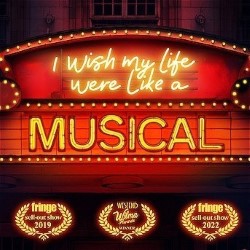
I Wish My Life Were Like A Musical!, Gilded Balloon at the Museum (Venue 64)

**** (4 stars)

“Everything a musical should be”

Oh goodness this show stirred up so many memories!

The opening number sets the tone – bright eyes and cheery smiles cover the quartet’s razor-sharp dissection of everything that can make an opening number truly appalling.  It’s greeted with such enthusiasm that it’s hard not to feel that at least fifty percent of the audience know this show by heart…

Four very talented performers – Emma Ralston, Joel Benedict, Rory Connolly and Samantha Dorsey take us on a journey through the life of an aspiring musicals performer – the thrills, the challenges, the disappointments, the highs [and lows] of stardom – in a non-stop stream of witty, punchy, satirical, whimsical, and oh-so-true-to-reality musical numbers created by the incredible Alexander S Bermange.  Aaron Renfree’s direction and choreography keep the audience engaged throughout, and designer Sorcha Corcoran and lighting designer Chris McDonnell produce a show that glitters, sparkles, and inspires us all with a desire to tread the boards and sing our hearts out.

Emma, Joel, Rory and Samantha introduce us to four young hopefuls, fresh out of music college and sure that they will instantly land a wonderfully satisfying and perfect job in a musical.  But first they have to succeed with an audition – and this is where my trip down memory lane began.  I resonated so strongly with so many of the situations: waiting what seems like forever for your turn in front of the auditioning panel; sure that you will be wonderful, that no-one else will have chosen the song you’ve picked, only to find that everyone else is singing that song too and, when you finally get on stage, the panel don’t bother to look at you and stop you before you’ve managed to sing more than a few bars.  Oh how depressingly familiar it all was!

Of course, if you don’t succeed in an audition, you could always take part in a performer’s showcase – assuming your performance isn’t scuppered by any number of things, not least the appalling quality of the piano that’s accompanying you.  And there are those who’ve maybe given up on their quest to be cast in a musical, and have turned into Superfans, whose passion for musicals takes over their entire lives. 

Should you make it on to the stage, being well aware of the many things that can mar or even ruin your performance, you need to begin with an apology – in this case, a list of ‘excuses’ so long and complex it’s a wonder the singer could make it on to the stage at all!  And then the title song – I wish my life were like a MUSICAL.  It seems as though life would be perfect: nothing would go wrong, it would be fit for a queen.   But oh dear: think of all the things that go wrong for characters in a musical – is this really what I want, after all?

Then joy of joys, you get cast!  But – now you have to learn the dance routine created by a choreographer who’s a masochist – it’s all a step too far.  You think things are looking up – you get cast in a leading role: but it’s as the understudy.  Every day living in hope, every day disappointed as your star turns up at the very last moment: is this to be your life forever, always standing by?

And that star – maybe their talent is undeniable.  Or maybe they are there simply because of their name, and the reality is that their talent is most definitely on the wane.  They love to sing, but goodness me they could give Florence Foster Jenkins a run for her money!

Then you get cast in an actual role.  An extensive period of preparation is needed each day if you are to bring your best to this role: is it really worth the effort?  Things are looking up – you are now the co-star in a romantic role: but that, too, is fraught with danger as you lead up to the dramatic/ traumatic climax of the show…   Even reaching the top of the bill, taking the starring role, so much is demanded of you – social media duties take up so much time as you let everyone know just how humble and unspoilt you are.  They also bring you the attention of equally media-savvy fans…

There are, of course, ardent fans of musicals who nonetheless have to keep this part of their lives hidden, as their friends would never dream of exposing themselves to such a frivolous art form.  And then there’s the DIVA, who makes life hell for everyone around them.

During a career in musicals, you’re going to come across any or all of these situations – you’ll either work with, or turn into, one of the awful people we’ve seen on stage this evening.  So why do it, why put yourself through all that misery?  The honest answer is it’s who I have to be – the magic, the elation of creation, the joy of performing make it all worthwhile. 

And thus the show ends.

Or does it?

Oh no, we have to have an ENCORE, which like all the other numbers is greeted with a positive storm of applause from an audience who have loved every minute of the performance and will, quite likely, be back for a repeat  performance tomorrow.

I wish my life were like a MUSICAL was everything a musical should be – bright, funny, witty, colourful, realistic, fantastical, barbed, loveable and loving.  And, as every good musical should, it sent us out into the realities of life with a spring in our steps and a song in our hearts.

I wish my life were like a MUSICAL, Gilded Balloon at the Museum (Venue 64) for more information go to: https://www.edfringe.com/tickets/whats-on/i-wish-my-life-were-like-a-musical

Mary Woodward at the Festivals

Not my grandmother’s daughter, Gilded Balloon at Appleton Tower (Venue 140) Review:

*** (3 stars)

“Heartwarming”

This show is an interesting blend of shadow puppetry, shadow play, and very personal storytelling.  Harley Brooke Walter remembers their grandmother’s influence on themself growing up, and contrasts their relationship with Harley’s one with their birth mother. 

It’s obvious from everything that they don’t say, rather than what they do, that Harley didn’t have a good parent-child relationship, but had, and still has, a brilliant one with their grandmother, whose voice we frequently hear in snippets from recorded conversations.

Harley begins by saying that they are not their grandmother’s daughter – and I guess that, biologically speaking, they are not.  What comes through over and over again is how much Harley admires Noonie’s warmth, humour, kindness: her skills with her hands, her affinity with the birds that come to her back yard, the way she faces up to and deals with difficult situations, instead of hiding from and denying them.  As one who themself ‘learned to be quiet, learned to be small, not to be an inconvenience’, they have nothing but admiration for how their grandmother found a way not to be quiet, not to be small, and to deal with, accept and move on from situations which might have destroyed a lesser woman.

Years of therapy, of introspection, and continued and continuing observation of their grandmother have enabled Harley to arrive at the realisation that they may not be technically her daughter but that this is how they want to be, how they can be if they allow themselves to be, and to let go of the connection with their birth mother and her expectations of how a daughter should be.

Harley’s show was dogged with misfortune – losing all the equipment for the show shortly before its opening, though happily being reunited with it in time for today’s performance.  Today a malfunctioning lamp [which decided to work halfway through the show] meant that she had to use a flashlight for the closeup shadow play, resulting in somewhat clumsier than usual transitions and effects. 

But there was also much to enjoy.  A hummingbird puppet which came and nestled on my hand at one point, was an unexpected delight, as was a red cardinal puppet which brought life to grandmother’s story about the red bird in her yard which didn’t fly away when she came out to put food down in her yard.  And Harley’s connection with their audience is immediate and warm: and they allow their vulnerability to shine out without in any way asking for our sympathy or pity.

What emerges in the course of the show is a heartwarming account of a lovely, loving, hospitable and strong Southern woman, through which Harley is finally able to realise they have so much in common with her that they can write a love letter to themself in the writing of this show.

Not my grandmother’s daughter, Gilded Balloon at Appleton Tower (Venue 140 for more information go to: https://www.edfringe.com/tickets/whats-on/not-my-grandmother-s-daughter