Mary Woodward at the Festivals

EIF, NFM Leopoldinum Benedetti & Sitkovsky’s tribute to Menhuin, Usher Hall, Review

***** (5 stars)

“Blissful and challenging”

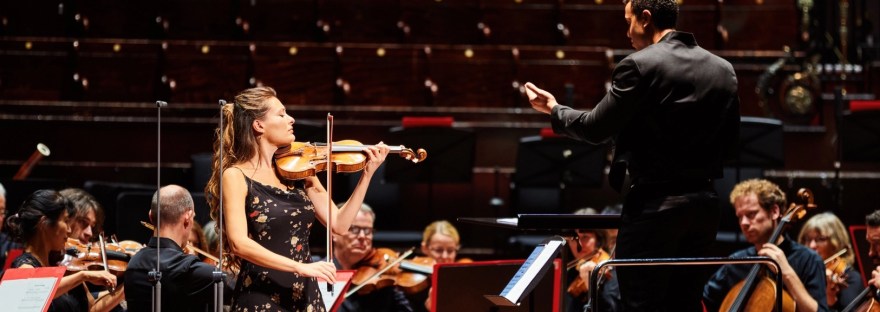
What a treat!  Blissful and challenging [for me] in equal measure, tonight’s concert by Poland’s National Forum of Music Leopoldinum string orchestra was part of this year’s Focus on Poland series.  Devised as a tribute to the great violinist and humanitarian Yehudi Menhuin, it was led by two of the Menhuin School’s many talented alumni, Festival director Nicola Benedetti and the orchestra’s Artistic Director Alexander Sitkovetsky.

Nicola came on stage to welcome us and introduce the programme and its performers to us.  She and Sasha Sitkovetsky were both pupils at the Menhuin School and had strong connections with all the pieces played tonight.   Joining the orchestra on stage for most of the programme were young musicians from the Festival’s Risings Starts of Strings.

The orchestra has no conductor – it’s led by the lead violin.  This gives a different dynamic to their playing: a collaboration, a conversation between equals, with room for inspiration and invention ‘on the hoof’’ rather than a meticulously prepared and directed performance.

Elgar’s Serenade for String Orchestra in Emi, Op 20 sounded so very English.  Its opening allegro was warm and delicate; the subsequent larghetto lush and romantically yearning; the closing allegretto had graceful, uplifting melodies dancing gently over the lower voices’ gentle skipping.

Panufnik’s Violin concerto from 1971 was from a completely different world. Sasha Sitkovetsky opened the piece with an angular solo outburst that sounded like a challenge to the orchestra before the movement built into a rich tapestry of harmonically angular sounds.  The second movement was brooding and melancholy, with the soloist regularly producing fantastically high and eerie harmonic notes before the music warmed into richness again.  The third movement was a lively helter-skelter, the soloist taunting and teasing the other musicians who responded in kind.  Angular rhythms and gypsy-like melodies, full of energy, framed a playful cadenza before everyone joined in a fast and furious finale.  I personally found this piece extremely challenging, but the whole Usher Hall audience saluted it with loud cheers and prolonged applause.

After the interval came my moments of bliss – JS Bach’s Concerto for 2 violins in D minor, BWV 1043.  Nicola and Sasha grew up playing this piece at the Menhuin School, and it’s been a part of my life and one of my two most favourite pieces in the world for as long as I can remember.  The two soloists engage in an intimate conversation, at times closely engaged, at others moving off on their own, and always as an integral part of the whole piece rather than ‘stand out’ parts over a less important backing.  It’s by turn tender, joyful, lively, fun, and utterly glorious throughout – small wonder that there was a positive storm of heartfelt applause after the final notes.

Bartòk’s Divertimento for string orchestra, Sz 113 closed the programme, and presented me with another challenge.  The opening allegro was very rhythmic with spiky harmonies, making me think of relentless machinery: there was a lot of passion, but I felt divorced from it – an observer rather than a participant.  The adagio’s dissonant melody floated over a low, almost spooky grumbling to which the violas attempted to offer a mellow consolation. The two moods’ conflict built into a rumbling discontent which ended suddenly and very uncertainly.  The closing allegro assai was lively, with a tune on which everyone agreed.  The first viola had a chance to shine before Sasha Sitkovetsky’s violin went berserk and everyone else followed.  Nicola Benedetti had a short showy solo and everyone on stage joined in a fast and furious finale which again was greeted with a positive storm of applause.

An incredible display of talent, and electrifying performance from all concerned!

EIF, NFM Leopoldinum Benedetti & Sitkovsky’s tribute to Menhuin, Usher Hall, for more information go to: https://www.eif.co.uk/events/nfm-leopoldinum-benedetti-sitkovetskys-tribute-to-menuhin

Mary Woodward at the Festivals

Africa Power: the colour of water, Music Hall at Assembly Rooms (Venue 20) Review

*** (3 stars)

“Glorious moments”

My goodness, that was LOUD!!

So loud, that I was suffering.  So loud, that what words there were to the songs were distorted beyond the possibility of my hearing.  So loud that at least some people present will inevitably suffer from hearing loss..

And the pity was that it could have been so good if they’d just reduced the sound levels a bit.

I chose this show hoping to have a pleasant hour having a window opened on a culture with which I’m not very familiar.  Alas, it didn’t quite work out like that – though I have to say that the majority of the audience seemed to enjoy themselves enormously.

The essence of the show was, I think, to highlight the importance of water.   It’s essential to all life forms on this planet: without it, very little can survive for long.  It took some elements of ancient wisdom: that people make too much noise all the time when they should rather stop and listen; and that in a time of water shortage the adorable but much-persecuted pangolin would find Bantu, the chosen one, who would lead people to a source of water.

Unfortunately, the previously mentioned noise meant it was almost impossible to distinguish any wisdom.   Much of the show was taken up by extremely good but to me somewhat uninteresting contemporary dance in which, yet again, the blokes wore baggy garments and the women’s costumes left very little indeed to the imagination.

Not my type of entertainment…

A huge screen above the stage gave us some wonderful images – animals walking slowly through virtual deserts; tropical fish swimming in crystal clear waters; jellyfish pulsing through the sea; a black and white urban landscape that morphed into a riot of colour; and gloriously jewel-bright colours flowing and merging in fabulous patterns.  Sometimes these enhanced the dance, at others they provided a welcome distraction.

There were glorious moments – particularly when a dancer with a cloak of lights wove patterns with it against a background of a night sky blazing with stars.

There was virtually a party political broadcast on behalf of the earth, outlining the damage humans are doing to it – the earth is crying out for help – and set against horrific film footage of plastic-filled oceans, lakes and rivers.  Impressive, but it was followed by another loud pop song with unrelated movements, rather than anything to enable the message to sink in or be taken to heart.

The pangolin did find Bantu, and water returned – I think: but the final lipsynched film monologue wasn’t very intelligible, and the final song was even less so.

The message was undeniably powerful, but for me the way it was put across worked against it.  A pity.  Hopefully others in the audience will have been greatly moved – there was certainly plenty of appreciative applause for most of the dance numbers and at the final curtain call.

Africa Power: the colour of water, Music Hall at Assembly Rooms (Venue 20) for more information go to https://www.edfringe.com/tickets/whats-on/africa-power-the-colour-of-water

Mary Woodward at the Festivals

The unlikely friendship of feather boy and tentacle girl, Central at Assembly Roxy (Venue 139) Review

**** (4 stars)

“Beautiful images”

They couldn’t be more unalike.  She likes slow, he likes fast; she loves the country, he the town.  She dreams of sinking into the sea, transforming into a kelpie, devouring a sailor from a passing ship [and wakes with a strange taste in her mouth].  He dreams that his shoulder blades split, wings emerge, and he rises to join the cloud of red and gold wheeling in the sky above his tenement building…

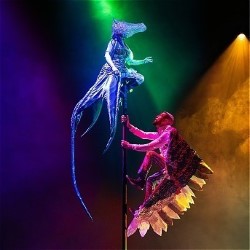
There could hardly be a more unlikely friendship than that between feather boy and tentacle girl – but a deep and enduring friendship it is, played out before us in the vast space above the stage of Assembly Roxy Central.  The show opens to our gasps as we see the two performers spotlight high above us, atop two tiny circles of metal at the top of two long poles, and the wonderment continues throughout the show.

You might be forgiven for thinking that Sadiq and Vee have wings or tentacles – or at least Velcro as an integral part of their skin.   How do you cling, many feet up in the air, to a metal pole when both arms and legs are waving gently in the breeze?  It’s even more bewildering when the two of them shin up the pole while hardly touching it, and still more so when they take off the brakes and slither down – surely they’ll crash into the floor?  But no, they just stop with exactly enough room to spare, and we can breathe again…

Simply to call this a display of aerial skills is grossly to undervalue it.  There’s so much more going on – storytelling, acrobatics, an incredible trust between two performers who quite literally hold each other’s lives in their hands.  There’s a huge sense of fun, too, as the two glide through the air, tumble on the ground, shin up and down the vertical poles, hang from a cable, or whirl round on a rotating pole,  almost faster than the eye can see… 

Vee’s kelpie suddenly grows hungry – ravenous, even – and reaches out greedily for food, getting ever nearer and nearer the audience until she rushes at us, and only Sadiq’s intervention prevents carnage.  Sadiq’s wings try to grow and he dreams of flying but can’t take off: as he crouches in terror, thinking Vee is now going to eat him – but she’s reaching out a hand to help him…. Together they battle against a tremendous wind and swirling ash or snow.  Vee gets to fly in a swirling cloud of sea foam, and Sadiq realises his dream of flying among the tumbling red and gold feathers.

There are innumerable beautiful images among the breathtaking feats of aerialism: and running all the way through the show the tangible evidence of that warm and most unlikely friendship of two very different people who yet find common ground, working together to enable each other to fly.

Today’s performance of one element of the Made in Scotland showcase was a sell-out.  The run finishes on Sunday and is selling very well.  Rush and get your tickets NOW!

The unlikely friendship of feather boy and tentacle girl, Central at Assembly Roxy (Venue 139) for more information go to : https://www.edfringe.com/tickets/whats-on/the-unlikely-friendship-of-feather-boy-and-tentacle-girl

Mary Woodward at the Festivals

EIF, Mozart La Clemenza di Tito, Usher Hall, Edinburgh, Review

***** (5 stars)

“Utterly brilliant”

Utterly brilliant and immensely satisfying, with gorgeous music and glorious singing.

Full-scale operatic productions cost ridiculous amounts of money.  It is therefore a joy that the Scottish Chamber Orchestra [SCO] under their conductor Maximilian Emelyanychev are continuing their tradition of bringing a ‘concert’ performance of a Mozart opera to the International Festival. 

At first sight, Clemenza is a full-scale, grandly public opera, with choruses of praise for the `emperor, but it’s really very intimate and focused on intently personal situations.  Love, friendship, loyalty and integrity are all challenged: and not everyone comes through the tests with flying colours.

Like many 18th century opere serie [‘serious operas’], the plot of Mozart’s La Clemenza di Tito is a tad convoluted.  Roman Emperor Titus, the merciful hero of the title, has recently parted company with the foreign princess Berenice.  Roman noblewoman Vitellia hopes to replace her at the emperor’s side.  When Tito asks Servilia to be his consort, Vitellia works on her besotted admirer, Sesto [who is Titus’s dear friend and Servilia’s brother] to lead a rebellion against his bestie.

Servilia is in love with Annio, who despairs when he learns of Tito’s proposal.  Not so Servilia, who faces up to the emperor and says her heart is already taken.  Noble Tito gladly gives his blessing to the two young lovers, and turns his attention to Vitellia, who tries to stop Sesto – she no longer wants Tito to die.  Sesto’s attempted coup fails and, as he refuses to incriminate the woman he loves, he is condemned to death by a heartbroken emperor.  Vitellia is at first lost in dreams of imperial glory but, full of remorse, has the decency to confess her part in the plot.

Noble Tito refuses to condemn anyone to death and pardons them all.  Cue general rejoicing and praise of his nobility and mercy.

All six singers were new to me, and all have superb voices: I look forward to hearing them again very soon.

Giovanni Sala, slim and elegant as the emperor Tito, had a voice that was soft and gentle as he pleaded with his friend Sesto to explain what had prompted him to attempt his murder, but whose rich, ringing tones gave his imperial pronouncements majesty and power.  Angela Brower’s Sesto was putty in the hands of the woman he loved, but riven with anguish at the thought of betraying his dearest friend and able to face his imminent death courageously.  I couldn’t help but wonder whether he and Vitellia had any future together after she confessed to masterminding the plot. 

Tara Erraught’s Vitellia was very sure of her power over Sesto.  Thirsting for vengeance – her father was the previous emperor – she had no qualms about manipulating her lover into an act of treason.  It was only later, when she realised that Sesto wasn’t going to betray her, that her conscience started to prick her.

Hera Hyesang Park was a gentle, loving Servilia, whose inner core of steel enabled her to confess her love for Annio to Tito – saying that she would still marry him, but he must know her heart was given to another.  Maria Warenberg’s Annio was superb: an ardent lover, a devoted friend to Sesto, and a loyal supporter of his emperor.  Peter Kalman didn’t have a huge amount to do, but with his magnificent voice played the elder statesman to perfection.

The SCO, led by Stephanie Gonley, were brilliant and obviously loved what they were doing.  Maximilian Emelyanychev had a ball at the harpsichord, bouncing about as he directed soloists, chorus and instrumentalists.  Hugely appreciative applause was deservedly given to the two clarinettists – Maximiliano Martin on basset clarinet and William Stafford on basset horn.  Two of the greatest arias in the opera engage the singer in a duet with one of these instruments whose melodies are an integral part of the aria.  In Sesto’s deh, per questo istante solo and Vitellia’s non piu di fiore, the instrument adds yet more expressive emotion to the singer’s words.  The SCO chorus, directed by Gregory Batsleer, made the most of their relatively short but impressive contributions and were deservedly applauded by the principals at the final ‘curtain’.

In short, it was an absolutely wonderful evening.  I’m already looking forward to next year’s SCO Mozart!

EIF, Mozart La Clemenza di Tito, Usher Hall, Edinburgh, for more information go to: https://www.eif.co.uk/events/mozarts-la-clemenza-di-tito

Mary Woodward at the Festivals

Does anyone else smell curry?  Theatre 3The Space @ Surgeons Hall (Venue 53) Review

**** (4 stars)

“Beautiful”

Kiren Virdee is getting ready for her performance as we enter – sparkly tunic and trousers, long scarf: she looks beautiful, but has to keep checking every single detail of her appearance.

Finally she’s ready to face us – but still seems to find it hard to find the words.  What does she want to say?

Does anyone else smell curry? <chuckle> repeat <chuckle> repeat <chuckle> <chuckle>.  It could be taken as an innocent comment – but is it?  Again and again, until it becomes unbearable: Kiren begins to tear at her clothes, to twist and gyrate and wrap herself into knots: finally succeeding in ripping them off, and putting on ‘western’ top and trousers…

There’s a constant soundtrack of individual remarks and comments, which slowly build up into a mosaic of voices recounting their experiences of growing up in South Asian households in Britain.  Kiren lipsynchs a lot of these – it’s both unnerving and very powerful to hear so many different voices apparently coming out of one young woman’s mouth.

I didn’t see anyone who looked like me onstage, in films or on tv.  Heroines are always white and blonde.  I never came across other gay Asians.  I didn’t see myself as a brown person.  I was five, and one of my classmates wouldn’t hold my hand – even at five, though I didn’t understand why, I knew I was different.  I’m too fat, too curvy, my face is not slim enough, I never liked my thick dark hair, my body hair was seen to make me unattractive.  All our differences were laughed at; people didn’t understand our culture.

This stream of sound goes on and on.  There are pop videos in which white people imitate Asian dance moves and gestures: stealing from the culture while not admitting the validity of the people with whom it originates.  Kiren dances, at first with a big smile on her face, but slowly the repetition of the negatives distracts her from her dancing.  Take my culture, but leave the person I want to be… 

The hurts and rejections – a tangible violence – become more and more painful, driving her to self-harm.  And all the time the frenzied whirl of efforts to conform to white standards of looks – pluck, wax, epilate, shrink: repeat: repeat: – faster and faster until she feels herself shrinking away into nothing.

More voices describe the realisation of being the only brown-skinned person in the room, or on public transport: of beginning to feel unsafe, often because of past experiences.  It’s depressing: I thought we’d solved racism years ago…

And I can’t conform to your expectations – I can’t speak Punjabi, I can’t dance the way you want me to…

What colour are we inside???

The internal conflict between the two cultures becomes increasingly exhausting.  The voices start to speak over each other, to grow louder and louder, and the tension in Kiren’s body increases – and always there is that little <chuckle>.  All those little violences don’t make you stronger: Bit by bit you’re chipped away to nothing.  Depression almost feels like self-care – have another hour in bed; you’re exhausted, have some chocolate; have the whole bar; go back to bed.  Eventually you disappear altogether.

There are many beautiful poems in this show.  The clarity of Kiren’s articulation of her feelings reminded me of the words of young poet Amanda Gordon at Joe Biden’s inauguration. 

I wish more people could come and hear this compilation of experiences of growing up feeling different, of dealing with a clash of cultures, of trying to conform to other people’s expectations…. Why is it expected that everyone coming to Britain should abandon their native culture and traditions?  Being unique in yourself can be a lonely place…

I’m glad that today’s show was a sellout, and really sorry that it was Kiren’s last one this August.  I hope Does anyone else smell curry? goes on to reach a much wider audience – sadly, in this day and age, it’s still sorely needed.

Does anyone else smell curry?  Theatre 3The Space @ Surgeons Hall (Venue 53) for more information go to https://www.edfringe.com/tickets/whats-on/does-anyone-else-smell-curry