Mary Woodward at the Festivals

The Green Knight (but it’s gay), George Mackay Brwon Library atScottish Storytelling Centre (Venue 30)

**** (4 stars)

“It’s not just gay, it’s very gay!”

I spent a delightful evening in the company of Niall and Tom, master storyteller and long-suffering musician and hater of puns, who combine to present an entertaining re-visioning of the mediaeval legend of Sir Gawain and the Green Knight.

The original tale is in many respects pretty gay already, but mostly covertly.  King Arthur is at Camelot, with his band of knights gathered at his round table for a feast to celebrate New Year’s Eve.  The king decrees that the feast can’t begin until someone tells a tale of their courageous exploits: but all are silent.  Maybe some marvel, then? 

A Green Knight, riding a green horse, enters and presents a challenge – take up my axe and strike a blow: then come to my chapel in a year and a day and I will return the blow.  Gawain takes up the challenge, lifts the axe, and cuts off the Green Knight’s head.  The Knight picks up his head and rides off, reminding Gawain of his promise to come to the Green Chapel in a year and a day…

Niall is a very good host, welcoming us to the Storytelling Centre’s Upper Room and assuring us that we would not be involved in any scary ‘audience participation’ – apart from that of the lovely Iain [whose agreement was gladly given] and whose noble efforts with the Green Giant’s head were warmly applauded.  The rest of us could sit quietly, fanning ourselves with the fans offered on our way in, or enthusiastically join in whenever we were invited to create a soundscape, or otherwise add detail to the story.

I knew the rough outline of the story, including the ‘temptations’ of Gawain at the castle of lord Bertilak and how he neatly sidesteps them, either because the knight is either totally virtuous or completely naive.  What I loved with this gorgeously [but gently] gay version is the way all the potential, covert, gay details were brought out of the closet and celebrated in all their glory. 

Throughout the tale, Gawain knows he is different from all the others in the laddish atmosphere of Arthur’s court, but doesn’t know why: he just keeps silent.  In the brilliantly inventive middle part of the tale [which the original author would undoubtedly have written if only he’d known it] Gawain is at an open mike poetry evening [don’t ask!] and delivers a beautifully sensitive, deeply moving poem in which he wishes he were a changeling.  This alone is worth the ticket price, but there’s so much more!

Sea horses, a glorious, golden but shy goldfish, a bog witch, a lost cup, a portable oven and a pair of garden shears all play their part in this enchanting narrative.  The language is wonderfully descriptive – I now have to go to Orkney to see the exact colour of the sea at sunset – and the invention magnificent, especially when Niall had to adapt his narrative to work with the audience-suggested name for Bertilak’s partner. 

The solution was sheer brilliance.  So was Gawain’s back story – how he arrived at court in Camelot, and [spoiler alert] the immensely satisfying revelation at the end of the narrative. 

Yet more reasons to celebrate this fabulous show which continually celebrates difference, divergence, and being oneself, no matter what that looks and feels like.

The Green Knight (but it’s gay), George Mackay Brwon Library atScottish Storytelling Centre (Venue 30) for more information go to: https://www.edfringe.com/tickets/whats-on/the-green-knight-but-it-s-gay
Mary Woodward at the Festivals

EIF: Ryan Wang, The Queen’s Hall, Review

***** (5 stars)

“What a Joy!”

What an incredible way to start the day!

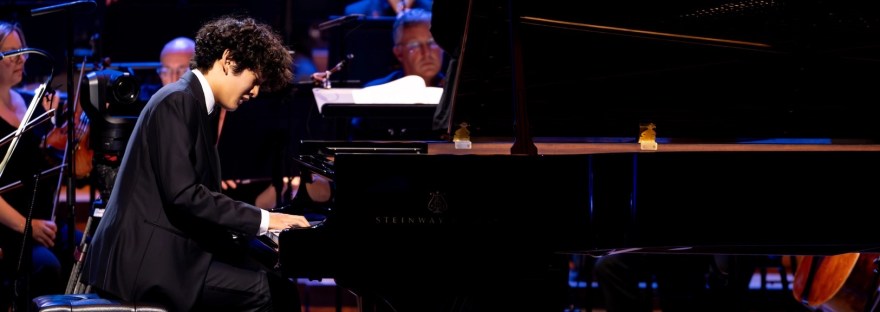
Ryan Wang is a young Canadian pianist who waslast year’s BBC Young Musician of the Year competition.  Earlier this year he won the Canadian Chopin Piano Competition, and today was, at the age of eighteen, the International Festival’s youngest-ever Queens Hall recitalist.  Ryan chose to give us an all-Chopin programme which displayed both the vast breadth and depth of the composer’s skill and the incredible talent of the pianist presenting his music.

The 24 Preludes, Op 28 take us through the cycle of keys, both major and minor, starting with C major and ending with D minor.  Their immense variety of both style and mood offer the pianist a magnificent showcase for their technical ability and emotional range, from the opening rippling agitato to the closing stormy allegro appassionato. Ryan’s ability is simply breathtaking.  There aren’t enough superlatives to describe his mastery of touch, tone, dynamic contrast, and mood.  He’s brilliant in the showy bits, has power and passion when required, but is gentle, tender and delicate too.  At one point his painissimo was so quiet I thought the sound would dissolve into nothing – and then sparkling cascades of notes or passionate, resounding chords would ring through the Queens Hall.  The audience were silent in rapt admiration – until they burst into prolonged applause after the final prelude.

After the interval we heard three Mazurkas Op.59 – lively dances which started off conventionally enough but went off into brilliantly executed flights of fancy.  Chopin’s Piano sonata no 2 in B flat minor followed, with an ever-changing stream of emotions – stormy, furious, sorrowful, lyrical, solemn and tender by turn.  The Variations on ‘Là ci darem la Mano’ in B flat Op2, written when the composer was only seventeen, closed the official part of the programme.   It was a joy to hear someone only a little older playing this exuberant, extravagant, passionate show-off piece, which rightly received a standing ovation.

But it didn’t stop there.  With the energy and enthusiasm of youth, Ryan returned to give us not one, not two or three, but FOUR encores.  A joyful waltz and two other Chopin pieces I couldn’t name were all ecstatically received – surely that would be it?  But no, Ryan came out again, settled to the keyboard, and began a wondrously quiet and gentle rendition of Beethoven’s Für Elise – the perfect way to calm us and send us out into the city, I thought.  But then it evolved into the most wonderful display of jazz and boogie I think I’ve ever heard in the oh-so-respectable Queens Hall.  Here was an amazingly talented young man letting his hair down and having a ball – what a privilege it was to be a part of it. 

Then he closed the piano lid and left the platform for the final time.

What a morning!  What a talent!  What a joy!

EIF: Ryan Wang, The Queen’s Hall for more information go to: https://www.eif.co.uk/events/ryan-wang

Mary Woodward at the Festivals

Lost Girls/ at Bus Stops, The Box at Assembly George Square (Venue 8), Review

**** (4 stars)

“Brilliantly Played”

Edinburgh.  August.  Jess and Iona’s paths keep crossing…

Originally part of the series a Play, a Pie and a Pint, Roisin Sheridan-Bryson’s play is both an extended love song to the city of Edinburgh and a long and convoluted lesbian love story, which may or may not have a happy ending, depending on whether or not you can go back in time/ rewrite endings the way you wish they could go.

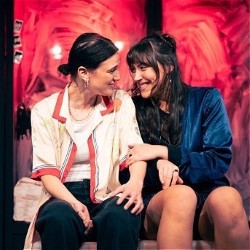
Jess and Iona want to tell us their story, whichstarts when they first meet randomly at a Fringe venue.  They meet, randomly or by arrangement at bus stops, in venues, on the streets and in the closes of the city.  Their tale is also a wonderfully detailed and descriptive account of Edinburgh in August – but they so often remember things differently.  Each knows their version of any incident is the correct one, and they continually correct each other – but there are times when, oh yes, they do indeed remember things the same way.   And now it’s their last night at the Fringe: how will they have the most fun, see the best show, party till the wee small hours and then…???

Jess, according to Iona, is brilliant, mad, a pain in the arse.  She’s a live wire, impulsive, unable to sit still, mouth never silent, engaging with everyone around her, speaking/ acting well before thinking – both enormous fun to be around and a huge liability in certain situations.  She has huge impenetrable walls around herself and is terrified to let them down.

Iona could hardly be more different.  She’s a quiet, thoughtful, gentle introvert, who nevertheless will go along with anything Jess proposes even though she’d prefer the exact opposite.  She’d like to take her time to think before she does or says anything, go slowly through life.  She probably always means what she says, and never acts impulsively when she’s not with Jess.

Intersecting, interconnecting, overlapping witty, descriptive, crackling dialogue slowly reveals a story that has been going on [it seems] for several years.  It’s pretty obvious right from the start that this unlikely couple not only fancy but love the other – but Jess is incapable of revealing this even to herself, and Iona isn’t going to speak if Jess won’t. 

A very small, impressively versatile set, and some every effective lighting add enormously to this play, which crackles with life and vigour most of the time.  I could wish that the closing moments’s dialogue was more audible, especially since Iona had her back to me and I was sitting immediately in front of a [very welcome] electric fan…

Both women are brilliantly and contrastingly played – but I can’t credit either actress by name, which is an enormous pity.  The script is superb, and the acting excellent – and the audience was loudly appreciative of the [spoiler alert] kiss immediately preceding the blackout.

Lost Girls/ at Bus Stops, The Box at Assembly George Square (Venue 8) for more information go to: https://www.edfringe.com/tickets/whats-on/lost-girls-at-bus-stops

Mary Woodward at the Festivals

EIBF, Hamish Hawk: Life in a Scotch Sitting Room, vol 0, Spiegeltent, Futures Institute, Review

**** (4 stars)

“What an Evening”

When I was wee, and lived in the south of England, my family and I used to listen to the radio together [this was in the days before every home had a television the size of a postage stamp].  There were the Goons, Round the Horne, the Navy Lark and the Men from the Ministry.  The Goons, in particular, were a great influence on me – their ridiculous sense of humour seemed perfectly sensible to me…

One voice I remember very clearly from this time, because its accent was to me [an innocent Sassenach] the strangest and funniest I had ever heard.  Instantly recognisable, it sounded completely poker-faced as it told stories from its owner’s childhood in the Gorbals and sang simple songs – but again and again there were eccentric, throwaway comments and descriptions in his anecdotes, and quirky, incongruous lines in his songs.  I absolutely loved this man’s words and voice – Ivor Cutler.

So, when I saw in the Book Festival programme a session entitled Hamish Hawk: Life in a Scotch Sitting Room, vol 0, I knew I had to be there.  I confess upfront that I had no idea who Hamish Hawk was, but was really excited at the prospect of what the programme described as a rare, lyrical homage to Scotland’s pre-eminent poet-eccentric.  Even better, we were offered the chance to see and hear Cutler’s own harmonium, the quaintly droning sounds of which were an integral part of the joy of listening to the man’s songs.

What an evening!  Not only was there the joy of hearing some of Cutler’s own words – and his inimitable songs – but there was the unexpected joy of hearing Hamish Hawk’s own words in anecdotes about his own Edinburgh childhood in Fairmilehead.  I don’t know Hamish’s songs, but his prose writing is brilliant – such precise descriptions of family life that I could feel I was there with him as he tried to navigate life with his parents and two older siblings.  Both Cutler and Hawk have a wonderful mastery of words, and are not above embellishing the truth while also celebrating and suffering the awkwardnesses of growing up in less than affluent circumstances.

Most of the songs were Cutler’s and I loved them all – though a special mention has to go to A bubble or two for its wonderfully macabre narrative, and Face like a lemon where a conventional love song is subverted by the descriptions of the beloved…  An excellent touch in the show was the use of a wonderful red velvet fez-like hat with a giant tassel: when wearing it, Hamish was using Ivor’s words and without it, they were his own.

It was a wonderfully absurd and delightfully entertaining evening, which the audience absolutely adored.  And it didn’t end when Hamish delivered his own song, Catherine opens a window – the subsequent conversation with Nicola Meighan was fascinating.  Not just because it filled in some of the background of how the show was commissioned [and how Cutler’s harmonium came to be centre stage] but revealing the depth of Hawk’s admiration of the older man and the inspiration he found in his work.  Another really interesting topic was the difference between writing songs and writing prose: Hamish and Nicola agreed the two used completely different sets of writing muscles.

And then it was time, reluctantly, to leave the Spiegeltent and trek off into the darkness, still glowing from the warmth of my encounter with two brilliant wordsmiths.

EIBF, Hamish Hawk: Life in a Scotch Sitting Room, vol 0, Spiegeltent, Futures Institute, for more information go to: https://www.edbookfest.co.uk/the-festival/whats-on/hamish-hawk-life-in-a-scotch-sitting-room-vol-0

Mary Woodward at the Festivals

The fit prince, (who gets switched on the square in the frosty castle the night before (insert public holiday here), Beyond at Pleasance Courtyard (Venue 33) Review

***** (5 stars)

“Enormous fun!” 

It helps that I’m a huge fan of both the Princess Diaries and the Princess Switch[es – all three films] but even if you knew nothing about any of these, you’d still have a wonderfully uproarious time in this show. 

Many in the sell-out audience are obviously huge fans of Awkward Productions’s shows, and know exactly what to expect – topical references, parodic songs, and extreme audience participation.  [Warning: if you’re a shrinking violet, do not accept an invitation to play a part in the show!  If you don’t mind, or actively love, being the centre of an enthusiastic crowd’s attention, grab the opportunity with both hands…]

Swedonia is a fictional country bearing not a little resemblance to the home of IKEA.  The King has just died, and we are at his funeral.  His widow, politicians, and other notables address us via videoconference links before there is a shocking announcement.  Prince Elian cannot inherit the crown unless he marries before midnight on Midsummer’s Eve, only two weeks away: if he fails to do this, the crown will pass to the neighbouring kingdom of Finlandia.  Elian is, of course, an extremely fit prince, but he can’t find anyone who pleases him.  He doesn’t have to marry a woman <phew!> but he meets many potential partners without a single spark flying between them.

Meanwhile, in New York City, Aaron Butcher, a baker, is still reeling from his break-up with the heartless Jakob while trying to make a success of his father’s bakery.  His bestie and assistant Jenny, a very feisty puppet, has been bombarding the Queen of Swedonia with messages which result in an invitation to go to Swedonia and bake the royal wedding cake.  Aaron’s reluctant to – he’s never left New York – but decides he’ll go when his ex turns up at the shop and namedrops his latest lover. 

After a delightfully convoluted journey, Aaron arrives in Swedonia, where an accidental encounter with Prince Elian does not go well – can you guess what happens next…?

The story is delightfully told by Linus Karp and Joseph Martin, with the help of their ASM, some lovely people on video, and the many willing and enthusiastic audience members who gamely brave the unknown and act out everyone else in the tale.  There are two charming horses, some decidedly dodgy orphans, a giggling priest, a seemingly innocuous doppelgänger, a suggestive sauna scene, a fleeting deer, and much much more.  Special credit must be given to the two volunteers who put their hearts and souls into becoming the bass and keyboard players for BAAB, a group bearing an uncanny resemblance to a Eurovision-winning foursome from some years ago: and to the musician – credited as Leland – who produced their wonderfully derivative medley of songs and the ever-sillier verses of the Swedonian national anthem.

It’s not in the least surprising that the whole performance was greeted with loud and loving laughter, nor that the entire audience rose to its feel to salute the cast for their absolutely fabulous [darling] sell-out show – and roared all the louder to learn that Linus and Joseph tied the knot this morning. 

The show blurb promises that The fit prince would be queer, chaotic, comedic and heartfelt – it was all this and more.  A perfect way to spend a Saturday [or any] afternoon celebrating the joy of being oneself, out, proud, alive, and loving.The fit prince, (who gets switched on the square in the frosty castle the night before (insert public holiday here), Beyond at Pleasance Courtyard (Venue 33) for more information go to: https://www.edfringe.com/tickets/whats-on/the-fit-prince-who-gets-switched-on-the-square-in-the-frosty-castle-the-night-before-insert-public-holiday-here