Blog

Mary Woodward at the Festivals

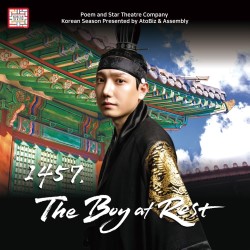
1457, The Boy At Rest, Studio 1 at Assembly George Square (Venue 17)

***** (5 stars)

“Haunting and Heartwarming”

Over the last few years, courtesy of my bonus granddaughter Maddy, I have become addicted to Korean drama on Netflix.  Imagine my delight, therefore, when I came across the listing for this show!

I’m very happy to say it lived up to all my expectations and more.  It was a joy to see and hear live actors speaking and singing Korean – and with subtitles projected on to the back screen, there was no problem understanding what was going on.  [I even got to recognise familiar words and phrases…]

The Joseon dynasty ruled in Korea from 1392-1910, and has been a source of many period dramas, or ones where contemporary characters discover that they lived previous lives in that period.  The costumes are gorgeous, the manners very elegant; there’s a lot of fighting with swords, and a huge amount of intrigue and skulduggery.

1457, the boy at rest contains gorgeous costumes, but no sword-fighting.  There is, however, a very wicked plot surrounding the young king Danjon.  His father died when he was only ten and his uncle, whom he greatly loved and admired, desired the throne for himself.  Danjon stepped down from the throne, hoping to lead a quiet life with his beloved wife Jeongsun.  His uncle, fearing that the young man would always be a focus for rebellion, banished him to a far away province.  The new king still did not feel safe, even after torturing and executing anyone who opposed his rule: finally he sent his nephew the order to take poison.

This sounds as though the show is unmitigated misery – far from it!  There is superb acting, wonderful music, lively dancing, drumming and singing, audience involvement, a lot of fun along the way, and the opportunity to reflect on concepts of fate and mortality.

The comic humour in the piece largely comes from three very lively Dokkaebi – day goblins – who live in the area to which the young king is exiled, and whose duty is to protect the area from bad humans.  They come to investigate the humans in the audience – are we bad, in which case they can do terrible things to us?  They are pranksters at heart, but principled ones…. They encourage our participation, narrate the story and add their own goblin commentary – how can these humans be so awful to each other?  [How indeed?]

There is a magnificent confrontation between the young king and his uncle: the boy loves his people but the uncle says love is not enough in a king – he must have power.  He demonstrates this when, later on, some of the boy king’s loyal ministers refuse to accept the man they see as a usurper.  They must all be destroyed – there must be no more support for the exiled king.

The music is a brilliant and constant presence.  There are some wonderful love songs and haunting songs of longing for the young king and his wife.  I wish I could credit them by name, because they are both superb.  The nobility of the young king is impressive – he rebukes anyone who calls him ‘your majesty’ because he doesn’t want them to suffer on his account.  Even the official bringing the ‘gift’ of poison is treated with loving courtesy.  His young wife, Jeongsun, refuses to accept help from the usurping king, preferring instead to support herself by dyeing cloth.  She cherishes Danjon’s memory all her life, even when news of his death reaches her and she realises there is now no hope of meeting him again some day.

All this sounds very miserable – but it isn’t, even though it’s very sad.  There are many moments of humour, and there are decent people who refuse to denounce the young king, and show him their love.  The young couple’s sorrow is heartfelt and deeply moving to witness; we too feel sorrow at the loss of people we love.  The show ends with a Requiem in which we are reminded that our loved ones who have died live on in our memories, and that by thinking of them we can help them reach a place of peace.

This is a superb show from Poem and Star Theatre Company, part of the Korean Season at the Fringe.  Come and enjoy, be moved, and carry its haunting atmosphere and heartwarming affection with you as you go through this crowded city and into the rest of your life.1457, The Boy At Rest, Studio 1 at Assembly George Square (Venue 17) for more information go to: https://www.edfringe.com/tickets/whats-on/1457-the-boy-at-rest

Mary Woodward at the Festivals

Mrs Roosevelt flies to London, Drawing Room at Assembly Rooms (Venue 20) Review

**** (4 stars)

“An impressive piece of writing

A good show,well delivered, well presented, well acted.  The audience was deeply appreciative – for me, it just went on a bit too long…

Insomniac, indefatigable worker, organiser, and champion of the underdog, wife and fifth cousin of president F D Roosevelt, human dynamo, chair of the United Nations Commission formed to draw up the Universal Declaration of Human Rights, and so much more, Elinor Roosevelt’s life motto might well have been what was a constant refrain throughout the show – “So much more to do”.

We first meet her towards the end of her life, at the time of the Cuban missile crisis in 1962.  A stand-off between Russia and the United States, it seemed for a few days that the world was on the brink of a war that could destroy it.  “If only Mr Kennedy and Mr Khrushchev would talk to each other, maybe at my cottage”, she says – after all, they’ve met there before…

Looking back over her life, she wonders whether it has achieved anything…. Cue a fascinating excursion through her life, seen through the framework of a visit she made to the United Kingdom in 1942.  America had joined the war and she flew across the Atlantic to represent her husband on a non-stop succession of conversations, meals both informal and exceedingly formal, with visits to everything from Buckingham Palace to a pig club.  Everywhere she went she talked to people, spoke encouragingly of all she saw, did her best to boost morale in the UK and kept people at home informed and engaged by a constant stream of newspaper columns and letters.

Her memory could be called elephantine, as she tells us about the people in her past and her present, people she meets on occasions separated by many years, statesmen and royalty, those engaged in the fight with weapons and those who fight in other ways – workers [mostly women], both paid and unpaid, and even children.  Her care and concern seem boundless – nothing is too small for her attention.

Alison Skilbeck has crafted this show well, with extensive use of Eleanor’s diaries and writings [and probably listened to a fair number of recordings of broadcasts, too].  She is very adept at creating instant portraits of the people she engages with – we particularly appreciate her portrayals of Elizabeth, Queen Consort of George VI [who became known as the Queen Mother after her husband’s death], and Queen Mary, George’s mother.  We see Churchill [and Mrs Churchill] alongside many other statesmen, heads of government, factory workers, Women’s Voluntary Service and Land Army people, and many more.  

The narrative jumps backwards and forwards in time, giving an increasingly broad picture of a woman who had a miserable start in life, a pretty horrific mother-in-law, and a definitely less than perfect husband.  It’s good to know there were loving women in her life too – something probably less well known about Eleanor – one of whom was a major influence in enabling her to grow into being First Lady.

It’s an impressive piece of writing, and an equally impressive feat of acting.  The production, direction and lighting are good – though I could wish there had been a lot less dry ice – I had to hold my hankie over my nose and mouth throughout the show.  And, as I’ve said, it went on a bit too long for me…

At the end of the show, Eleanor is looking back, remembering the bombs that ended World War Two.  “Truman had to bomb to end the war”, she said earlier in the show – but I couldn’t help thinking that all that had happened since then simply shows to serve that, no matter the size of the bomb you use, someone will build one bigger and more powerful: the arms race and the threats will simply go on and on.  And for all the UN has achieved and still [hopefully] continues to do, the UN declaration of human rights is not taken seriously or adhered to by so many governments and nations around the world today.

Did Eleanor Roosevelt’s life achieve anything?  I leave it to you to see the show and decide for yourself.Mrs Roosevelt flies to London, Drawing Room at Assembly Rooms (Venue 20) for more information go to https://www.edfringe.com/tickets/whats-on/mrs-roosevelt-flies-to-london

Mary Woodward at the Festivals

EIF, NFM Leopoldinum Benedetti & Sitkovsky’s tribute to Menhuin, Usher Hall, Review

***** (5 stars)

“Blissful and challenging”

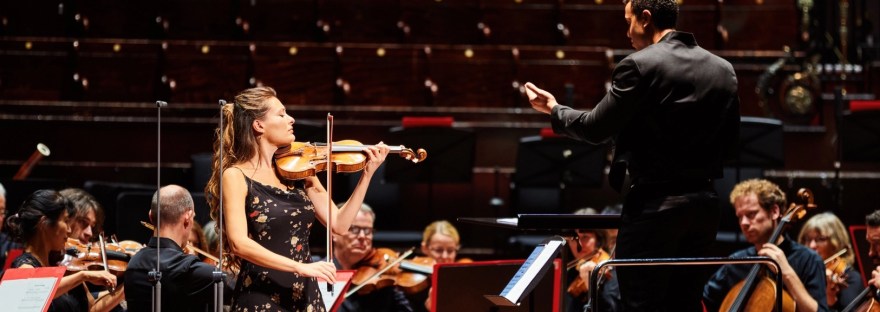
What a treat!  Blissful and challenging [for me] in equal measure, tonight’s concert by Poland’s National Forum of Music Leopoldinum string orchestra was part of this year’s Focus on Poland series.  Devised as a tribute to the great violinist and humanitarian Yehudi Menhuin, it was led by two of the Menhuin School’s many talented alumni, Festival director Nicola Benedetti and the orchestra’s Artistic Director Alexander Sitkovetsky.

Nicola came on stage to welcome us and introduce the programme and its performers to us.  She and Sasha Sitkovetsky were both pupils at the Menhuin School and had strong connections with all the pieces played tonight.   Joining the orchestra on stage for most of the programme were young musicians from the Festival’s Risings Starts of Strings.

The orchestra has no conductor – it’s led by the lead violin.  This gives a different dynamic to their playing: a collaboration, a conversation between equals, with room for inspiration and invention ‘on the hoof’’ rather than a meticulously prepared and directed performance.

Elgar’s Serenade for String Orchestra in Emi, Op 20 sounded so very English.  Its opening allegro was warm and delicate; the subsequent larghetto lush and romantically yearning; the closing allegretto had graceful, uplifting melodies dancing gently over the lower voices’ gentle skipping.

Panufnik’s Violin concerto from 1971 was from a completely different world. Sasha Sitkovetsky opened the piece with an angular solo outburst that sounded like a challenge to the orchestra before the movement built into a rich tapestry of harmonically angular sounds.  The second movement was brooding and melancholy, with the soloist regularly producing fantastically high and eerie harmonic notes before the music warmed into richness again.  The third movement was a lively helter-skelter, the soloist taunting and teasing the other musicians who responded in kind.  Angular rhythms and gypsy-like melodies, full of energy, framed a playful cadenza before everyone joined in a fast and furious finale.  I personally found this piece extremely challenging, but the whole Usher Hall audience saluted it with loud cheers and prolonged applause.

After the interval came my moments of bliss – JS Bach’s Concerto for 2 violins in D minor, BWV 1043.  Nicola and Sasha grew up playing this piece at the Menhuin School, and it’s been a part of my life and one of my two most favourite pieces in the world for as long as I can remember.  The two soloists engage in an intimate conversation, at times closely engaged, at others moving off on their own, and always as an integral part of the whole piece rather than ‘stand out’ parts over a less important backing.  It’s by turn tender, joyful, lively, fun, and utterly glorious throughout – small wonder that there was a positive storm of heartfelt applause after the final notes.

Bartòk’s Divertimento for string orchestra, Sz 113 closed the programme, and presented me with another challenge.  The opening allegro was very rhythmic with spiky harmonies, making me think of relentless machinery: there was a lot of passion, but I felt divorced from it – an observer rather than a participant.  The adagio’s dissonant melody floated over a low, almost spooky grumbling to which the violas attempted to offer a mellow consolation. The two moods’ conflict built into a rumbling discontent which ended suddenly and very uncertainly.  The closing allegro assai was lively, with a tune on which everyone agreed.  The first viola had a chance to shine before Sasha Sitkovetsky’s violin went berserk and everyone else followed.  Nicola Benedetti had a short showy solo and everyone on stage joined in a fast and furious finale which again was greeted with a positive storm of applause.

An incredible display of talent, and electrifying performance from all concerned!

EIF, NFM Leopoldinum Benedetti & Sitkovsky’s tribute to Menhuin, Usher Hall, for more information go to: https://www.eif.co.uk/events/nfm-leopoldinum-benedetti-sitkovetskys-tribute-to-menuhin

Mary Woodward at the Festivals

Africa Power: the colour of water, Music Hall at Assembly Rooms (Venue 20) Review

*** (3 stars)

“Glorious moments”

My goodness, that was LOUD!!

So loud, that I was suffering.  So loud, that what words there were to the songs were distorted beyond the possibility of my hearing.  So loud that at least some people present will inevitably suffer from hearing loss..

And the pity was that it could have been so good if they’d just reduced the sound levels a bit.

I chose this show hoping to have a pleasant hour having a window opened on a culture with which I’m not very familiar.  Alas, it didn’t quite work out like that – though I have to say that the majority of the audience seemed to enjoy themselves enormously.

The essence of the show was, I think, to highlight the importance of water.   It’s essential to all life forms on this planet: without it, very little can survive for long.  It took some elements of ancient wisdom: that people make too much noise all the time when they should rather stop and listen; and that in a time of water shortage the adorable but much-persecuted pangolin would find Bantu, the chosen one, who would lead people to a source of water.

Unfortunately, the previously mentioned noise meant it was almost impossible to distinguish any wisdom.   Much of the show was taken up by extremely good but to me somewhat uninteresting contemporary dance in which, yet again, the blokes wore baggy garments and the women’s costumes left very little indeed to the imagination.

Not my type of entertainment…

A huge screen above the stage gave us some wonderful images – animals walking slowly through virtual deserts; tropical fish swimming in crystal clear waters; jellyfish pulsing through the sea; a black and white urban landscape that morphed into a riot of colour; and gloriously jewel-bright colours flowing and merging in fabulous patterns.  Sometimes these enhanced the dance, at others they provided a welcome distraction.

There were glorious moments – particularly when a dancer with a cloak of lights wove patterns with it against a background of a night sky blazing with stars.

There was virtually a party political broadcast on behalf of the earth, outlining the damage humans are doing to it – the earth is crying out for help – and set against horrific film footage of plastic-filled oceans, lakes and rivers.  Impressive, but it was followed by another loud pop song with unrelated movements, rather than anything to enable the message to sink in or be taken to heart.

The pangolin did find Bantu, and water returned – I think: but the final lipsynched film monologue wasn’t very intelligible, and the final song was even less so.

The message was undeniably powerful, but for me the way it was put across worked against it.  A pity.  Hopefully others in the audience will have been greatly moved – there was certainly plenty of appreciative applause for most of the dance numbers and at the final curtain call.

Africa Power: the colour of water, Music Hall at Assembly Rooms (Venue 20) for more information go to https://www.edfringe.com/tickets/whats-on/africa-power-the-colour-of-water

Mary Woodward at the Festivals

The unlikely friendship of feather boy and tentacle girl, Central at Assembly Roxy (Venue 139) Review

**** (4 stars)

“Beautiful images”

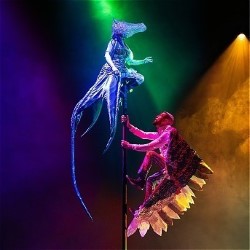
They couldn’t be more unalike.  She likes slow, he likes fast; she loves the country, he the town.  She dreams of sinking into the sea, transforming into a kelpie, devouring a sailor from a passing ship [and wakes with a strange taste in her mouth].  He dreams that his shoulder blades split, wings emerge, and he rises to join the cloud of red and gold wheeling in the sky above his tenement building…

There could hardly be a more unlikely friendship than that between feather boy and tentacle girl – but a deep and enduring friendship it is, played out before us in the vast space above the stage of Assembly Roxy Central.  The show opens to our gasps as we see the two performers spotlight high above us, atop two tiny circles of metal at the top of two long poles, and the wonderment continues throughout the show.

You might be forgiven for thinking that Sadiq and Vee have wings or tentacles – or at least Velcro as an integral part of their skin.   How do you cling, many feet up in the air, to a metal pole when both arms and legs are waving gently in the breeze?  It’s even more bewildering when the two of them shin up the pole while hardly touching it, and still more so when they take off the brakes and slither down – surely they’ll crash into the floor?  But no, they just stop with exactly enough room to spare, and we can breathe again…

Simply to call this a display of aerial skills is grossly to undervalue it.  There’s so much more going on – storytelling, acrobatics, an incredible trust between two performers who quite literally hold each other’s lives in their hands.  There’s a huge sense of fun, too, as the two glide through the air, tumble on the ground, shin up and down the vertical poles, hang from a cable, or whirl round on a rotating pole,  almost faster than the eye can see… 

Vee’s kelpie suddenly grows hungry – ravenous, even – and reaches out greedily for food, getting ever nearer and nearer the audience until she rushes at us, and only Sadiq’s intervention prevents carnage.  Sadiq’s wings try to grow and he dreams of flying but can’t take off: as he crouches in terror, thinking Vee is now going to eat him – but she’s reaching out a hand to help him…. Together they battle against a tremendous wind and swirling ash or snow.  Vee gets to fly in a swirling cloud of sea foam, and Sadiq realises his dream of flying among the tumbling red and gold feathers.

There are innumerable beautiful images among the breathtaking feats of aerialism: and running all the way through the show the tangible evidence of that warm and most unlikely friendship of two very different people who yet find common ground, working together to enable each other to fly.

Today’s performance of one element of the Made in Scotland showcase was a sell-out.  The run finishes on Sunday and is selling very well.  Rush and get your tickets NOW!

The unlikely friendship of feather boy and tentacle girl, Central at Assembly Roxy (Venue 139) for more information go to : https://www.edfringe.com/tickets/whats-on/the-unlikely-friendship-of-feather-boy-and-tentacle-girl