Mary Woodward Review

Scottish Opera Trial by Jury, Festival Theatre, Edinburgh, Review

**** (4 stars)

“Sobering Thoughts!”

I grew up on Gilbert and Sullivan’s comic operas – my family’s Christmas treat was going to the Savoy Theatre in London to see the D’Oyley Carte Opera Company perform Iolanthe, the Mikado, Patience, Ruddigore.  We had recordings of some of these, and I knew words and songs by heart, and knew exactly what ‘proper’ G&S looked like. In time I moved on to ‘grand opera’, but still had and have a very soft spot in my heart for these wonderfully witty, quintessentially English mockeries of Establishment, Privilege, and Correct Behaviour.

I was thoroughly delighted when some years ago Scottish Opera in conjunction with D’Oyley Carte put on a sparklingly witty production of Mikado, so I was really looking forward to Trial by Jury, which I’d never seen live.  At the time of its writing, breach of promise of marriage was a serious matter and the subject of criminal trials.  In Trial by Jury the Plaintiff accuses the Defendant of promising marriage and then going off with another young woman.  Judge and jury all side with her for no obvious reason except that she is young and pretty.  The Defendant tries to excuse himself by explaining how it is that a young man’s fancy is inconstant – but declares that he’s perfectly happy to marry both young women.  When it’s pointed out that this is bigamy and also a crime, things look black – until the Judge solves the dilemma by announcing that he himself will marry the Plaintiff, who is perfectly happy to marry a rich old man.  General rejoicing.

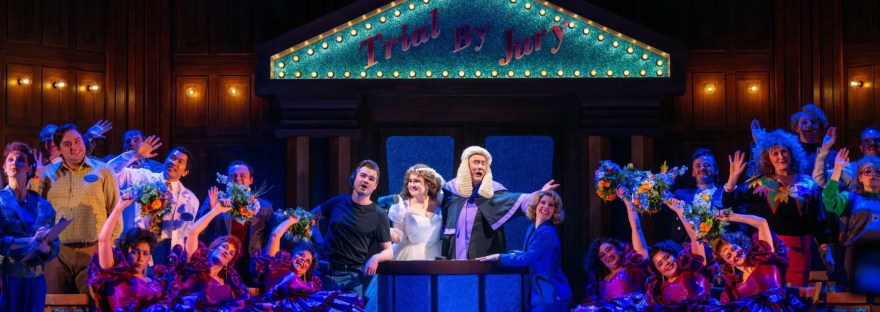
Written in the 1870s, this production moves to the set of a 1980s television game show, which proves the perfect vehicle for all the outrageous behaviour on stage.  The costumes are delightful [I particularly liked the six bridesmaids’ frilly purple frocks] and the set wonderfully constructed to add variety to what could have been a very static show.  As I expect from Scottish Opera, the cast were all superb, the chorus as individual as the principals, and the whole sing sung perfectly seriously rather than ‘nudge nudge wink wink isn’t this funny?’ which tends in the end to be much less funny.

For me, Jamie MacDougall stole the show as Defendant Edwin, his costume and wig reminding me very strongly of a young Donald Trump, convinced of the justice of his claim, indifferent to the hostility of the court, and perfectly prepared to undertake an illegal action if that would prevent him going to jail.  Kira Kaplan’s Plaintiff, Angelina, was a vision in sparkling white, her crystal clear voice and perfect demeanour giving some credence to the immediate and violent feeling in her favour of all present.  

Edward Jowle was a wonderful TV show host and delightfully ineffective Usher, completely failing to bring about silence in court, no matter how many times he called for it.  Chloe Harris was a wise and witty Counsel for the Plaintiff – another lovely voice here – while Ross Cumming generally failed to keep order as Foreman of the Jury.  These four singers are this year’s Scottish Opera Emerging Artists, once again demonstrating the company’s ability to pick singers who are going to go far.  The Learned Judge – Richard Suart – was perfect as the game show host/ star – though perhaps going rather further than was usual in such shows in deciding to award the main prize to himself…  The chorus were a superb collection of very different individauls, as I’ve come to expect from Scottish Opera.  I particularly loved the grand set-piece sextet with full choral underpinning, reminding me very strongly of the magnificent sextet in Lucia.

Underlying all this sparkling gaiety is a rather more serious theme – how charm and beauty can blind people to the reality of the truth.  All sins, it seems, can be forgiven if you are young and beautiful or old and canny and know how to manipulate people.  The Judge has reached his high status by marrying a rich attorney’s elderly, ugly daughter – but everyone takes this as perfectly okay: no need to be qualified to do something, just use money and influence to get where you want to be.  The Plaintiff wins everyone’s sympathy just by being beautiful [and possibly weeping a few crocodile tears].

This theme was taken up in A Matter of Misconduct, a new opera by Emma Jenkins and Toby Hession.  Having already greatly enjoyed their earlier pieces for Scottish Opera’s touring company – Told by an Idiot and In Flagrante – I was pretty sure I was going to enjoy this new, larger-scale work.  I did enjoy it, but was not bowled over by it – hence only four stars instead of the five I would have liked to give.  

There was an enormous amount to enjoy.  Just as with G&S, the dialogue was witty and extremely topical – in this political atmosphere the hugest laughs came every time Granny’s campervan was mentioned, though there were many other glorious witticisms, pointed comments, and positively outrageous rhymes.  I think the problem for me was that some of the situations went on a little longer than necessary – as if the material was sometimes stretched out to fit the desired length of time.  It didn’t help that at times the supertitles failed to deliver the complex dialogue, leaving us all somewhat in the dark.

The plot was very topical and, in some ways, sickeningly familiar.  Deputy Prime Minister Roger Penistone is filming a promotional video for the final week of a leadership contest in which he is the front runner.  He is then miked up for an appearance on Loose Women, where he will be joined by his wife Cherry, who is promoting her wellness brand, GUSH.  Sandy Hogg, a government special advisor bursts in in a shower of ripe expletives to announce that a major scandal is about to erupt around Roger and his wife – this has to be buried, and it will take a lawyer to sort it out.  Enter cynical and extremely savvy Sylvia Lawless, senior partner in the firm of Lawless, Lawless, Lawless and Crook, who outlines the necessary measures.

Suddenly the news breaks that the Prime Minister has been hospitalised and may not recover.  Roger is now Acting PM, and has to prepare for an immediate major press conference.  To his horror, he realises that the body mike with which he was fitted for Loose Women has been live all the time.  Facing the press corps is not easy!  When it is over, and everyone has gone, Sylvia Lawless comments that this scandal, too, will be buried.  Penistone is popular, the story will be forgotten – but she’ll not forget, and will keep the recording equipment as an insurance policy…

Our quartet of Emerging Artists were again superb.  Kira Kaplan was the lawyer this time, a smooth and cynical political operator, whose comments about mud sliding off the very rich and well-connected were very pertinent.  Ross Cumming was vilely good as the savvy career politician who went into total meltdown when he faced the prospect of going to prison.  Chloe Harris was his aspiring but politically naïve wife Cherry, who nonetheless was determined to stand by her man if the worst happened.  Edward Jowle was the well-intentioned, aspirational press secretary, Hugo Cheeseman, who undoubtedly deserved all the criticisms hurled at him by government advisor Sandy Hogg.   This was Jamie MacDougall at his brilliant Scottish best, utterly fed up of cleaning up after his charge and totally disinclined either to mince his words or wrap anything up in flannel.  The chorus had a grand time being adoring fans, baying press hounds, and anything else the script required.

A Matter of Misconduct told a story only too commonplace these days.  At the end of the show, screens updated us on the main protagonists’ careers – Roger Penistone had a landslide victory, Hugo Cheeseman became No. 10’s communications director, and Cherry took part in I’m a Celebrity…  Only Sandy Hogg went to Echlefechan  for a well-earned retirement.  

We were also reminded of the more than 100 examples of politicians’ ‘misconduct’ in recent years, which for the most part were ignored, let slide, and forgotten.  

A sobering thought on which to end…

Scottish Opera Trial by Jury, Festival Theatre, Edinburgh,Runs until Friday 6th June for more information go to: https://www.capitaltheatres.com/shows/trial-by-jury/

Brett Herriot Review

Moulin Rouge! The Musical, Edinburgh Playhouse, Review:

***** (5 Stars)

An Intoxicating Delight!”

The Broadway and West End smash hit Moulin Rouge! The musical embarks on its first world tour with a debut season at the Edinburgh Playhouse. Based on Baz Luhrmann’s acclaimed 2001 motion picture taking audiences into the heart of the great Moulin Rouge cabaret club in Paris which celebrates its 135th Anniversary this year where decadence meets creativity as humanity of the bohemians come together to perform. It’s also the timeless story of forbidden love between Satine, A stunning performance from Verity Thompson and Christian, a beguiling turn from Nate Landskroner. It’s a heady mix that proves to be an intoxicating delight!

This is a juke box musical that raises the bar to new heights with a beautiful book by John Logan and the original creative team of Director Alex Timbers, Chorographer Sonya Tayeh reunite for this production which brings the magic and sparkle of the West End to Edinburgh and leaves the audiences beguiled with its charm.

Performances are faultless across the board, with both Thompson and Landskroner delivering career defining and finally nuanced performances and they prove they have the vocal ability to match. Cameron Blakely is a triumph of comedy timing and showmanship in the role of “Harold Zidler”. James Bryers brings terrific villainy to his role as “The Duke” but allow just enough the characters fear to flow through.  The ten strong principal cast are joined by an outstanding 15 strong ensemble who Paris of 1899 to life with ease and style in equal measure. There isn’t single wrong note among this tight cast who sing with gusto back by Musical Director Ben Ferguson’s utterly sublime ten strong pit orchestra.

Production wise you won’t see a better theatrical treat in Scotland. Derek McLane scenic design is awe inspiring and flows from the footlights and embrace the massive playhouse auditorium. This is bolstered by Justin Townsend’s remarkable lighting design that sets new standards for touring productions. Peter Hylenski’s Sound design is everything and more. Special mention must go to Catherine Zuber’s outrageous, stunning and simply eye popping costume design. The costumes not only enrich the story but embrace the true soul of the Moulin Rouge itself.

Moulin Rouge’s heartfelt message is the greatest thing you will ever learn is just to love and be loved in returned! And my word does that exude from every moment this production is front of its audiences. This is a show that’s steeped in love from its creative’s, its cast, its musicians and its audiences in equal measure.

The Playhouse is the only Scottish date on the world tour for now and reaffirms the venues standard as being the home of the West End Musical seeing Moulin Rouge! The musical will change your expectations of what musical theatre can do and you’re going to miss out on something truly epic if you don’t grab those last remaining tickets now! So Hurry along because you Can Can Can!!!Moulin Rouge The Musical,  Edinburgh Playhouse, Runs until Saturday 14th June 2025. For more information and tickets go to:https://www.atgtickets.com/shows/moulin-rouge-the-musical/edinburgh-playhouse/

Mary Woodward Review

The Show for Young Men, Festival Theatre Studio, Edinburgh, Review

**** (4 stars)

A man in overalls is standing in front of three metal panels.  The radio is playing what sounds like a discussion of football managerships’ tactics.  Suddenly a large pole appears behind the screen and is chucked over into the Man’s space.  He immediately banishes it to the outer darkness.  A stream of other objects follows, all meeting the same fate: it seems as though the Man’s space must be kept clear of all extraneous items…

The object-thrower is revealed as a Young Man in a scarlet tracksuit: he doesn’t seem to appreciate the Man’s desire for order, but revels in creating disorder and generally Having Fun.  He is soon kitted out in a set of overalls, and the two start to co-operate as Dolly Parton belts out Nine to Five – if only the workplace could always be this much fun!

The relationship between the Man (Robbie) and Young Man (Alfie) goes through many phases.  At times playful, at others combative, alone and together the two dance – though ‘dance’ is insufficient to describe the mixture of acrobatics, clowning, gymnastics, antics and risk-taking these two enjoy showing to us.  Joy, anger, fear, hurt, loneliness, unwarranted nastiness, a growing mutual affection, a caring tenderness towards each other are all displayed without words: at the end of the show both parties have grown in their relationships with themselves and with each other.

In some ways, The Show for Young Men is very much a show for men, especially the ones who find it impossible to express in words anything about their feelings, both positive and negative.  I personally found the recurrent recorded football talk very distracting, though for many people it might have been an ignorable background noise.  I found the use of music much more meaningful [but then, I’m a musician, not a football follower!]

What was staggeringly impressive was Alfie’s physical skills and absolute trust in Robbie: never doubting that he would be held, caught, supported, brought safely to earth, no matter what he was doing.  An added bonus was a song from him halfway through – not all the words were clear, but it seemed to be about being aware of ‘the warning signs’: a message to us all, I feel.

Robbie Synge (man) and Alfie (young man) were not only performing amazing physical feats, but also moving – whirling! – the component parts of the set around them as they did so.  All in all, GuestHouse Projects in co-production with Aaben Dans, Denmark have produced a superb show which I hope enthrals and amazes audiences both in the UK and Denmark.

It’s a lovely way for me to end this year’s Imaginate Festival.  Congratulations to everyone involved in making it happen, and roll on 2026!

Imaginate Children’s Festival: The Show for Young Men, Festival Theatre Studio, Edinburgh, Runs until Sunday 1st June for more information go to: https://www.imaginate.org.uk/festival/whats-on/the-show-for-young-men

Mary Woodward Review

The Pale Baron, Traverse Theatre, Edinburgh, Review

***** (5 stars)

“Scarily prescient!” 

Before the show begins, a recorded announcement reminds us several times not to switch off our phones, so that our whereabouts are known “at all times”.  Felix and Felka march on stage and invite us to sing along with them in praise of the Pale Baron of the Underwater State, whose birthday it is next week – but it soon becomes apparent that we don’t know the words. 

We must learn them – it is most important that we are loud in our praise of the Baron, who alone has the right to hold his enormous jewelled talking stick.  He has arranged that on his birthday 1,000 new stars will be catapulted into the heavens where they will stick: there will be no more shooting stars.  Felix and Felka are concerned that our singing is not loud and enthusiastic enough, that we don’t know the words:  we must praise the Baron’s glorious body, wonderful memory and above all his right to wield his magnificent talking stick.

Felix and Felka seem on edge: is there someone hanging around outside? is there someone in the loading dock? Is there the danger of an inspection?  Are the people in the audience okay?  Do they know why they are really there?  It’s okay, it’s safe to get on with what we’re really here for – a performance by Felix and Felka of their own songs, revolutionary songs, which they can’t perform in public, and which celebrate the poets who have disappeared. 

The Pale Baron hates many things and people, but he especially hates poets: poets don’t rhyme, and there can be a lot of meaning in the blank spaces between the lines.  Children must be under constant supervision: there must be NO questions.  Public radio announcements constantly reinforce the message that that the world is a shop, which must constantly be kept going.  People must prove that they are useful and productive, or they will be reclassified as ‘inferiors’.  It is a public duty to inform the authorities about ‘inferiors’, and most especially those most loathsome ARTISTS.  Foreigners are looking for land, but are redundant and inferior: the Underwater State is only for birthright residents.

Felix and Felka keep reiterating their ‘good’ credentials: they are not poets, they are musicians – but it’s clear they are constantly on edge.  We learn that Felka is from everywhere and nowhere, born in a country that doesn’t exist any more, lost my mother tongue, have no roots…. Felix, on the other hand, has never lived anywhere else: he is stable, a base to rely on, someone with deep roots.  We are introduced to Ronnie, a plant that had to be rescued when the water came, and is now an indoor plant who accompanies the two musicians on tour.

The music is fascinating mix of styles and genres.  Sometimes it’s hard to hear the lyrics, which was a pity, given that they were extremely pertinent.  I particularly liked the quiet lament the sea climbs into the sun: look, the land goes under, the love song to the earth, and the final song in which Felix hopes that Felka finds somewhere in the stars where she could finally put down roots.  The audience really loved the dwarf song [the Pale Baron is extremely fond of dwarfs, most possibly because they are smaller than he is…].

The depth of the relationship between Felix and Felix gradually becomes very clear to us – but do they realise it themselves?  I was surprised by how gripped the young audience were, how totally engaged in the ‘are they aren’t they’ relationship, and how much they wanted the couple to be together.  I did wonder if they’d be held by the breaks in lively action, especially when it got bleakly serious: credit to the actors, they held them through the difficult bits, and the questions asked afterwards showed a keen interest in both the play and the players.

The undercurrent of fear in this world was brilliantly portrayed.  I would be interested to know quite how much they understood of the repressive, judgemental and ‘othering’ society that was being evidenced.  The emphasis on borders, outsiders, moving on, punishment and repression of anything inventive, creative, questioning, were clear to the adults present: did the kids also pick up on these?  Oh to be a fly on the classroom wall when the show was being discussed back in school – and I hope it led into conversations about how to prevent such things becoming even more of a reality than they already are…

The Belgian company Kopergietery originally performed The Pale Baron in Dutch, and re-learned it in English, for which I [and probably the rest of the audience] am/ are profoundly grateful.  Anna Vercammen wrote the words, and Joeri Joeri Cnapelinckx made the music for the songs which run throughout the show.  Between them they sing, play piano, guitar, euphonium, pocket trumpet and a strange analogue device with many voices.  They slowly create a scarily accurate picture of a world in which a monstrous egomaniac controls everything, while everyone who displeases him meets a very unpleasant end.

The Pale Baron will remain with me for some time to come – I hope it will prompt me to action, too.

Imaginate Children’s Festival, The Pale Baron, Traverse Theatre, Edinburgh, Runs until Saturday 31st May for more information go to: https://www.imaginate.org.uk/festival/whats-on/the-pale-baron

Mary Woodward Review

Tangram Kollektiv: Shades of Shadows, Festival Theatre Studio, Edinburgh, Review

***** (5 stars)

“Magic of the Highest Order!”

Amazing! Such a contrast from yesterday’s show: rows and rows of silent children, utterly gripped by what was unfolding in front of them, wondering what on earth was coming next.

A simple set – three screens surround a low square table which holds an anglepoise-type lamp, a teapot and two mugs.  Two people sitting having a drink when suddenly the lamp goes out.  They clink their mugs together and it comes on again – but after a few times, the magic stops working and they wonder what to do.  Removing the bulb reveals something inside it – when it falls into one of the mugs a tiny person is released and starts to grow.  They explore the table-top world on which they find themself, their tiny clogs clicking and clacking across the table, up and along the lamp’s angled arm, and out into the wide world…

This is magic of the highest order, created by a team of three – puppeteers Clara Palau y Herrero and Sarah Chaudon and director/ technician Tobias Tonjes, who between them invite us into a wonderful exploration of the world of shadows.  At first the shadows behave as you might expect, mirroring the actions of the person casting the shadow.  But then they take off and have a life of their own, making the shadow-caster become the copier of their shadow… how does a spoon become a fish? An aeroplane?  

Where do shadows go in the darkness?  How does one person interact with one, two, then three shadow people at once?  What happens when shadow mugs decide to act by themselves? Watch their acrobatics, see them waltz to the gentle music – aaagh!  What’s happening – there’s a hideous sound of breaking crockery…???  When the tea party scenario returns, how can the shadow person drink when there are no shadow mugs?

There’s a wonderful bit where lights themselves take on a life of their own – dancing across the screens, even trapping the actors’ silhouetted heads inside them so that one silhouette at one point swallows the other: but not for long!  The two lights play some more and then merge and expand to reveal the table set for tea… the spotlight shrinks till there’s just the mug and the tiny person, who explores the set again before jumping up into the lamp again. Which goes out.

The Tangram Collective have produced a truly wonder-full show exploring how amazing shadows are, which it’s obvious their young audience enjoyed hugely.  In the Q&A session at the end some marvellous questions were posed, from which we learned that the show took seven weeks to make, and was based on a lot of deep research into the philosophy of shadows; that it takes several years for children to connect shadows with the objects that make them, seeing them at first as completely separate entities; and that the company has given some 320 performances to date in many European countries – and now in Scotland.

I absolutely loved Shades of Shadows!  Alas, this was the last performance – I would have loved to see it again…

Imaginate Children’s Festival presents Tangram Kollektiv: Shades of Shadows Festival Theatre Studio, Edinburgh, RUN ENDED