Brett Herriot Review

Sister Act, Portobello Town Hall, Review:

***** 5 Stars

“Truly Divine!”

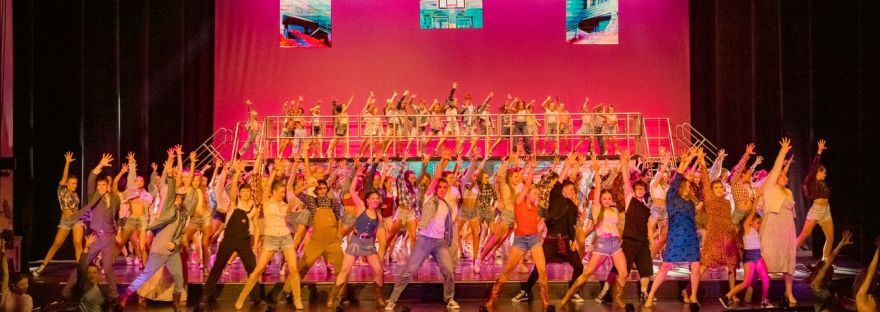
Its breathtaking to think that thirty-three years have passed since 1992’s smash hit musical movie “Sister Act” starring the legendary Whoopi Goldberg was released. Telling the story of a Las Vegas show girl, Deloris Van Cartier, when working a casino in Reno she is witness to a shocking crime. She needs to hide while awaiting to give evidence at the trial and divine intervention steps in as she goes to ground in a catholic convent. Challenged by the mother superior to anything that will make the choir sound better she discovers a new passion for music and is touched by sisterhood making her discover her true place in the world.

Following a sequel movie in 1993, it would be 13 years later in 2006 that the original movie was adapted for the stage in a musical with music by Alan Menken, Lyrics by Glenn Slater and a book by Bill and Cheri Steinkellner. The musical transposes the action to 1978 and the score is a disco infused eruption of joy that puts comedy along with a major dose of pathos at its heart.

The show has enjoyed global success with productions in both the west end and on Broadway. It’s now beloved with local companies and Portobello based Stage Door Entertainment take on the show in their resident venue of the Town Hall and they deliver a production which is Truly Divine!

Directed by Lisa Goldie with musical direction from Tommie Travers and Choreography by Aidan O’Brien the production team have performances at the centre of a show rich in comedy, stunning vocals and heart touch pathos.

Performances across the board are excellent with the simply stunning performance from Tinofara Fombe in the role of “Deloris Van Cartier” which is more remarkable as this performance is her debut in Musical Theatre. She truly captures the essence of Deloris perfectly and has the vocal power to stun those walking by the town hall let alone the audience in the auditorium. Deborah Beveridge channels her best Dame Maggie Smith in the role of “Mother Superior” Beveridge delivers a” Prime of Miss Jean Brodie” take but her comedy timing is peerless and that matches her faultless vocals. Special mention also must go to Orla McDonald Russell in comedic tour de force as Sister Mary Lazarus. While the female roles are the centre of the show, with company fielding a near fifty strong ensemble, there are wonderful performances from the men too. Peter Tomassi gives the right edge of villainy as Curtis and he is supported in wonderful style by Stephen Donaldson, Marc Robertson and Fionn Cameron as Joey, Tj and Pablo respectively. Rounding out a stellar principal cast is Kevin McConnachie as “Eddie” who takes the audience on a journey of self discovery in wonderful style.

Production wise Stage Door have delivered well within the confines of the town hall, Travers, O’Brien and Chris Cowies set design is perfectly judged and Heather McLuskey’s lighting design adds real theatrical magic. At this press performance there was a slight technical delay due to sound issues but Simon Ferguson on sound delivered a faultless show and the audience would never have known the difficulties faced. Lesley O’Brien’s costume design is bang on the money and the cherry on the sister act cake is the stunning 11 strong pit orchestra under the baton of Travers who clearly revel in the show as much as the cast.

Stage Door entertainment have proven there here to stay in the town hall and each production keeps getting better and better. With several more productions planned for the rest of the year the audiences will keep returning. So why not grab a ticket and be blessed with theatrical treat of divine proportions. 

Stage Door Entertainment Presents Sister Act the Musical, Portobello Town Hall runs until Saturday 17th May 2025, for Info and tickets go to: https://www.stagedoorentertainment.co.uk/sister-act-tickets

Brett Herriot Review

Keli, National Theatre of Scotland, Royal Lyceum Theatre Edinburgh, Review:

**** (4 Stars)

Intensely Gripping”

Originally commissioned as an audio play by the Royal Lyceum Theatre and now developed in collaboration with the National Theatre of Scotland and the National Theatre as part of London’s Generate programme. Keli returns to the Lyceum taking up residence on their main stage ahead of a Scottish Tour.

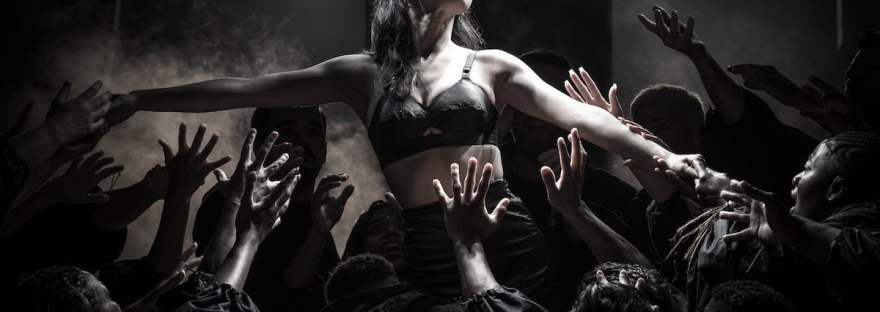
Written and composed by Martin Green and directed by Bryony Shanahan KELI, a taught and emotionally engaging performance from Liberty Black, tells the story of a fiery, sharp witted seventeen year-old in a former mining town in central Scotland. The pits are long gone have little meaning to Keli, but the mines left music in the blood of both the town and its residence. As the best player her brass band has ever had, music is easy. Everything else is a fight. Feeling trapped in small-town life, the pressure mounts in an intensely gripping play that at its heart is an exploration of community, creativity, music and the desire to identify in generation long detached from the struggles of the miner’s strikes and it’s still lingering effects.

Green’s writing while intense does rely on a non ending stream of strong language and while it does convey Keli’s story it eventually gets tiring in a play that clashes “Trainspotting” with “Brassed off” to a highly stimulating effect. While the show does feature both the Whitburn and Kingdom Brass Bands its Green’s compositions that set this show apart. It’s blend of traditional brass band instruments with a modern soundscape really brings the show alive in both intensity and passion and is a beguiling element that makes the show soar.

Performances from the eight strong cast are excellent with Liberty Black leading the company with an high accomplished performance as “Keli”. Karen Fishwick puts in a stellar performance as “Jane/Lady S/Euphonium” a talented musician in her own right with acting ability of true depth.  Olivia Hemmati makes her professional début with a comedic tour de force as “Amy/Saskia”. Phil McKee turns in a finally crafted dramatic performance as “Brian” whose strength and sensibility is a calming factor to the intensity of Keli. Critically acclaimed Scottish actor Billy Mack returns to the show in the role of “William” an ethereal figure from the past but thanks to Mack’s accomplished performance delivers a character of real depth.

Production wise Keli delivers a dystopian world thanks to the Set and Costume design from Alisa Kalyanova whose brilliant design captures the long gone coal seams, to the band rehearsal room and even the Royal Albert Hall with ease. This is enhanced by Robbie Butler’s deeply thoughtful lighting design which is complimented in excellent style by George Dennis’s Sound Design.

Keli is brave as it is capturing and delivers on the National Theatre of Scotland mission to explore untapped theatre makers that represent the best of Scotland and its stories. As Keli heads out on tour it truly delivers a refreshingly adult story that puts music and its power at its heart. Beguiling stuff indeed.

National Theatre of Scotland Presents Keli, Royal Lyceum Theatre Edinburgh, Runs until Saturday 17th May. For more information and tickets go to: https://www.nationaltheatrescotland.com/events/keli#dates-and-times

 The Production will tour to Dundee Rep, Perth Theatre and Glasgow Tramway.

Brett Herriot Review

SLO Jesus Christ Superstar, Festival Theatre Edinburgh, Review:

**** (4 Stars)

A brave production with a passionate heart!”

Fifty five years since its initial concept album was released, Andrew Lloyd Webber’s and Tim Rice’s Jesus Christ Superstar has become an enduring classic of the musical theatre cannon. Telling the story of the final days in the life of Jesus Christ with an anthemic rock score the show has been reinvented many times from the most intimate theatres to full arena productions.

Edinburgh based Southern Light bring the show to the Festival theatre stage for the first time in its 128 year history in a production that is markedly different from anything they have done before. Directed by Fraser Grant with musical direction from Fraser Hume and choreography by Louise Williamson this is a production that borrows heavily from acclaimed west end director Jamie Lloyd.

Lloyd is achieving great success on both sides of the Atlantic with productions of Sunset Boulevard and Romeo and Juliet thanks to his inventive use of live cameras and projections on stripped back sets. Fraser Grant deploys the same style to great effect in a production of the show that brings the show into the modern world. For the most part it works and is aided by the contemporary costume design from Sandra Summers. Choreography by Louise Williamson also embraces the contemporary and isn’t scared to push the boundaries with a heavy infusion of sexuality and same sex couples it’s a joy to watch the well drilled dance troupe in the show give it their all.  

This production truly puts the light onto the performances and there are many west end worthy turns from across the company.  Colin Sutherland as “Jesus” brings a raw intensity to the role and captures from the off and equally delivers strong vocals that emote the feelings of the character with ease. Ethan Baird delivers a more understated turn as “Judas” with the traditional tenor falsetto belt being replaced with an edgy rock lilt in his voice however a lot of the lyrics are lost due to poor diction and annunciation.  The true stand out star of the show is the divine Lara Kidd in the role of “Mary” with powerhouse vocals and a finally crafted characterisation that draws you to her in every second she is on stage, she is indeed a fine west end performer of great skill. Special mention has to go to Darren Johnson as “Pilate” who delivers the most intense and capturing performance of a conflicted soul. This is an impressively big ensemble cast numbering over ninety although for the majority there pushed to the sidelines of the stage almost like additional audience members and they do feel slightly under used at times.

Production wise the show truly succeeds the set design from Fraser Grant and James Gow takes the modern feel up a notch making the large expanses of the Festival Theatre feel like a rock arena and this is bolstered by Gow’s beguiling lighting design  that is a triumph of detail and colour and brings its own emotions to the stage. The live video element also adds to the aesthetic but it does feel like more could have been achieved with it. Paul Smith’s sound design is excellent with a perfect balance between musical director Fraser Hume’s stellar 12 piece band and performers, given its a rock open that’s a tricky balance to achieve but Smith has achieved it with ease.

Southern Light has delivered a brave production with a passionate heart that embraces its ambition to be somewhat of a departure for the company. With a cracking pace and clear story telling it’s a show that captures. However it does feel like more could have been achieved from the individual elements but what you do have is a cracking night of theatre from a musical which has become a modern classic! Wonderful stuff indeed.

Southern Light Presents Jesus Christ Superstar, Festival Theatre, Edinburgh, runs until Saturday 10th May, For more information and tickets go to: Southern Light: Jesus Christ Superstar

Mary Woodward Review

LOOKING FOR ME FRIEND: the music of Victoria Wood, Traverse Theatre, Edinburgh, Review: 

**** (4 stars) 

“A wonderful summation” 

How do you celebrate the life of a much-loved British Treasure who died far too young after bringing joy, fun, and laughter to millions through her work? 

You get Paulus the Cabaret Geek and pianist Michael Roulston [of Fascinating Aida] to bring her songs to life, and laugh yourself silly for a couple of hours in the company of fellow-devotees, that’s what. 

As Paulus quips at the start, it takes two men to do the job of one woman [and only half as well].  It’s almost impossible to put into words just how talented Victoria was.  This bouncy northern woman, whose figure did not conform to the sylph-like dimensions expected by the entertainment industry, and whose accent was most definitely not the expected RP, brought a new way of being funny to our screens in the mid-80s.  A keen observer of people, her uncannily accurate understanding of feelings and motivations, she was never vicious in her humour – always kindly, never belittling even the silliest of people, laughing with, not at them. 

Her way with words was wonderfully witty: she would build a song with ever-increasingly ridiculous phrases which culminate in something so outrageously funny that you simply have to howl with laughter again and again.  She could also do quiet tragedy, pathos, sympathetic understanding of human suffering, with warmth and generosity.  One of the most moving things I remember seeing was Victoria as Housewife, 49, a play based on the wartime diaries of one of the many people who contributed to the Mass-Observation project.  Understated, self-deprecating, unsparingly honest – such a contrast to the bouncy, sparkly pianist with a beaming smile we usually think of. 

Paulus definitely had the bounce, the sparkle, the energy, and Michael definitely had the fabulous piano technique.  Together they gave us a selection of Victoria’s songs and jokes, switching from humour to pathos in the blink of an eye, and celebrating both a talented artist and the legacy she has left in the camaraderie that grows between perfect strangers once they realise they are all ardent fans.  Mention is also made of the wonderful women who joined her in so many dramas – Celia Imrie, Julie Walters, and so many more: there seemed to be no end to Victoria’s talents, and her generosity in writing fabulous parts for her friends. 

Linking all this, Paulus told of the transformational effect on himself as a lonely, chubby boy of eleven who was simply different from everyone else at school.  Her shows were something he could watch with his mum and much older sister.  Finding someone who was also different from the accepted norm of entertainers of the time gave him the courage and confidence to start performing – and look at him now!  A shared love of Victoria’s humour led to a friendship with Michael Roulston – and look at them now, too! 

Impeccable diction in an age where word endings are usually swallowed; a wonderfully flexible and expressive voice; a delightfully outgoing personality – all these attributes belong both to Victoria and Paulus.  I should also add, a bloody good memory – all those words!  And in songs like Northern Song, which is simply a random collection of phrases associated with ‘being northern’, there’s no narrative line to help you along the way.  So many outstanding characters brought to life – the sad, lovelorn eleven-year-old silently yearning for the sixteen-year-old with whom they share nothing but a daily journey on the school bus; the lonely widower who’s just lost his wife and keeps making two cups of tea in the morning; the outrageous goings-on of a Saturday night out; the sad realities of a modern romance.   

We laugh with her at the ridiculousness of life – but are never brought down into gloom and despondency.  We are encouraged to get real, to give up the relentless fight against ageing, and live for now.  One of my favourite songs [new to me] from the evening was the joyous catalogue of all the women as whom she wanted to be reincarnated, culminating in the woman whose Christmas preparations include putting her sprouts on in November…   

If you have a dream, go with it: all there is is now… What better life advice could you ever be given?  And what a wonderful summation of Victoria’s own life. 

What a lovely way to end a show. 

But  

That wasn’t the end 

We did get all we had been waiting for: the Ballad of Barry and Freda, aka Let’s Do It 

Words fail me 

It was brilliant 

What a way to end a show, what a way to celebrate Victoria Wood. 

LOOKING FOR ME FRIEND: the music of Victoria Wood, Traverse Theatre, Edinburgh, RUN ENDED by UK Tour continues for more information go to: www.lookingformefriend.com 

Mary Woodward Review

The Scottish Colourists: Radical Perspectives Dovecot Studios, Edinburgh, Review 

***** (5 stars) 

This is an exhibition which needs visited again and again – it’s so full and rich you’d get violent indigestion if you tried to take it all in in one short visit… I turned up for one of the regular Tuesday and Thursday lunchtime tours, and am very glad that I had sufficient time to restore myself with a bowl of [excellent!] Indonesian soup and a cheese scone before diving back into the exhibition for a more leisurely examination of everything on display.  Of necessity, the tour only looks at some of the extensive collection on display, which includes many exquisite works by other artists alongside those of Peploe, Fergusson, Hunter and Cadell. 

Were there only four Colourists?  Well…there were other artists with similar ideas – but many of them, both men and women, died young, and before the Four had become established as a group.  How come they are a group?  Well… a strong bond of friendship seems to have grown up between them over the years: they went on painting trips together, encouraged and criticised each other, and those who survived longer were devastated by the deaths of their friends.  Why were they all men?  Well… not for the lack of talented female artists of the period, but largely because they died young, often in childbirth.  Why ‘Scottish’?  Well…  three of them came from Edinburgh, the fourth from Bute; they mostly came from wealthy families, so could go to Paris to study and paint – and of course there they came into contact with artists, styles of painting, and ways of living that were in strong contrast to their ‘respectable’ and mostly grey home city. 

And why ‘Colourists’?  Well…there’s a sudden explosion of colour into their work, and with the colour comes life, and joy, and a sense of freedom from care – creating a painting that makes the viewer feel something, rather than simply faithfully reproducing what the artist is looking at.  There are landscapes, and still lifes, and portraits, and accompanying them are a wonderful assemblage of works by artists who influenced, assisted, accompanied the four Colourists on their journey of exploration of the world around them.  Whistler, Singer Sargent, Lavery, Augustus John, Derain and others add context and contrast, and the explanations that accompany the works also name the people who contributed to [or hindered] the gradual coalescence of the foursome into a recognisable group of artists with a recognisable style.  As a Quaker myself, I was interested to learn of the somewhat biased approach to assembling exhibition material of Roger Fry, member of the famous chocolate family, who didn’t seem to think the works of these Scottish artists worthy of inclusion. [but then I wasn’t particularly Impressed by the only example of Fry’s own work – Farm Buildings on display at Dovecot.] 

Okay, enough blethering – what about the pictures?  Well, I could wax lyrical about most of them: and I still can’t quite fix on The One I Would Steal If I Could.  [This approach, which is one I generally employ at exhibitions, leaves out all consideration of how it might fit into my tiny flat or how the theft could be managed!]. It was a joy to see paintings I know well from Scottish collections I’ve visited, and even more joy to see paintings new to me, which I’d happily see again and again. 

One of the most surprising of my ‘likes’ was Composition with Grey Leaves and a Sliced Circle, a work by Duncan Grant which shows the influence Cubism was having: it’s a wonderfully random yet perfectly balanced assemblage of shapes which simply glows with colour.  [On which note, I loved the warm, rich red of the walls on which all the works were hung.]  Another surprise was Robert the Bruce and De Bohun by Eric Robertson.  Labelled ‘ rare example of Scottish Vorticism’, it’s a wonderfully swirling canvas showing the moment when the two heavily-armed horsemen clash in battle in a wonderfully Scottish landscape.  Near that is a Fergusson painting of Three Submarines – another surprise to me, for the subject this time.  Another glowing surprise was Arenig, North Wales by James Dickson Innes, a Llanelli-born artist whose painting to me seemed almost tropical in its feel and colouring. 

There’s a superb drawing by Cadell of his lover Charles Oliver – at a time when homosexuality was illegal, Oliver was referred to as “my most faithful friend” and called his “manservant” – it’s a lovely, intimate portrait which sits beside two other, more ‘public’ Cadell oils of The Boxer [a champion boxer who became a much-loved policeman in the Grassmarket] and The White Shirt, which is thought to be of a Black merchant seaman from Cape Verde who settled in Leith. 

There’s a good sprinkling of paintings by women artists – look out for Anne Estelle Rice’s Seascape with Sailing Boats, Bessie MacNicol’s The Pink Hat, Margaret Rice’s Red Bowl, Devon Cottages and Portrait of Flossie Jolley – but the exhibition’s overwhelmingly male-dominated. 

And of course, there’s a wonderful collection of canvases by the four Colourists – still lifes, landscapes, portraits; old favourites and new delights.  Which one would I steal?  With so many to choose from, it’s a really difficult choice – I’m torn between Fergusson’s Jonquils and Silver from 1905 and Cadell’s Carnations [1913].  I overheard a couple’s conversation which suggested they would nick Cadell’s Loch Creran, Argyll which he painted in 1932. 

Which would you choose?  

The Scottish Colourists: Radical Perspectives Dovecot Studios, Edinburgh, Run Continues https://dovecotstudios.com/whats-on/the-scottish-colourists