Mary Woodward at the Festivals

The Other Mozart, Studio 2, Assembly George Square ( Venue 17), Review

**** (4 stars)

“A Joy”

Maybe you only know of Mozart from the film Amadeus, or Peter Schaffer’s play of the same name, which makes great drama out of the [mostly fictional] rivalry between the young genius and Imperial Court Composer Salieri.  Maybe you know more – of the many tours around Europe when he was a child prodigy, or about the man, his incredible music, his all-too-brief life. 

Most people don’t know that Wolfgang Amadeus had an older sister – she’s there in the family portrait in the house in Salzburg where brother Wolfie was born.  They’re seated side by side at the keyboard, with father Leopold standing magisterially beside the instrument, hand raised as he gives both siblings a lesson.  

Anna Maria Mozart, known affectionately as Nannerl, was herself an accomplished musician, whose talent showed itself at an early age.  Her brother’s talent became apparent even earlier, and canny Leopold took them both on extended tours round the courts of the great and good all over Europe, receiving lavish gifts but not the patronage or employment he so obviously hoped for.   Wolfgang went on to make a name for himself, though never a fortune: Nannerl slips out of the picture in her teenage years, and most people know nothing more about her.

In The Other Mozart, created and written by Sylvia Milo, she and Daniela Galli alternate in the role of Nannerl, who stands centre stage, surrounded by a vast circle of fabric which is strewn with letters and sheets of manuscript paper.  The story we hear is drawn from facts, stories, and extracts from the Mozart family’s letters to each other – copious amounts of letters, since they wrote constantly to each other while travelling between or living in different cities.

Just as Amadeus is narrated from the extremely jealous standpoint of supposedly talentless Salieri, the Other Mozart is a potentially very biased narrative from a jealous older sister.  Potentially, I say – what comes over is Nannerl’s massive feeling of frustration.  She, as I’ve said, demonstrated great musical talent from an early age, and her father was very happy to develop and encourage her: and then Wolfgang was born and everything changed.  

I don’t know if Nannerl was jealous of her younger brother or loved him to bits: nor, indeed, do I know if her talent was less than his.  What is known is that Nannerl and Wolfie were exhibited a bit like performing animals or talented pets – always with Wolfie getting to do the really showy bits – until his sister was in her mid-teens.  And then it all stopped for Nannerl – she was sent home to be with her mother while her brother and father continued touring.

A constant thread running through this show is the outrageously low opinion of women prevalent in Europe in the 18th century.  Women’s brains were lesser than men’s: thinking and reasoning would make them ill.  Their function was simply to be decorative, to please and support their husband, and of course to reproduce.   It was acceptable for them to play a keyboard instrument, but most definitely not an orchestral instrument.  And of course, they were incapable of composition….  After a certain age, it was inappropriate for Nannerl to perform in public – it would seriously lessen her chances of making a suitable marriage.  She could, however, continue to play – “music will be your ornament, with which you will please your husband”.

In Vienna, the Mozarts had met and been impressed by the musicality of Marianna Martines, an unmarried woman who was a pupil of Haydn’s.  She played her own compositions in public, to loud acclaim.  But Nannerl couldn’t hope to emulate her – Martines was of noble birth and had money, while Nannerl had neither.  Back home in Salzburg, Nannerl endured lessons in ‘womanliness’ and housekeeping from her mother while continuing to receive letters from her father and brother telling of all the latter’s troubles and triumphs.

And the story goes on – very little detail about Wolfgang’s career and compositions, some really bitchy reactions to his marriage to Constance Weber, and virtually nothing about the deaths of her father and brother.  We hear quite a lot about her unrealised hopes of marriage to ‘Franz’ and her subsequent marriage to a member of the nobility: as his third wife, which entailed looking after five stepchildren in addition to the three she bore herself.  We also learn of the blossoming of her reputation later in her life, as she became the guardian of her brother’s reputation and works, and was appreciated for her own musical talents, only to be forgotten again after her death.

Today’s show, with Daniela Galli as Anna Maria Mozart and a vast range of other characters, kept the audience engaged, amused and thoroughly entertained.  She paced around the set, drew props out of concealed pockets in the frills of the vast skirt covering the stage, picked up and read from some of the innumerable letters strewn around.  Centre stage was a strange construction, which at first sight could have been the skeleton of a strange creature from a sci-fi movie.  It turned out to be the framework for a corset and the support for the panniers of an eighteenth-century frock, into which at times Daniela strapped herself, mirroring the constricting conventions imprisoning women of the time.  It was a joy to see her, at the end of the show, rise up from the floor and grow into the tall, graceful, whole, talented woman Nannerl Mozart should have been allowed to be.

The Other Mozart, Studio 2, Assembly George Square ( Venue 17), for more information go to: https://www.edfringe.com/tickets/whats-on/the-other-mozart

Mary Woodward at the Festivals

EIF, Book of Mountains and Seas, Royal Lyceum Theatre

*** (3 stars)

“Mystified”

Well that really was something completely different.

How to describe the indescribable?  Twelve singers, two percussionists and six puppeteers – who didn’t get a curtain call, which I think is inexcusable – presented four  ancient Chinese myths, part of a collection itself called The Book of Mountains and Seas.

The legend of Pan Gu, tells of the creation of the world.  The giant Pan Gu hatches out of a cosmic egg and separates its contents into yang and yin, creating the sky and the world.  As he grows, these move further and further apart: when he dies, his body becomes everything in creation, both in the heavens and on the earth.

The Spirit Bird tells of a princess, Nu Wa, who drowns at sea.  Her spirit enters the body of a bird and for all eternity tries to exact her revenge on the sea, dropping into it an endless succession of twigs and pebbles.

The Ten Suns are the children of mother Xi He and Di Jun, God of the Eastern Heaven.  Each takes it in turn to ride around the earth on a Sun Bird, until one day they get tired of doing this and decide to ride round together, causing crops to wither, water to evaporate , and all living things on earth to die.  The god of archery, Hou Yi, is summoned and kills nine of the suns: the tenth is left to bring light to the world.

Kua Fu Chasing the Sun tells of the giant Kua Fu who can’t understand where the sun disappears to each night, and decides to chase it to find out.  He runs faster and faster, and in his thirst drinks dry the rivers and the seas.  He dies of exhaustion: he drops his walking stick, which grows into forests of peach trees.

These legends are all full of meaning for us, in particular questioning our attitudes to the earth we inhabit and the way we relate to and treat the land, the sea, and all living things.  Some of the visual effects were very beautiful, especially the glowing globes of the suns against the darkness surrounding them; the puppetry that created the giant Kua Fu’s running was very impressive.  I particularly loved the shower of peach blossom petals which fell from on high like a shower of fireflies on to the stage.

I wish I could say the same of Hang Ruo’s music and libretto.  The twelve singers of Ars Nova Copenhagen are obviously extremely talented musicians who delivered a score which had for the most part no well-defined rhythmic pulse and for its entirety no sense of tonality or key.  How they each kept time, found their notes, and held them against the conflicting sounds coming from those around them, I have no idea.  Listeners more accustomed than I to listen to contemporary music may have found it deeply meaningful and/ or moving: I found it very hard to enjoy or make any sense of what I was hearing.  Wordless vocalising, mostly on single notes or in very short phrases, alternated with seemingly meaningless syllables, partly from the original Chinese text and a nonsense language invented for this piece.  At one point I began to believe the singers were singing ‘mug-gle, mug-gle’ – but they can’t have been….

It didn’t help that a protruding box on the next shelf up obscured part of the titles and translations that were being projected on to the back of the stage: had I not looked at the on line programme before the show began, I would have been completely lost.

There were some rousing cheers in the applause at the end of the show, but I fancy I was not the only audience member left totally mystified by the whole experience.

EIF, Book of Mountains and Seas, Royal Lyceum Theatre, for more information go to: https://www.eif.co.uk/events/book-of-mountains-and-seas

Mary Woodward at the Festivals

Scotlands Fest, The Heart of Darkness – Ken Currie, Paintings and Writings, St Columba’s by the Castle (Venue 367) Review

**** (4 stars)

“Absolutely fascinating”

I’m always delighted when I get the opportunity to thank an artist or performer in person for their work, and today was such an opportunity.  Ken Currie was in conversation with [retired] art historian Tom Normand.  The two have been friends for years, and Tom has been a witness to Ken’s success as an artist right from his early beginnings as a student at Glasgow College of Art.  As one of the ‘New Glasgow Boys’ Ken was famous in the art world in a way you might associate with being a member of a boy band today.

Unlike previous Scottish artists, Ken didn’t have to teach to make a living.  On the strength of an early exhibition, he was commissioned in 1987 to paint eight panels for the ceiling of Glasgow’s People’s Palace [famous as the home of Billy Connolly’s banana boots].  These paintings clearly demonstrated his interest in Scottish [and particularly Glaswegian] working people and of figurative art as opposed to the abstract styles in fashion at the time, especially among members of the Edinburgh art elite.

In subsequent years a change in Ken Currie’s style and technique began to be visible, with greater luminosity and more universal themes.  In 2002 the Scottish National Portrait Gallery [NPG] invited him to paint the portraits of three prominent oncologists – his first ever portrait commission.  The resulting painting has become the most popular and most visited painting in the gallery.  [It’s one I am constantly drawn to, and I’m feeling the need to see it again asap.]  Ken remarked that people’s reaction is almost always “fight or flight” – it’s an extraordinarily compelling work, with the three men appearing almost ghost-like against a dark and potentially menacing background.

It was fascinating listening to Ken talk about how the painting was made.  The two surgeons were far too busy to sit for him, so Ken spent hours watching them in the operating theatre.  [The third was concerned with research, and equally busy].  All three allowed him to take plaster casts of their faces, so he was able to study how light and shade fell on their faces and incorporate that into his picture. 

Later on he talked about a more recent, equally compelling addition to the NPG’s collection, Unknown man, a portrait of anatomist Susan Black, who is pictured with a shrouded cadaver.  This was not a formal commission, but painted ‘because he wanted to’.  His studio journal at the time, as he tried to make sense of all the things he had seen in the anatomy department in preparation for the work, contained musings about the difference between live bodies in the operating theatre and dead ones in the anatomy department – the latter no longer a living person but a human-shaped object”.

In the Q&A at the end of the session, Ken spoke of being completely incapable of “painting for relaxation”.  For him it is a compulsion: through it he releases his inner tension that comes from his concern for and interest in the many crises, political and otherwise, that surround us locally, nationally and globally.   He also quoted someone else’s observation that an artist only makes 50% of any work – the other 50% comes from the viewer.

Ken Currie: Paintings and writings is a book that arose out of correspondence between him and Tom Normand and draws extensively on Ken’s studio journals.  They show his mindset while working on a painting and is a daily record of his thoughts and comments on what’s going on in the world around him.  He never intended them for publication and stopped writing them for some time after the publication of the book.  He has now resumed – so maybe one day there will be a Ken Currie #2!

This was an absolutely fascinating hour which will result in a visit to the Portrait Gallery as soon as I can make the time.  This was the penultimate session in Luath Press’s ScotlandsFest series – I’m already looking forward to next year!!!

Scotland’s Fest, The Heart of Darkness – Ken Currie, Paintings and Writings, St Columba’s by the Castle (Venue 367) for more information go to: https://www.edfringe.com/tickets/whats-on/scotlandsfest-the-heart-of-darkness-ken-currie-paintings-and-writings

Mary Woodward at the Festivals

An Ode to The Casting Director, The Penny Gilded Balloon Patter House (Venue 24), Review.

***** (5 stars)

“Simply Brilliant”

Life, the universe and Lothian buses conspired to make me miss this show yesterday: I am SO glad I was able to get to it today – it’s brilliant!

As one who’s spent a moderate amount of time auditioning for singing jobs, I was prepared to offer some sympathy to Sophie Fisher during her Ode to a casting director.  I wasn’t prepared for this acutely observed and superbly acted show, which had the audience in fits and at times, I suspect, suppressed sobs.  Certainly the applause at the end demonstrated appreciation both for the artistry of the show and the emotional rollercoaster ride its protagonist experienced.

Life as a struggling artist is bad enough if you have a loving, supportive family and dear ones.  If you don’t it’s total hell…. It’s a miracle our aspiring actress has continued to turn up for anything and everything for which she gets an audition, while shelling out a small fortune on coaching sessions of questionable value.  Her parents are eternally underwhelmed by all she is doing, convinced that she should have continued her law degree and become a solicitor, or at the very least an accountant.  Her boyfriend of eight months has no interest in her career or her as a person.  Her saccharine-voiced [and totally incompetent] agent can’t be bothered to ensure she has the script she needs for an audition: and as for offering any form of support or sympathy – forget it!  We are rooting for her every inch of the way – but will she continue with her resolve to be an actor, or will the mounting tsunami of criticism and discouragement drown her?

The auditions and acting classes themselves are continual exercises in maximum humiliation with minimum return,  every excruciating minute making us cringe still further.  Crisps, screaming Viking warriors, riding a rainbow to land on a sofa, non-drumming, ‘ordinary person’ dancing…

You’d think it couldn’t get any worse – until you encounter the partner exercises with what must be the world’s most un-giving, un-supportive, most self-obsessed wannabe actors.  And there is, of course, the boyfriend’s ‘caring and concerned’ ending of their relationship…. Sophie’s renditions of her acting partners [and the boyfriend] are absolutely spot-on: her co-star [and director]’s Method Acting á la Brando is priceless.

I don’t want to give anything away, but I must give a huge shoutout for the final two scenes – an absolute masterclass in transparent emotional sincerity.

Today’s show was a sell-out.  Don’t delay, get your tickets today!

An Ode To The Casting Director, The Penny Gilded Balloon Patter House (Venue 24), for more information go to: https://www.edfringe.com/tickets/whats-on/an-ode-to-the-casting-director

Brett Herriot at the Festivals

Guys Sing Dolls, Studio at Paradise in Augustines Venue 152, Review:

***** (5 stars)

“A blissful hour of musical cabaret”

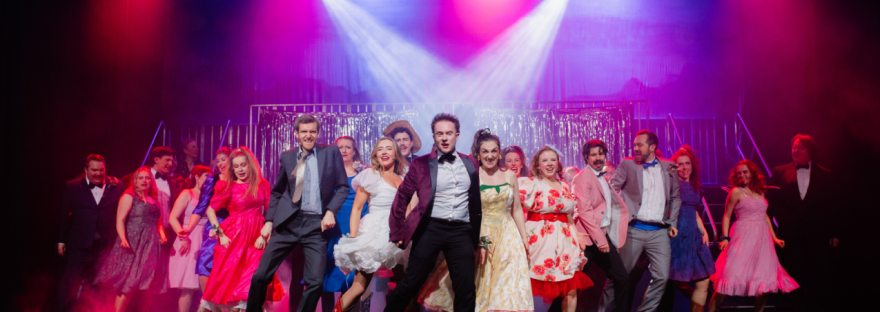
Big Band Does productions have revived their Guys sing dolls concert format following a successful preview in 2024 at Dirty Martini and the company unite four stunning singers, Scott Coltman, Chris McLeish, Marc Mackinnon and Alistair Robertson drawn from across Scotland who deliver a blissful hour of musical cabaret laced with comedy.

The premise is simple four accomplished singers deliver songs most popularly performed by women to great comedic effect but also deliver moments of pathos driven truth that touches the heart. Especially in the case of McLeish heartfelt rendition of Joni Mitchell’s Both Sides Now. The ballads sit perfectly in a programme that includes up tempo numbers and musical theatre classics including an impressive “Gotta get a gimmick” from the titular “Gypsy”.

Produced and Directed by Coltman and Jonnie Grant, female performers are not totally excluded from the performance thanks to a show stopping guest performance from “Heckler” Pippa Evans who gives an inspired take on Oliver’s reviewing the situation to brilliant comic effect.

The whole show is anchored by stylish piano playing from acclaimed musical director Neil Metcalf in a show that embodies the spirit of late-night cabaret with joyful comedy in a mix that shows the very best of the Fringe spirit.

Guys Sing Dolls as a limited Fringe run with just one more performance scheduled on 14th August which is sold out but due to overwhelming demand an additional late-night performance has been scheduled for Saturday 23rd August at 22:30 and would make the perfect finale to a day at the festivals so be sure to grab what remaining tickets there are!

Guys Sing Dolls, Studio at Paradis in Augustines Venue 152, for info go to: https://www.edfringe.com/tickets/whats-on/guys-sing-dolls