Mary Woodward at the Festivals

The fit prince, (who gets switched on the square in the frosty castle the night before (insert public holiday here), Beyond at Pleasance Courtyard (Venue 33) Review

***** (5 stars)

“Enormous fun!” 

It helps that I’m a huge fan of both the Princess Diaries and the Princess Switch[es – all three films] but even if you knew nothing about any of these, you’d still have a wonderfully uproarious time in this show. 

Many in the sell-out audience are obviously huge fans of Awkward Productions’s shows, and know exactly what to expect – topical references, parodic songs, and extreme audience participation.  [Warning: if you’re a shrinking violet, do not accept an invitation to play a part in the show!  If you don’t mind, or actively love, being the centre of an enthusiastic crowd’s attention, grab the opportunity with both hands…]

Swedonia is a fictional country bearing not a little resemblance to the home of IKEA.  The King has just died, and we are at his funeral.  His widow, politicians, and other notables address us via videoconference links before there is a shocking announcement.  Prince Elian cannot inherit the crown unless he marries before midnight on Midsummer’s Eve, only two weeks away: if he fails to do this, the crown will pass to the neighbouring kingdom of Finlandia.  Elian is, of course, an extremely fit prince, but he can’t find anyone who pleases him.  He doesn’t have to marry a woman <phew!> but he meets many potential partners without a single spark flying between them.

Meanwhile, in New York City, Aaron Butcher, a baker, is still reeling from his break-up with the heartless Jakob while trying to make a success of his father’s bakery.  His bestie and assistant Jenny, a very feisty puppet, has been bombarding the Queen of Swedonia with messages which result in an invitation to go to Swedonia and bake the royal wedding cake.  Aaron’s reluctant to – he’s never left New York – but decides he’ll go when his ex turns up at the shop and namedrops his latest lover. 

After a delightfully convoluted journey, Aaron arrives in Swedonia, where an accidental encounter with Prince Elian does not go well – can you guess what happens next…?

The story is delightfully told by Linus Karp and Joseph Martin, with the help of their ASM, some lovely people on video, and the many willing and enthusiastic audience members who gamely brave the unknown and act out everyone else in the tale.  There are two charming horses, some decidedly dodgy orphans, a giggling priest, a seemingly innocuous doppelgänger, a suggestive sauna scene, a fleeting deer, and much much more.  Special credit must be given to the two volunteers who put their hearts and souls into becoming the bass and keyboard players for BAAB, a group bearing an uncanny resemblance to a Eurovision-winning foursome from some years ago: and to the musician – credited as Leland – who produced their wonderfully derivative medley of songs and the ever-sillier verses of the Swedonian national anthem.

It’s not in the least surprising that the whole performance was greeted with loud and loving laughter, nor that the entire audience rose to its feel to salute the cast for their absolutely fabulous [darling] sell-out show – and roared all the louder to learn that Linus and Joseph tied the knot this morning. 

The show blurb promises that The fit prince would be queer, chaotic, comedic and heartfelt – it was all this and more.  A perfect way to spend a Saturday [or any] afternoon celebrating the joy of being oneself, out, proud, alive, and loving.The fit prince, (who gets switched on the square in the frosty castle the night before (insert public holiday here), Beyond at Pleasance Courtyard (Venue 33) for more information go to: https://www.edfringe.com/tickets/whats-on/the-fit-prince-who-gets-switched-on-the-square-in-the-frosty-castle-the-night-before-insert-public-holiday-here

Mary Woodward at the Festivals

Help I’m trapped in a one-woman show, 10 Dome at Pleasance Dome (Venue 23), Review

**** (4 stars)

“Acutely Observed”

Once again I’m in a show which wasn’t what I expected, but which was excellent.

Kate Skinner, an American actor, has us laughing from her first entrance – congratulating us for coming to her show, even though we know it’s about a widow.  She’s 70, and one of the things about getting older is that the people around you, whom you love, start dying…. One of these is her husband Ron Mclarty, whose death five years ago she sees as some sort of cosmic prank.  This show is a posthumous love letter to him – whenever she talks about him, her face lights up into a luminous smile.

It’s also a humorous account of her forays into the world of online dating, begun after she realised she was beginning to see a visiting plumber as more than a workman…  At first, she regarded this as therapy, mere window shopping – but then began to wonder if she could, would, should take it further.  Her best friend, her ‘dating doula’, outlined the steps she should follow – contact, online conversation, coffee or a drink in a neutral space.

Being Kate, she didn’t necessarily do things in the correct order.  And here followed some potentially hilarious but also depressingly familiar stories about encounters with people who weren’t particularly bothered about providing accurate descriptions of themselves, especially where age and height were concerned.  “The attack of the incoming kiss” and the “rotating tongue kiss” were regular features of these encounters, all described with a wealth of acutely-observed and memorable detail and delightfully edgy New York humour.

Along the way, Kate learned much about herself, and it was interesting to see her development from critical observer [as if taking part in a scientific experiment], to someone who began to see her dates’ point of view – maybe they’d not kissed anyone in a very long time?  Maybe the mind-numbingly boring one-sided conversations were because Kate was the first person who’d ever listened?

Kate’s use of language is delightful and evocative: it’s easy to laugh with her, remembering all too clearly hesitantly dipping one’s own toe in the dating pool.  Running through the show are loving remembrances of Ron, increasingly poignant as she loses him to dementia.  With all these memories, is it surprising that she’s happy to walk round the edge of the dating pool, but can’t bring herself to plunge in.

She’s very engaging, a pleasure to watch, her expressive face and body moving easily from joy to sorrow and all points in between.  I resonate strongly with her experiences of trying to engage in conversation with gatherings where most people are in couples and simply can’t cope with a woman on her own – “who knew there were so many ways to disappear?”.  Where I part company with her is that a very long time ago now I was on my own after a lifetime of being unhappy while coupled up.  I decided after some fruitless forays into the world of ‘meeting people’ that I wasn’t going to waste any more time on this, but would instead concentrate on enjoying my own life – if someone came along, fine: if they didn’t, then at least I’d had a life I enjoyed!

Gentle reader, no-one ever came along.  But I’ve had an absolutely brilliant life “on my own” – doing things I enjoy, having good friends, but also being really comfortable with my own company.  A love like Kate and Ron’s never came my way, and part of me envies her.  Another part is glad that she’s arrived at a point in her life where she can celebrate what a gift she had, and celebrate her single life rather than seeing it as a trap from which she’s desperate to escape.

An excellent, thought-provoking, and very funny show which her audience really loved.

Help I’m trapped in a one-woman show, 10 Dome at Pleasance Dome (Venue 23), for more information go to: https://www.edfringe.com/tickets/whats-on/help-i-m-trapped-in-a-one-woman-show

Mary Woodward at the Festivals

EIF, Scottish Ballet: Mary Queen of Scots, Festival Theatre, Edinburgh, Review

***** (5 stars)

“Admiration, Amazement, Awe.”

Scottish Ballet have done it yet again – produced a new work which leaves me speechless, groping helplessly for words with which to express how incredible it is. 

We are gripped from the opening moments, as a spotlit old crone watches in amazement as flakes of snow tumble gently around her in the darkness.  Filled with joy at this sight, she is suddenly twisted in torment and crouches, anguished and frozen.

Elizabeth I of England, at the very end of her life, looks back at the turbulent life and death of her cousin Mary, Queen of Scots.  We see Mary’s gay, carefree life in France, where with her handmaids, the ‘four Mary’s’, she rejoices in the lively atmosphere of the French court, alongside her husband, the Dauphin.  His death cuts short her rejoicing, and her stern and stately mother in law, Catherine de Medici sends her back to her kingdom of Scotland.

In Scotland Mary meets and is attracted to Rizzio, who becomes part of her entourage.  Elizabeth sends Lord Darnley [who has claims to both the English and Scottish thrones] to Edinburgh.  Mary is bedazzled by him, marries him, and becomes pregnant: Darnley and Rizzio begin an affair, which Mary discovers.  Darnley arranges for, and takes part in, Rizzio’s murder in Mary’s presence.

Elizabeth’s principal secretary Walsingham’s spy network is everywhere and sees everything.  Darnley dies and Mary is accused of his murder.  She gives birth to a son, James, and flees to England to seek sanctuary with her fellow Queen.  Walsingham’s intelligence adds fuel to the rumours that Mary is plotting against Elizabeth; he puts pressure on the English queen to sign Mary’s death warrant.  Mary is executed, a scarlet-clad martyr: Elizabeth lives to a great age – but James is waiting in the wings…

Choreographer Sophie Laplane and director James Bonas have co-created a glorious work which deserves a permanent place in any ballet company’s repertoire.  Visually stunning, immensely powerful, and deeply moving, it holds the audience captivated throughout, only allowing them the release of a positive roar of acclamation and standing ovation at the final curtain.  Mikael Karlsson and Michael P Atkinson’s original score is a marvel of invention, superbly played by Scottish Ballet’s orchestra under the baton of Martin Yates.

Soutra Gilmour’s set is a grey box, whose walls at times rise but then fall to create a claustrophobic backdrop for the action – most tellingly when the accusations against Mary appear and increase the pressure Walsingham is putting on Elizabeth.  Bonnie Beecher’s lighting only serves to underline the atmosphere of intrigue, while Gilmour’s mostly black costumes showcase the wealth of the royal courts, black being the colour of cloth only the very wealthiest could afford.  The Dauphin’s silver costume and Mary of Guise’s gargantuan silver framework and costume set them apart from ordinary mortals.  Darnley’s white costume links with the cream of Older Elizabeth and the cream and gold of Younger Elizabeth, whose auburn hair streams fierily down her back.  Mary’s simple velvet costume gleams richly and allows her a freedom of movement denied to her English cousin; an auburn streak in her shining black hair hints at the relationship between them.  The birth and growth of James was brilliantly realised, and the insect-like spies were a stroke of genius!

And then we have the dancing…  I simply don’t have the words to describe it in any technical way: all I can say is that, like everything of Laplane’s that I have seen, it’s inventive, complex and simple at the same time, graceful, joyful, expressive and an utter delight.  As someone whose principal passion is opera, it’s a marvel to me that so much can be expressed without a single word.  Every movement, every gesture, every look speaks volumes. 

Roseanna Leney’s Mary is a marvellous mixture of passion and majesty, tender and haughty in turn, betrayed by her heart and suffering intensely.  Charlotta Öfverholm is incomparable as Older Elizabeth, initially watching events with interest but increasingly conscience-stricken and remorseful.  Harvey Littlefield’s Younger Elizabeth towers over everyone else on stage, the very essence of regal power until she is pressurised into signing Mary’s death warrant and instantly recoils in horror.

Thomas Edwards’ sinuous, snakelike Walsingham, Javier Andreu’s ardent, enthusiastic Rizzio and Evan Loudon’s charismatic, duplicitous and ultimately cold-hearted Darnley were all perfectly cast and all superb dancers.  As ever, Scottish Ballet’s corps is made up of dancers who work perfectly together as a team and shine in all the smaller roles they are given.

And then there’s the lime-green-neon clad Jester of Kayla-Maree Tarantolo, a fascinating and unsettling observer, participant and manipulator of the action.  Sometimes care attendant of Older Elizabeth, at times controller or disturbingly gleeful observer of the action, her slender form appears everywhere, both assisting and initiating the action, sometimes with loving care, at others with almost demonic joy.  An ingenious invention, wonderfully portrayed.

There’s so much more I could say, if only time and space allowed.  The house was packed, the last show is tomorrow: spare a thought for the dancers, giving four performances of this complex and demanding new work in only three days!  I’m so happy to learn that there will be performances in Edinburgh, Glasgow, Aberdeen and Inverness in the next couple of months: I will want to get tickets for all four venues, to experience this fabulous piece again and again…

EIF, Scottish Ballet: Mary Queen of Scots, Festival Theatre, Edinburgh for more information go to: https://www.eif.co.uk/events/mary-queen-of-scots.

Mary Woodward at the Festivals

The Other Mozart, Studio 2, Assembly George Square ( Venue 17), Review

**** (4 stars)

“A Joy”

Maybe you only know of Mozart from the film Amadeus, or Peter Schaffer’s play of the same name, which makes great drama out of the [mostly fictional] rivalry between the young genius and Imperial Court Composer Salieri.  Maybe you know more – of the many tours around Europe when he was a child prodigy, or about the man, his incredible music, his all-too-brief life. 

Most people don’t know that Wolfgang Amadeus had an older sister – she’s there in the family portrait in the house in Salzburg where brother Wolfie was born.  They’re seated side by side at the keyboard, with father Leopold standing magisterially beside the instrument, hand raised as he gives both siblings a lesson.  

Anna Maria Mozart, known affectionately as Nannerl, was herself an accomplished musician, whose talent showed itself at an early age.  Her brother’s talent became apparent even earlier, and canny Leopold took them both on extended tours round the courts of the great and good all over Europe, receiving lavish gifts but not the patronage or employment he so obviously hoped for.   Wolfgang went on to make a name for himself, though never a fortune: Nannerl slips out of the picture in her teenage years, and most people know nothing more about her.

In The Other Mozart, created and written by Sylvia Milo, she and Daniela Galli alternate in the role of Nannerl, who stands centre stage, surrounded by a vast circle of fabric which is strewn with letters and sheets of manuscript paper.  The story we hear is drawn from facts, stories, and extracts from the Mozart family’s letters to each other – copious amounts of letters, since they wrote constantly to each other while travelling between or living in different cities.

Just as Amadeus is narrated from the extremely jealous standpoint of supposedly talentless Salieri, the Other Mozart is a potentially very biased narrative from a jealous older sister.  Potentially, I say – what comes over is Nannerl’s massive feeling of frustration.  She, as I’ve said, demonstrated great musical talent from an early age, and her father was very happy to develop and encourage her: and then Wolfgang was born and everything changed.  

I don’t know if Nannerl was jealous of her younger brother or loved him to bits: nor, indeed, do I know if her talent was less than his.  What is known is that Nannerl and Wolfie were exhibited a bit like performing animals or talented pets – always with Wolfie getting to do the really showy bits – until his sister was in her mid-teens.  And then it all stopped for Nannerl – she was sent home to be with her mother while her brother and father continued touring.

A constant thread running through this show is the outrageously low opinion of women prevalent in Europe in the 18th century.  Women’s brains were lesser than men’s: thinking and reasoning would make them ill.  Their function was simply to be decorative, to please and support their husband, and of course to reproduce.   It was acceptable for them to play a keyboard instrument, but most definitely not an orchestral instrument.  And of course, they were incapable of composition….  After a certain age, it was inappropriate for Nannerl to perform in public – it would seriously lessen her chances of making a suitable marriage.  She could, however, continue to play – “music will be your ornament, with which you will please your husband”.

In Vienna, the Mozarts had met and been impressed by the musicality of Marianna Martines, an unmarried woman who was a pupil of Haydn’s.  She played her own compositions in public, to loud acclaim.  But Nannerl couldn’t hope to emulate her – Martines was of noble birth and had money, while Nannerl had neither.  Back home in Salzburg, Nannerl endured lessons in ‘womanliness’ and housekeeping from her mother while continuing to receive letters from her father and brother telling of all the latter’s troubles and triumphs.

And the story goes on – very little detail about Wolfgang’s career and compositions, some really bitchy reactions to his marriage to Constance Weber, and virtually nothing about the deaths of her father and brother.  We hear quite a lot about her unrealised hopes of marriage to ‘Franz’ and her subsequent marriage to a member of the nobility: as his third wife, which entailed looking after five stepchildren in addition to the three she bore herself.  We also learn of the blossoming of her reputation later in her life, as she became the guardian of her brother’s reputation and works, and was appreciated for her own musical talents, only to be forgotten again after her death.

Today’s show, with Daniela Galli as Anna Maria Mozart and a vast range of other characters, kept the audience engaged, amused and thoroughly entertained.  She paced around the set, drew props out of concealed pockets in the frills of the vast skirt covering the stage, picked up and read from some of the innumerable letters strewn around.  Centre stage was a strange construction, which at first sight could have been the skeleton of a strange creature from a sci-fi movie.  It turned out to be the framework for a corset and the support for the panniers of an eighteenth-century frock, into which at times Daniela strapped herself, mirroring the constricting conventions imprisoning women of the time.  It was a joy to see her, at the end of the show, rise up from the floor and grow into the tall, graceful, whole, talented woman Nannerl Mozart should have been allowed to be.

The Other Mozart, Studio 2, Assembly George Square ( Venue 17), for more information go to: https://www.edfringe.com/tickets/whats-on/the-other-mozart

Mary Woodward at the Festivals

EIF, Book of Mountains and Seas, Royal Lyceum Theatre

*** (3 stars)

“Mystified”

Well that really was something completely different.

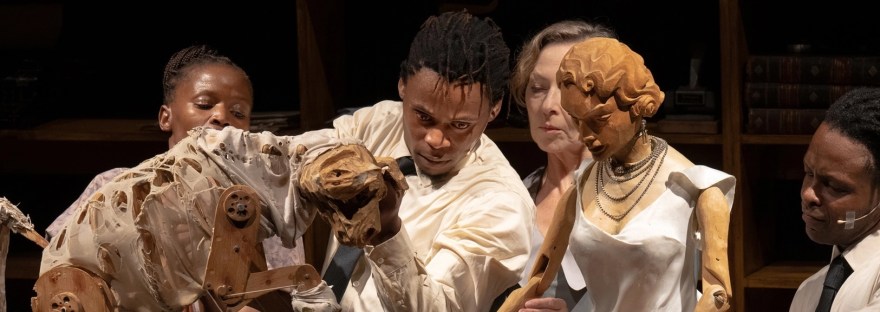
How to describe the indescribable?  Twelve singers, two percussionists and six puppeteers – who didn’t get a curtain call, which I think is inexcusable – presented four  ancient Chinese myths, part of a collection itself called The Book of Mountains and Seas.

The legend of Pan Gu, tells of the creation of the world.  The giant Pan Gu hatches out of a cosmic egg and separates its contents into yang and yin, creating the sky and the world.  As he grows, these move further and further apart: when he dies, his body becomes everything in creation, both in the heavens and on the earth.

The Spirit Bird tells of a princess, Nu Wa, who drowns at sea.  Her spirit enters the body of a bird and for all eternity tries to exact her revenge on the sea, dropping into it an endless succession of twigs and pebbles.

The Ten Suns are the children of mother Xi He and Di Jun, God of the Eastern Heaven.  Each takes it in turn to ride around the earth on a Sun Bird, until one day they get tired of doing this and decide to ride round together, causing crops to wither, water to evaporate , and all living things on earth to die.  The god of archery, Hou Yi, is summoned and kills nine of the suns: the tenth is left to bring light to the world.

Kua Fu Chasing the Sun tells of the giant Kua Fu who can’t understand where the sun disappears to each night, and decides to chase it to find out.  He runs faster and faster, and in his thirst drinks dry the rivers and the seas.  He dies of exhaustion: he drops his walking stick, which grows into forests of peach trees.

These legends are all full of meaning for us, in particular questioning our attitudes to the earth we inhabit and the way we relate to and treat the land, the sea, and all living things.  Some of the visual effects were very beautiful, especially the glowing globes of the suns against the darkness surrounding them; the puppetry that created the giant Kua Fu’s running was very impressive.  I particularly loved the shower of peach blossom petals which fell from on high like a shower of fireflies on to the stage.

I wish I could say the same of Hang Ruo’s music and libretto.  The twelve singers of Ars Nova Copenhagen are obviously extremely talented musicians who delivered a score which had for the most part no well-defined rhythmic pulse and for its entirety no sense of tonality or key.  How they each kept time, found their notes, and held them against the conflicting sounds coming from those around them, I have no idea.  Listeners more accustomed than I to listen to contemporary music may have found it deeply meaningful and/ or moving: I found it very hard to enjoy or make any sense of what I was hearing.  Wordless vocalising, mostly on single notes or in very short phrases, alternated with seemingly meaningless syllables, partly from the original Chinese text and a nonsense language invented for this piece.  At one point I began to believe the singers were singing ‘mug-gle, mug-gle’ – but they can’t have been….

It didn’t help that a protruding box on the next shelf up obscured part of the titles and translations that were being projected on to the back of the stage: had I not looked at the on line programme before the show began, I would have been completely lost.

There were some rousing cheers in the applause at the end of the show, but I fancy I was not the only audience member left totally mystified by the whole experience.

EIF, Book of Mountains and Seas, Royal Lyceum Theatre, for more information go to: https://www.eif.co.uk/events/book-of-mountains-and-seas