Brett Herriot Review

Here & Now, Edinburgh Playhouse, Review:

“Soars into the Audiences Hearts!

**** 4 Stars

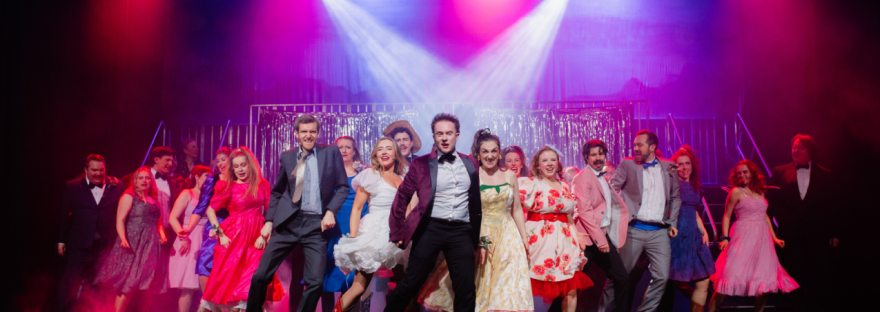
Pop Icons of the 90’s and 00’s Faye, Claire, Lisa, Lee and “H” redefined the power of bubble gum pop as “Steps” shaped a generations childhood and became the soundtrack to many a teenager’s heart. Now the expansive back catalogue of Steps hits has been brought together in a brand-new musical with a book by Shaun Kitchener.

Telling the tale of life in the costal supermarket Better Best Buys and the staff who work there who are of course a close band of friends who seek a summer of love and beyond but is it a dream that’s better best forgotten? or can they truly take a chance on a happy ending? Well, the answer is we get a musical cram packed full of pop classics in a life affirming tale that while light on dramatic bite soars into the audiences’ hearts as they relive the best of their youth.

Lara Denning turns in a finely nuanced performance as “Caz” her dream of adopting lies shattered as her husband walks out her, “Neeta”, Rosie Singha in fine form is in love with “Ben”, Ben Darcy but can’t find the words to confront her feelings. Then there’s “Robbie”, that gloriously cute Blake Patrick Anderson, who is scared to commit to a boyfriend until fabulous drag queen “Jem”, played by River Medway in a show stealing performance, comes into supermarket and Robbie’s heart. Throw into a mix an evil boss who wants to turn Better Best Buys into holiday condo’s and we get a battle of hearts and minds as well as the battle for there jobs.

Yes, Kitchener’s book is cliché central, but it works and is at times very moving as well refreshing to see relationship spanning both heteronormality and the rainbow spectrum with ease. The story really does match up the mantra of Steps Themselves. Directed by Rachel Kavanaugh she delivers well putting the music at the heart of the show but also making the best of the story that the show hangs on. Matt Cole delivers epic choreography throughout ensure those classic dance moves beloved by generations is blended well into routines that pack plenty of poppy fizz. Tom Rogers set design take bubble-gum to the next level with powder pink and blues in abundance and its beautifully lit by Howard Hudson effective lighting design.  Gabriella Slade also delivers the good with a fantastic costume design especially in “River Medway’s” over the top solo number its gloriously camp and gay in equal measure. Adam Fisher’s sound design takes a couple of numbers to settle in, there were some balance issues with onstage performances being drowned out by Musical Director Georgia Rawlins sublime six strong pit band, but it does balance out eventually.

Here & Now is a musical that wears its heart on its sleeve and is a joyous celebration of not only Steps but also how their music continues to transcend time and with a story that’s straight from coronation street it makes it accessible and easy to watch. There is no tragedy in this show as its very much a sparkling night of musical fun.

So make sure your not a deeper shade of blue and 5,6,7,8 your way to the Playhouse as this is the final Scottish Stop for the debut UK tour and I assure you Here & Now will send you into the evening with a smile on your face as your remember just how good those songs are! Altogether now! “Love’s got a hold on my heart!”

Here & Now, A Brand New Musical, Edinburgh Playhouse runs until Sunday 1st March, for more information and tickets go to: Here & Now – The Steps Musical Tickets | Edinburgh Playhouse in Edinburgh | ATG Tickets

The UK Tour Continues

Mary Woodward Review

The BIBA Story: 1964-1975, Dovecot Studios, Edinburgh, Review

**** (4 stars)

Delightful and Fascinating”

It’s hard to imagine life before Biba but, gentle reader, I was there and I remember…  Life was pretty drab and grey, and young people were expected to look like smaller-sized clones of their parents.  The concept of young people as beings with lives, minds and wishes of their own was hard for many people to grasp.

And then suddenly, there was Biba…and nothing would ever be the same again.  It’s hard to believe that the Biba phenomenon lasted little more than ten years and yet had a lasting effect on the world of fashion and the development of a concept of ‘lifestyle’.  For those of us old enough to remember those days, Dovecot’s exhibition offers the opportunity to wander down memory lane.  For those who did not have that experience, come and marvel at the simplicity of the way in which our lives were changed forever.

Barbara Hulanicki, alongside her husband Stephen Fitz-Simon, started a small mail-order company selling inexpensive clothing for women and children in 1963 – Biba’s Postal Boutique.  An advertisement in the Daily Mirror resulted in 17,000 orders for a Brigitte Bardot inspired pink gingham dress.  This success prompted Barbara to give up her day job as a [very successful] fashion illustrator and concentrate solely on Biba.

In 1965 a very small shop in Kensington was transformed into a seeming night club with black walls and random pieces of old-fashioned furniture on which customers could perch while trying to find their perfect purchase.  The emphasis was on affordable up-to-the-minute fashion, aimed at young people with an eye to design but with a very limited budget. 

Initially, the clothes were designed for very skinny young women – Twiggy was an early customer, and the perfect size and shape for Biba designs.  Only 500 of each garment would be made, so a design sold out quickly and the shop’s stock would be constantly changing.  The colour palette of the clothes was also unusual – in addition to black and brown, mauve, rust, plum and purple were much in evidence.  Feather boas and wide-brimmed felt hats became archetypal Biba add-ons, and were much in evidence in Swinging London in the late 60s.

Biba swiftly outgrew its first Kensington shop and in 1966 moved to a triple-fronted shop not far away.  For the first time, men’s and children’s clothes could be bought, alongside many non-clothing Biba products.  Three years later, Biba moved into a shop on Kensington High Street, offering a wide array of clothing, accessories, cosmetics and furnishings.  In 1973, Big Biba was opened, and proclaimed ‘the most beautiful store in the world’.  Formerly the Derry & Toms department store, it was transformed to provide the ultimate Biba shopping experience, with seven floors of merchandise from groceries to cosmetics and furnishings in addition to a constantly-changing array of clothing.  Now one’s entire life could be lived in Biba…

Alas, this only lasted two years.  in a very short space of time, Hulanicki relinquished all right to the Biba name, and moved on into another chapter of her life, not even retaining the majority of her own Biba clothing.

The garments on display in this fascinating exhibition have mainly come from private collections.  Many are from the collection of Sarah Plunkett, the first manager of the first London Biba; others from Lilli Anderson, the last person to stop working at Biba when it closed in 1975; yet more are from individuals who responded to a recent appeal for Biba clothes and memorabilia, and generously allowed them to be displayed here. 

It’s touching to see the small holes and imperfections in garments which have virtually been worn to death, they were loved so much.  It’s also quite scary to see just how small the dresses are, how ridiculously skimpy and tight the sleeves are, and be reminded of quite how short one’s skirt was in the 60s…  Alas, I would never have fitted into early Biba – even as a young woman I was tall and not at all slender – but I suspect that even when Biba garments were made in larger sizes, they would never have looked good on me… <sigh>

There are some fabulous garments on display, and not just simple frocks.  Coats are much in evidence, as are suits of various sorts: and more glamorous wear, including evening wear, marketed as nightwear because that incurred a lower rate of tax…  It’s interesting to see the development from simple shift dresses to more flowing garments, with wider sleeves and an increasingly ‘hippy’ vibe. 

There are some extraordinary fake-fur garments [a snow leopard pants suit!] and some surprisingly vividly coloured clothes, contrasting with the generally sombre palette used.  One singularly gorgeous simple cream dress had me feeling momentarily very light-fingered – but it would never have fitted, and its absence would have been instantly spotted!

The exhibition ends with personal memories of some Biba customers with photos of them wearing their favourite clothes.  There’s also a place where you can write your own Biba memory and put it on the wall with all the others – and spend an age reading them all as you relive your youth…

This is a delightful and fascinating exhibition which is a window into a [goodness me!] now bygone era, when life seemed simpler and all you had to do was work out for how long you’d have to save to be able to afford the next Biba garment or item…  oh happy days!  Go and enjoy!

The BIBA Story: 1964-1975, Dovecot Studios, Edinburgh, Exhibition runs until Saturday 27th June for more information and tickets go to: The Biba Story: 1964–1975

Mary Woodward Review

The Great Wave – Scottish Opera, Theatre Royal, Glasgow, Review

**** (4 stars)

“A Brilliant Concept!”

I don’t know quite what I was expecting with this collaboration between Scottish Opera and KAJIMOTO, but what I found was much food for thought and some exquisite moments fusing art and music.

The Japanese artist Hokusai is probably best known to most Brits as the man who painted ‘that famous picture of the enormous blue wave towering over a tiny mountain’.  Composer Dai Fujikura and multi-disciplinary artist, writer and producer Harry Ross, with the assistance of a team of very talented creatives, offered us a series of scenes from the life of the artist. 

We began in silence: mourners bring single lilies to lay on what one assumes is a coffin – though like so many things in this opera, the shape and purpose of the central object is not immediately clear to a western eye.  Hokusai is dead, but his spirit watches over his daughter Ōi as she remembers coming to live and work with her father.  A shivering Chinese flute provides an unearthly accompaniment.

Hokusai is struck by lightning.  While unconscious, he has a vision of being in a small fishing boat from which he can see a distant view of Mount Fuji.  A giant wave nearly overwhelms the boat.  He becomes consumed with the need to survive, and to paint the Great Wave.

We go back and forwards in time: scenes from the funeral; public art-making by the painter; his financial struggles and the acquisition of a pot of Prussian Blue pigment [‘more valuable than gold’]; the ageing artist sharing health-giving tea with his daughter; his move to Obuse and interaction with the people there: and a final dream-like scene in which the painter’s spirit commingles with and disappears into the mythical Tiger and Dragon. 

Throughout the opera, the constant refrain is “give me ten more years” – Hokusai the artist never sits still, confident that he had ‘got it right’: he is always looking to refine his art so that every line, every dot expresses the essence of what he is trying to portray.

I guess my first reaction was “Quite what is an opera?”  The Great Wave is not filled with jealousy, rage, despair, unrequited, thwarted or forbidden love, dynastic tangles, sibling rivalry, mistaken identities, or tragic deaths: so is it opera?  Certainly there are words and there is music, but any emotions are restrained almost to the point of non-existence.  Blessedly the dialogue is in English, and there are supertitles to help when the pitch of the notes or the timbre of the voice make comprehension difficult.

The music took some getting used to – not because it was not pleasant to listen to, but because it was all completely new, with few ‘comfort zones’ in which to rest for a while.  There was some gorgeously evocative Chinese flute playing – fascinating to see the instrument itself when its player took his bow at the final curtain.  There was a gloriously bubbling accompaniment to the drinking of the health-giving tea offered by daughter to father, and some terrifying moments during the dream-storm during which Hokusai experienced the Great Wave. 

The music certainly doesn’t fit into a standard operatic pattern of conversation [recitative] to advance the action and song [arias and ensembles] in which the singer or singers reveal their feelings.  In telling a friend about the challenges of making sense of it, especially on a first hearing, I was reminded of Debussy’s Pelléas et Mélisande, which similarly consists of a number of scenes [which I described to her as inscrutable] from which one tries to work out quite what is happening and what is each character’s motivation, with little help from the music.   There were very few moments in The Great Wave when more than one voice joined in harmony – and those few were most welcome.   As with other modern works, I feel I would benefit hugely from hearing it more than once, whereupon it might begin to make a lot more sense.

Visually the piece was very impressive.  Initially, a huge whiteish cylinder dominated the stage – until it separated into three sections which, when rotated, revealed a gigantic representation of the Hokusai painting so familiar to us all.  Most of the costumes were creamy-white, so when in the second half Hokusai and Ōi’s costumes were infused with some of the Prussian Blue, it was a striking [and welcome] contrast.   There wasn’t much other moveable scenery – though at times there was a large group of stagehands getting props on and off stage: good that they got their own applause at the final curtain. 

Applause, too, for the puppeteers, whose sinuous weaving of Tiger and Dragon throughout the final scenes contributed hugely to the spectacle.  My companion summed it up nicely when he suggested that Hokusai was dissolving into and becoming one with the world of Tiger and Dragon – a brilliant concept which is difficult to portray on a Glasgow stage: it could be done so superbly with film effects…

Running through the whole piece was a meditation on what is life about? what is being an artist about?   As I’ve said, “Give me another ten years and I will be a better artist” was Hokusai’s constant refrain.  At times we got many of his pictures, projected on to the segments of the cylinder.  Unfortunately for those on the edges of the auditorium, the projections were not always particularly easy to see clearly.  The Great Wave itself, though, was utterly fabulous, on a mammoth scale commensurate with the wave from the artist’s dream.

There was also the challenge of understanding something from an unfamiliar culture. The representations of ‘Japanese culture’ that we receive mostly from western artists and western ideas of what ‘Japanese’ is [think Puccini’s Madam Butterfly, or Gilbert and Sullivan’s Mikado] all very good, but rarely if ever representations of the real Japan. 

My recent obsession with K-drama on Netflix was an eye-opening introduction into a completely different cultural world where gestures, facial expressions, behaviour, and the niceties of language all mean something which I am only slowly learning to understand.  The recent film Rental Families was another instance of how hard it can be for westerners to understand oriental culture.  How easy to judge by western standards rather than try to grasp the reality…  It was very helpful to read the synopsis of the action before the show began: I would have found it equally helpful to have an introduction to the basics of Japanese culture and manners, costume and behaviour!

Cast and creatives, too many to mention individually, have worked together to create a novel and challenging work.  Huge credit to everyone involved in The Great Wave – yet another amazing Scottish Opera first! 

Scottish Opera presents The Great Wave, Theatre Royal, Glasgow, Run Ended. The production will play the Festival Theatre Edinburgh on Thursday 19th and Saturday 21st February for more information and tickets go to: https://www.capitaltheatres.com/shows/the-great-wave/

Brett Herriot Review

Homo(Sapien), The Studio, Edinburgh, Review:

***** 5 Stars

“A Beguiling Exploration of Self, Gender and Sexuality “

Returning to the venue that saw its development during its early days and following a critically acclaimed run at the 2025 Edinburgh Fringe Festival, Homo(Sapien) written, produced and performed by the truly gifted and cute Conor O’Dwyer takes up a slot in Capital Theatre’s The Studio Spring season and not only marks a fitting marking of LGBT History Month but it’s a beguiling exploration of self, gender and sexuality.

O’Dwyer arrives on stage in the character of “Joey” full of sparking energy as Joey is on the cusp of penetrative sex for the first time. Just as the moment almost comes to pass Joey Proclaims that he is a “Bad Gay”. Joey doesn’t need sex he needs to discover himself and his place in the world. What follows is a flash back story of Joey’s life balancing being Irish, Gay and the battle with religion as well a family who may not understand or worse allow bigotry to blind them to the articulate human being that Joey is.

Directed by Jen McGregor this is truly a captivating hour of autobiographical theatre that blends comedy, drama and a deep-seated sense of truth that makes it endlessly captivating to watch. McGregor’s direction is assured and she places both O’Dwyer talent and the truth of the writing at its heart.

O’Dwyer is a consummate performer landing the comedy with ease and his ability to move between characters is seamless but it’s his ability to express a deep-seated reality within the piece that captures the audience he delivers a finely nuanced performance that indicates there is much to come from this stellar performer.

Production wise its simply staged, using just three chairs and a flower bedecked cross but is beautifully lit by Abbie Lowe and features a gorgeous underscore by Manus McGuire and East West Fiddles. This is very much a slice of the fringe brought to audiences on cold winters night but fills the audience’s heart with hope and the power of self-discovery that believing in oneself anything is possible.

Homo(Sapien) is a play that wears its heart on its sleeve yet captures everything The Studio was set up to achieve, giving space for new writing to develop and new performers to shine and this is one play that does that in spades so head to The Studio for the last few tickets to the final performance.

Homo(Sapien), The Studio, Edinburgh, The production runs until Saturday 14th February for more info go to: https://www.capitaltheatres.com/shows/homosapien/

Brett Herriot Review

Kiss Me Kate, Church Hill Theatre, Edinburgh, Review:

“West end worthy moments!

*** 3 Stars

Kiss Me Kate with music by the iconic Cole Porter and book by Bella and Samuel Spewack is approaching its 80th anniversary since its debut at the Shubert Theatre in Philadelphia prior to its Broadway opening at the New Century Theatre in December of 1948.

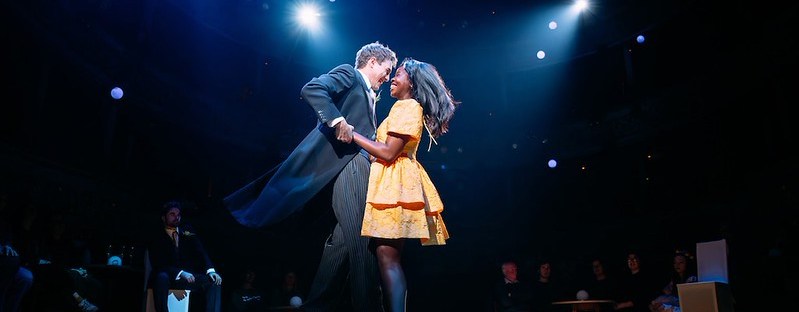
Written as Porters response to the success of Rodgers and Hammerstein’s Oklahoma! Kiss Me Kate is essentially a show within a show as we watch now divorced couple Fred Graham (a taught leading man performance from Ewan Robertson) and Lilli Vanessi (Nina Birbeck in fine bitchy form) trying to get along as they perform Shakespeare’s The Taming of the Shrew. Add to the mix a secondary love story and 1940’s gangsters we end up with a parable of Shakespeare’s finest comedy retooled for a more modern generation.

The inherent problem with Kiss Me Kate and the reason its not often performed by amateurs and pro’s alike is the writing hasn’t stood the test of time all that well, two generations have passed since its creation and its attitudes and mentality don’t stand up all that well to modern audiences combined with the fact the show runs at a shade over three hours it’s a challenge and them some. However, its one which director William Freebairn has taken to with gusto.

Freebairn has whipped his 19 strong ensemble company into a well drilled cohort even if some of the end results are uneven. Performances from the leads are excellent with both Robertson and Birbeck leading the company in accomplished style. The same is true of Elham Khosravipour and Dan J Bryant as Lois Lane and Calhoun respectively especially Bryant has a real talent for comedy characters. The company shine especially brightly when delivering Caitlin Visser and Lyss Britton co choreography. They push both the company and constraints of the church hill stage to it limits and deliver west end worthy moments especially in “Another Op’nin, Another Show” and “Too Darn Hot”

Speaking of “Too Darn Hot” whilst the choreography is sublime special credit goes to the gorgeous Aaron Venter as Paul who delivers the song with great skill and an impassioned performance. Sadly, it was let down spectacularly by the awful sound quality. Co Sound designed by Sam Burgess and Luke Hardwick. There were major sound issues throughout the performance with balance, clarity and feedback running riot. Some mic levels were set blisteringly loud others didn’t have enough volume. Sadly, for Venter his Microphone completely broke down and while he did the right thing and raised his game and projection the sound desk persisted in leaving his microphone live drowning him out spectacularly with popping and banging a plenty complete with roaring loud moments when the Mic did kick in sporadically. They would have been better in killing the mic and letting Venter deliver the sparkling number without the sound massacre he endured. To Aaron Venter’s credit he still delivered the number in style.

Sound aside the production elements deliver well with Lily Goodchild’s lighting design delivering an old school feel that benefits the show and Danby Lee and Charlie Smith set design also makes the best of the space available. Eloise Robertson’s costume design captures the era but would have benefited with more variation. The true cherry on the cake is musical director Emily Smith and her 15 strong pit band who are utterly sublime especially Percussionist Ethan James who is given free reign with his Jazz Skill.

The Footlights Kiss Me Kate has a fourth star in its grasp and delivers much for a show that’s very much from a by gone era but the audience cant help but be won over by the cast who give it there all and deliver an entertaining evening of musical theatre.

Edinburgh University Footlights presents Kiss Me Kate, Church Hill Theatre, Edinburgh runs until Saturday 14th February, for more information go to: Kiss Me, Kate – Tickets | Fienta