
***** (5 stars)
“A Fabulous piece”
Having gone to the Storytelling Centre not quite sure what to expect, I came out of the theatre on Sunday afternoon going “that was f***ing brilliant!”
Alas, my editor wouldn’t accept a four-word review: so here’s my attempt to explain why this piece was so very good…
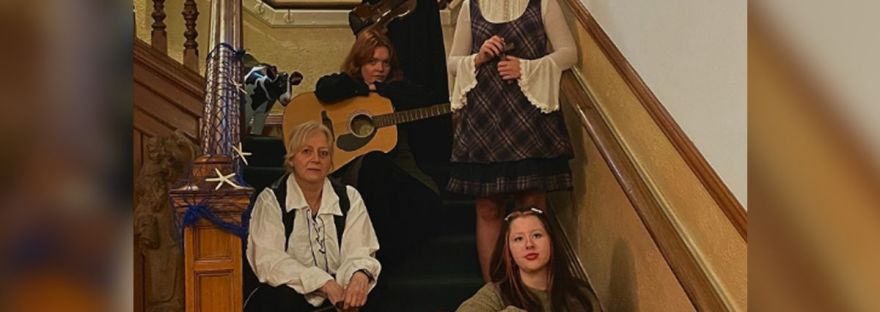
Five very talented women – Lorna McFarlane, Sydney Mulligan, Gracie Spencer, Alannah Skellett and Lori Stott – invite you to consider what comes into your head when you hear the word witch. Pointy black hat? Hooked nose? Horrible warts? Green face? Undoubtedly some cackling in there somewhere, a cauldron over a log fire, double double toil and trouble….
Come with them to the picturesque seaside village of Pittenweem on the Fife coast. Lively, sunny, touristy: but hiding dark and shameful secrets which should make you boil with rage and determine “never again”… It’s still a wee village where awbody kens awbody [and awbody’s business] – but back in the day there were terrible things afoot.
It’s 1704. Witchcraft has been a capital crime since 1563. King James VI and I’s book Daemonologie is a royal defence of witch-hunting. Any inexplicable natural phenomenon – bad weather, poor harvests, sudden sickness or death, outbursts of plague, failure to find fish – is blamed on witches and witchcraft. Accusations, trials, imprisonments, torture, killings are rife in Scotland – and the vast majority of the accused are women.
It was enough to be loud of voice, confident, prosperous, single, or simply different – and there was very little possible defence. Witches’ power obviously derived from the devil – and the church was terrified of the devil, so accusations of heresy abounded. And of course, the church, the minister, and any men who felt they had authority, were terrified of any woman whom they saw as a threat to their power, and ready to believe any man who made an accusation against them.
Thus we have 16-year-old Patrick Morton, who works in his father’s blacksmith’s shop in Pittenweem, starting rumours about Beatrix Layng whose request for some nails he refused, saying he needed them for urgent work at the nearby harbour. Patrick claims to have fallen ill because Beatrix cursed him: this claim excites the attention of the local minister, Patrick Cooper. Cooper’s obsessed with uncovering the works of the devil, and it’s quite probable that he ‘helped’ the young Patrick Morton to name more names. And so the whole hideous tale unfolds, given poignant voice by some incredible songs and stirring outbursts from the wronged women. Alongside this painful narrative run equally distressing modern parallels.
At the end of the piece Patrick Morton confesses that he’s made the whole thing up – “I had to show her who’s in charge – don’t judge me for my sense of humour…and yet again the male defence of ‘I want you so you have to give me what I want’ plus ‘can’t you take a joke?’ leave me enraged. How many have to die before you take a stand? echoes down the ages – will it never end?
This is a fabulous piece which does its best to avenge past wrongs, give voices to the voiceless, and stir our hearts and consciences. At the same time it’s superb entertainment and a very cannily-wrought piece of theatre. Atmospheric lighting, wonderfully surreptitious costume- and character-changes, intricate choreography, evocative music expertly played, moments of delightful tongue-in-cheek humour, a sharply pointed script, haunting singing and passionate performances add up to something that is, indeed f***ing brilliant.
Witches Corner simply has to come back on stage very soon. When it does, don’t miss it!
Encapulus Productions present Witches Corner, Witches Corner, Scottish Storytelling Centre, Edinburgh, RUN ENDED

 ScotsGay Arts