
***** (5 stars)
“Absolutely superb”
Four young men – a poet, a painter, a musician, and a philosopher – struggle to make a living in Paris. It’s Christmas Eve, freezing cold, and they are cold, hungry, and penniless. Rodolfo, the poet, burns some of his manuscripts for a fleeting moment of warmth while Marcello, the painter, thinks longingly of Musetta, his former lover. Schaunard, the musician, and Colline, the philosopher, arrive with some food to share. Their landlord hears them horsing about and comes demanding the rent they owe him, but they distract him and slip away to join the fun in the streets outside. Only Rodolfo remains, trying to finish something he’s writing.
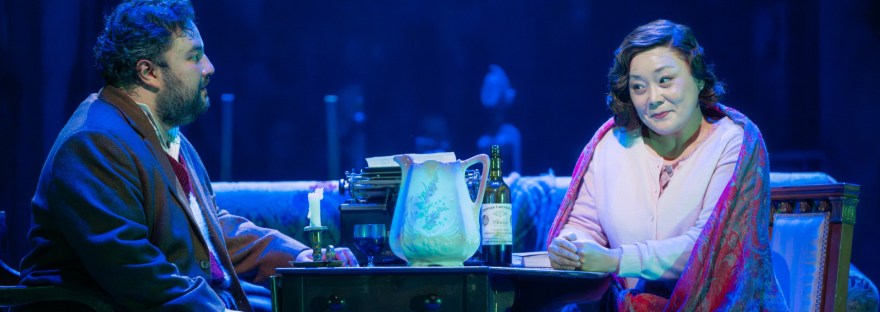
A knock at the door heralds the arrival of a young woman who lives upstairs: her candle has gone out and she needs to relight it. She then drops her key and can’t find it again – both candles have now gone out… In the darkness the two collide, and Rodolfo realises she is very cold – her hand feels frozen. He tells her about his writing: she tells him she embroiders flowers for a living, and that although her name’s Lucia, everyone calls her Mimi. The two fall in love, and go out to join Rodolfo’s friends at the Café Momus.
The streets are full of people rushing to complete last-minute errands, sitting enjoying themselves, or simply watching the world go by. Mimi meets Rodolfo’s friends: Marcello is in agonies watching Musetta with Alcindoro, her latest elderly admirer. He realises he still loves her: together they and the others disappear, leaving Alcindoro to foot their bill.
A couple of months later, things aren’t so rosy. Mimi is constantly distressed by Rodolfo’s irrational jealousy, and tells Marcello she is going to leave him. Rodolfo in turn confesses that he’s worried about Mimi’s increasingly poor health. The two lovers agree to stay together till the spring comes, but Marcello and Musetta break up again.
Spring has come, and Marcello and Rodolfo try to pretend they don’t miss the two women. Schaunard and Colline arrive with food to share, but they are interrupted by Musetta, who says Mimi is dangerously ill. Musetta leaves with Marcello, intending to pawn her jewellery to pay for some medicine and a doctor. Schaunard and Colline go to pawn Colline’s overcoat, leaving the two former lovers to remember happier times. The others return, but only in time to witness Mimi’s death.
This production – a revival of André Barbe and Renaud Doucet’s 2017 production for Scottish Opera – is, in the main, absolutely superb, as is the lighting design of Guy Sinard. The show opens with a crowded scene in present-day Paris, with tourists waving selfie-sticks, pawing through antique shops’ offerings, and listening to a street singer. A young woman with a pink knitted hat sits and listens to an old gramophone record – the lights dim and she is transported back into the past, to the garret where two young men are trying not to freeze to death…
So far, so good – though I guess if Mimi dies at the end of the opera, how can she be in Paris looking back at her past life…? [it’s opera, don’t ask awkward questions!] The time-travelling is infinitely more jarring at the start of the second half – we’ve gone back in time, so why bring us back for a mostly incomprehensible present-day scene with migrants and protesting dairy workers which then somehow mutates to the street scene between the four lovers?
The intimate scenes are superb – each of the six major characters is real, passionately alive and wanting to feel all the intensity of the emotions sweeping through them. The crowd scenes are handled brilliantly – one could see them many times and still find new bits of business one hadn’t seen before. The chorus, and the newly-formed children’s chorus, are all magnificent. The principal soloists all have gorgeous voices, and Scottish Opera’s orchestra under Stuart Stratford played as thrillingly as ever – though I could wish that, at the most intensely emotional moments, they hadn’t swamped the singers’ top notes. Mario Chang and Hye-Youn Lee were an excellent pairing as Rodolfo and Mimi, though I found Roland Wood and Rhian Lois’ Marcello and Musetta a much more engaging duo – loving to hate and hating to love each other, they kept stealing the show. Edward Jowle had already impressed me in his roles in the double bill Scottish Opera presented earlier this year: he did so even more as Schaunard. Callum Thorpe’s voice was a joy to hear, and he made the most of Colline’s contributions – especially his farewell to his coat.
The real problem I have with this opera is the conflict I feel between what the music is saying and the reality of what’s being presented on stage. When I was younger [and especially when in love] I wallowed in the lush romantic music – love sweeps you off your feet and conquers everything, it’s the most important thing in life… And then I matured, and slowly and painfully learned that being swept off one’s feet isn’t the best basis for a sound relationship, so that I can’t watch something like Bohème without an internal critical commentary on the main protagonists’ behaviour. But then – they were young, and foolish, and maybe I need to be a bit more charitable: after all, I made some utterly appalling life decisions when I was their age…
Suffice it to say that, despite all my internal grumpiness, it was a splendid evening, overriding all my objections and showcasing the very best that Scottish Opera has to offer. Come and relish the joy of being alive, and in love; marvel at the overflowing energy of the crowd scenes; and shed a tear [or several] at the sad bits. Let this glorious production and Puccini’s heartrending music carry you away to the land where all that matters is love: save reality for another day.
La Bohème, Scottish Opera, Theatre Royal, Glasgow, Runs until Saturday 25th October for more information go to: La bohème | Scottish Opera
The Production will also visit His Majesty’s Theatre Aberdeen Wednesday 30th October – Saturday 1st November, Eden Court Theatre Inverness Thursday 6th November – Saturday 8th November and the Festival Theatre Edinburgh Friday 14th November – Saturday 22nd November.

 ScotsGay Arts