
**** (4 stars)
“An extraordinary show!”
The stars are for the visuals, the wrapping paper rather than the content. On my way out of the theatre, two friends each separately expressed total bewilderment at what Faustus in Africa was trying to say – which comforted me, as I’d spend the whole evening trying to work out quite what was going on.
I wanted to see the show simply because Handspring Puppet Company, who created the unforgettable horses in Michael Morpurgo’s War Horse, were performing in this show, created by William Kentridge. The Faust legend is familiar to me from both theatre and opera, but I have to say it was hard to follow quite what was being said in this version of the narrative, which had us travelling by seaplane around the continent of Africa.
Faust is extremely learned and successful, but totally dissatisfied with his life. He makes a deal with the devil, promising his soul in exchange for unlimited knowledge, wealth and power. The devil grants his every wish, but Faust is never satisfied, constantly seeking some new sensation. At the last minute, as Mephistopheles is about to collect his soul, he is thwarted and Faust’s soul goes to heaven.
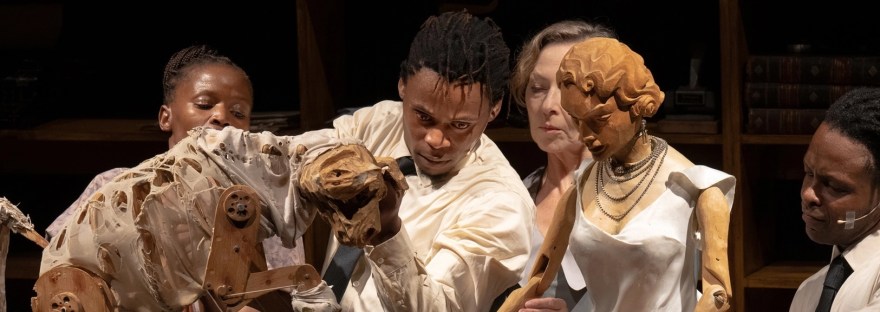
In this production, Mephistopheles was played by a human actor, while the puppeteers not only voiced and brought the other characters to life but also played all the minor, human characters. A clever, multi-layered set representing Faust’s extensive library led the eye to a screen at the back of the stage on which were projected an almost incessant and frequently bewildering series of images. Information, commentary, illustration continually demanded our attention, while supertitles overhead added further to the visual distractions as we struggled to work out who was who – and quite when the action was taking place – on the stage below.
Faustus in Africa was first performed in South Africa in 1995, and the audience there would have understood many of the cultural references that were not clear to me last night. My greatest source of confusion was the superb animal puppet [that perhaps represented the spirit of native Africa] which seemed to be meant to be a dog, but appeared to have a horse’s tail and hooves and behave at times much more like a cat. The significance of the rulers and politicians was also to some degree lost on me, not the most politically clue-up person on this earth…and the locations on Faust’s whistle-stop tour of the continent also failed to resonate with any great significance. A pity.
What came over very clearly was a rising tide of anger at the exploitation of the continent by European colonial powers. Gradually every asset was being stripped from the land, rulers were replaced by puppet governments, and the wealth accrued by Faust continued to increase. Faust was about to lose his soul – but was redeemed by Mephistopheles, who needed him and all the corrupt officials to maintain the status quo and continue bleeding the continent dry.
The puppetry was exactly what I’ve come to expect from Handspring – so accomplished that I was confused not to see Faust in the curtain call, and had to tell myself ‘but that’s because he was represented by a puppet’… The actors who give voice and movement to the figures are beyond words brilliant and deserved every moment of the thunderous, if confused, applause which greeted the end of the show.
Thirty years on, has anyone learned anything? I fear not…
EIF, Faustus in Africa!, Royal Lyceum Theatre, for more information go to: https://www.eif.co.uk/events/faustus-in-africa

 ScotsGay Arts