
**** (4 stars)
“What a delight!”
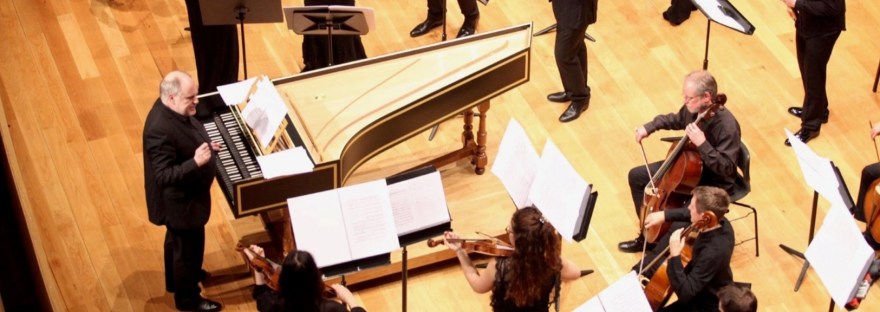
What is described in the programme as “an early comic cantata” from Handel was a real treat, with the expected superb playing from the Dunedin Consort under John Butt being joined by some equally superb singing from Julie Roset, Nardus Williams and Reginald Mobley.
The plot is simple. Tirsi and Fileno are both in love with the lovely shepherdess Clori. Tirsi is in anguish because he knows that his love is untrustworthy: it causes him intense grief and pain but still he can’t help loving her. Fileno is also aware of his love’s inconstancy, but seems a little more resigned to it. Clori seems simply to love playing up to both of them, promising constancy, saying she loves whichever one she is talking to, and promptly flattering and seducing the other when the first one’s back is turned.
This seems like the recipe for disaster – shouting, screaming, bloodletting at least, murder at worst: but this is a Handel comedy, not a tragedy, and it all ends happily – in the supertitle translation we were offered, the two lovers agree that to live and not to love is impossible, so they must accept the pain that comes along with this. Clori certainly seemed perfectly happy with this arrangement, but I don’t know if Tirsi and Fileno were quite so sure…
Tirsi was the first to take the stage. Sung by English soprano Nardus Williams, Tirsi was somewhat self-pitying. It’s vain to hope that her heart will be as faithful as mine, he sings – and then berates himself because, despite the pain he feels, his heart continues to forgive Clori. She enters, and Tirsi hides to watch her – knowing that he’s going to suffer yet again.
French soprano Julie Roset’s Clori is really pleased with herself and her situation. Her opening aria has a pair of recorders providing the birdsong accompaniment as she tells the nightingale to sing to her lover. Fileno [African-American countertenor Reginald Mobley] enters and Clori tells him how sorry she is to reject him, while not really meaning it at all. Tirsiis a helpless and increasingly irate witness as Fileno begs Clori to swear to be faithful – but even when she has done this, Fileno still doesn’t feel confident or safe. There’s a wonderfully fiery trio of conflicting emotions before Fileno and Clori smilingly sing a duet anticipating future bliss to conclude the first half.
Tirsi rebukes Clori, and [my notes say] ‘they have a right spat’. Tirsi can’t take any more – do you want to kill me? he sings as the two vocal lines beat furiously against each other before uniting again. Alone, he rages: there’s no wild beast – nor anything in the underworld – more ferocious and cruel than you, he sings. It’s Handel at his fiery best, with Tirsi’s furious streams of notes cascading everywhere and trumpet-like oboes ringing out against them. Clori does her melting ‘ooh, little me: how can you be so cruel as to disbelieve me? I love you, Tirsi’ act utterly brilliantly, and the heartrendingly beautiful violin and cello interjections convey the truth of the emotions that I fear Clori herself simply cannot, or doesn’t want to feel.
Fileno asks how anyone can trust the promise of a girl. Poor fidelity, he sings: how rare you are. Cello and theorbo alone accompany this aria – it’s an utterly gorgeous accompaniment. Tirsi pours out his grief to Fileno – I heard her promises to you, and my grief is like yours. His aria is a wonderful description of the excellence of her deceitful ways – her sighs, her pale lips, her sidelong glances can all soften a heart of stone. He suggests the two of them let go their jealous anxiety and instead be friends. Toby Carr then has the most wonderful theorbo solo before Jonathan Manson’s cello and Matthew Truscott’s violin join in the interjections to Fileno’s aria – the swallow, even though wounded, rejoices to be back in its nest in Egypt: better the pain that’s known than the impossibility of life without the beloved object. A lively trio closes the cantata.
The singers were all new to me, and I look forward to hearing them again. In the first half Reginald Mobley sounded as though the arias lay in the wrong part of his voice, making his bottom notes forced and disconnected from the rest: the second half’s arias were a much better fit. Nardus Williams’ rich golden voice and fiery outbursts were a delight to listen to, making me keen to hear her sing Partenope with ENO later this year. But the crown has to go to silvery-voiced Julie Roset – utterly incomparable both vocally and visually, enjoying every second of her manipulation of her two lovers, and seemingly completely indifferent to the pain her duplicity causes them.
The Dunedin Consort delight me every time I hear them play – and this was no exception. Their mastery of their instruments, and their deep understanding and enjoyment of what they play, is always a joy to witness. The music, too, was a marvel – early Handel, already showing such deep understanding of the human heart and all its emotions. It also demonstrates his green credentials – his ability to re-use and recycle music written earlier: several of the movements in this only recently re-discovered cantata were familiar to me from later operas.
Small wonder the Queens Hall audience erupted into loud and prolonged applause at the end of the performance: another triumph for John Butt and the Dunedin Consort.
EIF, DunedinConsort and John Butt, The Queen’s Hall, for more information go to: https://www.eif.co.uk/events/dunedin-consort-john-butt

 ScotsGay Arts