
***** (5 stars)
“A Triumph”
Utterly astounding! Brilliant, breathtaking, beautiful beyond belief…
Here the Orpheus legend was pared down to its very bones: Euridice is dead on her wedding day, Orpheus is inconsolable. Amor, the god of love, is moved by his grief, and permits him to go to the underworld to bring her back to life – but he must neither look at her nor speak until they are once more in the land of the living. Orpheus braves the tormented spirits in Hades and arrives in the realm of the blessed spirits, where he finds his beloved, and tells her to come with him. She cannot understand why he will neither look at her nor speak to her – does he no longer love her? Her anguished pleading eventually overcomes his resistance: he turns, speaks – and she drops dead. Even more grief-stricken, he longs for his own death. Amor consoles him and rewards his great love by bringing Euridice back to life. Cue general rejoicing.
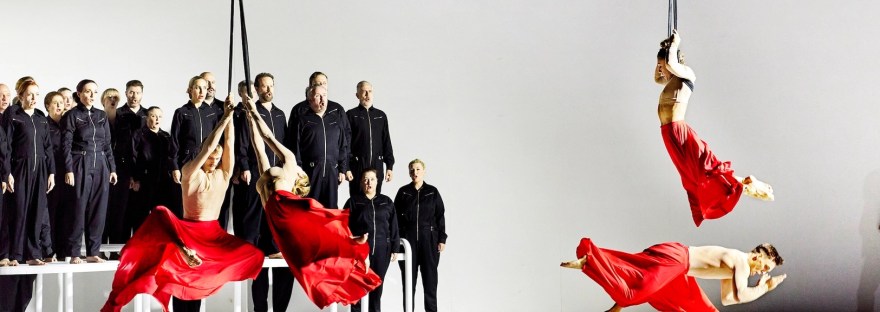
Only in this production, it doesn’t quite turn out that way… As the curtain rises, we see Orpheus manacled to a bed in a sterile white environment: what follows suggests that everything we see on stage is a product of his grief-stricken madness. In a stark black and white environment, the only note of colour is the shocking red of Euridice’s dress – the colour of blood, of life itself. Can love triumph over death, or is death the only certainty in this world…?
Superbly supported by the brilliant Scottish Chamber Orchestra under Laurence Cummings, Samantha Clarke and Iestyn Davies are joined on stage by a chorus of artists from Scottish Opera and Circa, an Australian-based ensemble of circus artists. Their extraordinary display of acrobatics, tumbling, and aerial work bring involuntary gasps of amazement and apprehension from the audience.
Orpheus is surrounded by bodies leaping, tumbling, writhing around his bed. People build themselves into towers and the topmost members fall like stones to the floor, being caught, or curling themselves to safety at the last possible moment. There’s a mesmerising piece of aerial work with two immensely long bands of cloth, and innumerable other feats both on stage and in the air that leave one’s jaw hanging open in disbelief.
Even Orpheus is drawn into the action as he climbs ever higher over a pile of bodies on his journey to the realm of the blessed spirits, while Samantha Clarke in her role as Amor sings suspended in mid-air, as befits the god of Love. The chorus are superb as they interact with Orpheus and moving the plot forward: thankfully they remain for the most part at stage level.
And weaving around all this is Gluck’s sublime music, expressing the deepest human emotions pared down to their basic essence. Iestyn Devies is an incomparable Orpheus, his voice ringing clear and true and so full of pain it hurts to witness it. And there’s the rub: while such anguish is being poured out, should there be the distraction of extraordinary feats of Circa? Much of the time, it’s completely appropriate, giving physical shape to Orpheus’ torment – but in the most intense moments, it was an unwelcome distraction.
That aside, the production is a triumph. Visually stunning, lit to perfection, shocking in its simplicity, small wonder the 3,000-strong Playhouse audience erupted in a storm of applause at the final curtain.
EIF, Gluck: Orpheus and Euridice, Edinburgh Playhouse, for more information go to: https://www.eif.co.uk/events/orpheus-eurydice

 ScotsGay Arts