
**** (4 stars)
“An excellent hour”
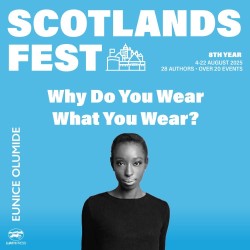
And now for something completely different – from the northern wastes of Scotland to the heart of the fashion industry, in the company of Scottish supermodel Eunice Olumide. She was in conversation with Gemma Metheringham, whose linked in profile describes her as “a circular fashion business model consultant”.
Eunice is a modern polymath, the contemporary equivalent of a ‘Renaissance man’ – Gemma’s introduction listed some of her many spheres of action and interest, which they seemed virtually endless. Not ‘just’ a supermodel but [among other things] an actress, film maker, entrepreneur and ambassador for Zero Waste Scotland who has a postgraduate degree in film studies and an OBE. With all that, you might be forgiven for thinking she might think rather highly of herself, but she comes across as very down to earth and grounded. She grew up in a black family in Wester Hailes and knew what it was like to be unable to afford to buy the things that you simply had to have if you were to be at all cool. She learned from her mother how to make the garments she wanted to wear, and in doing so learned that with the clothes she made, she could create her own unique personality.
Eunice and Gemma’s conversation ranged far and wide, but certain themes kept recurring – social isolation, the waste inherent in today’s fashion industry, and the many small actions it’s possible to do, and so find some solutions. Eunice remains impressively hopeful, despite all the challenges facing the world today: she believes that the majority of people are inherently good, and that change is possible. One of her favourite phrases was “we can do anything we want to do”.
Some of the things they talked about:
Bonding by making things together, creating intergenerational and cross-cultural links instead of being trapped and isolated in small monothematic social bubbles. Growing things, cooking and sharing food together increases our sense of closeness to other people. “Exchanges of humanity make us more happy in life”.
Create your own distinctive clothing by recycling and repurposing previously worn garments. Dispose responsibly the things you no longer wear.
Show younger people that making things is cool. Pass on your skills, or at least write them down somewhere for when others suddenly realise they have a need for them. Encourage young people to make things, and create new from old – “they like making things, they just don’t know that they do.” Present them with alternative ways of doing things: show them the possibilities
Cheap clothing is an expensive mistake. Save up and buy a good pair of shoes, then create a wardrobe of your own from second-hand stuff. [my note to self – remember the Sam Vimes Boots theory of economics – that the wealthy spend a lot less money on clothes because they buy expensive, well-made things that last, instead of continually having to pay out for cheap and shoddily-made things.]
Clothing tells stories about our identity, can bring us together intergenerationally, and could invite us to involve ourselves in geopolitics. We are all part of the fashion industry which is failing to uphold decent standards, and whose mindset is that Growth is the only thing, all-important thing. The clothing industry is responsible for 10% of all global emissions. At what point will They realise that this is a mistake, that making yet another billion dollars’ profit is not the most important thing in life? We can have an effect – not buying things sends a powerful message, to which the industry will react.
Small entrepreneurships are possible – one young man reluctantly attended one of Eunice’s workshops at the Victoria & Albert museum in London [‘men don’t belong in the fashion world’] but was inspired by the session to start up his own business buying secondhand clothes and selling them on at a profit. There’s a vast pool of secondhand clothing out there – people buy and discard so much – that you could use it in so many creative ways, and set up your own microbusiness…
Acting together can change the world. We can all begin with tiny steps…
What other things might help? Some intriguing suggestions included:
Better labelling of garments – for example, showing its microfibre leakage, or the toxic microplastics content, or the toxicity of the dyes used.
What would you do if you simply were not allowed to throw anything away?
Have a small number of good quality outfits that work all year round and wash well.
The global north spends a lot of time agonising about but failing to act on sustainability and the circular economy. Why not listen to countries in the global south which are already doing these things?
Take time to slow down, to think, to enjoy things. “There are so many brilliant things to do all around us, to do together”…
All in all an excellent hour, full of ideas not simply to think about, but to put into action whenever, however, and wherever we can.
ScotlandsFest Why do you wear what you wear?, St Columba’s by the Castle (Venue 367) for more information go to: https://www.edfringe.com/tickets/whats-on/scotlandsfest-why-do-you-wear-what-you-wear

 ScotsGay Arts