
**** (5 stars)
“Deeply Impressive”
Is it really thirty years since Matthew Bourne’s Swan Lake rocked the world of classical ballet and brought joy to the hearts of the rainbow community by showing that same-sex love was deep and real and passionate and just as right and as valid as that between heterosexuals? Goodness me: I wasn’t young even then, and am now thirty years older – and still this ballet has the power to move me deeply as I become completely immersed in its magical, painful, realistic and fantastical world.
A prince is unhappily trapped in a stiflingly conventional household in which everything takes place with mechanical, almost robotic, military-style precision. There is no room for such messy things as feelings – dear me, no! The prince’s mother is tightly wrapped in magnificent robes – even her incredibly flowing white satin dressing gown seems stiffly starched and speaks of ironclad self-control [though she is not averse to encouraging the respectful attentions of uniformed lackeys]. The nearest she gets to showing any signs of humanity or affection is stretching out a hand towards – but never touching – her son, even when he is writhing in agonies of despair and loneliness. He dreams of escape, of wild swans erupting into his bedroom, but wakes to the intricately synchronised routine of allowing himself to be washed and dressed and accompanying his mother to any number of state visits, openings, and appearances…
An encounter with a seemingly brainless blonde bimbo appears to offer him an opportunity to experience human affection – but between them, the Queen and the mysterious Private Secretary [undoubtedly a close relation of Machiavelli] put paid to that. A disastrous visit to the [hysterically funny ‘old style’] ballet is followed by a most unhappy experience in a nightclub, after which the young prince finds himself on the edge of a lake, seriously contemplating throwing himself into it.
And this is where the magic begins… Swans, swans, and yet more swans appear: virile, masculine, full of energy and power, and the biggest and strongest of them all is mesmerisingly attractive. A tentative, wordless conversation begins; the strength of feeling between them grows, and culminates in the Prince’s first ever experience of real love. No wonder he feels on top of the world and spontaneously kisses the old woman who comes to feed bread to the birds in the park!
At a ball at the palace, princesses try to attract the Prince’s attention – he does his duty by them but is clearly not interested. He’s more concerned about his mother’s behaviour, especially when a startlingly attractive tall dark Stranger appears. There’s something very familiar about him, and the Prince is heartbroken when his approaches are rejected while the Stranger pays attention to the princesses and even the Queen. Suddenly there’s a gun in the Prince’s hand: a shot is fired and someone falls dead. The Prince collapses and is carried out as paparazzi rush to capture shots of the spectacle.
The Prince is incarcerated in ‘hospital’. Horrifying mechanical attempts at ‘treatment’ and ‘healing’ are attempted, while the Queen is unable even to pat her son’s shoulder sympathetically. She really just wants him to pull himself together and act as a true royal should…. Back in his bed, the Prince curls into a tiny ball. Swans emerge all around him. His own special Swan appears, wounded: the others attack him while the prince reaches out for him in despair – to no avail. The swan is gone, the Prince is desolate: his horrified mother comes into the room to find him dead. She can’t see above the bed her son, curled round the Swan’s neck – the lovers united in death.
The superbly synchronised, multi-layered choreography of the first scene always has me wishing I could watch it again and again – so much is going on all at once that it’s impossible to comprehend it all. The ballet in the following scene is so cringingly awful, it’s a miracle that the performers are able to keep their faces straight as they demonstrate all the ‘qualities’ that give classical ballet so bad a name – vapid arm-waving and posturing; ridiculously passionless and feeble attempts at storytelling; all the worst cliches you can imagine… such a strong contrast to Matthew Bourne’s clear, clean, straight storytelling in which every glance, every tiny movement or gesture speaks volumes.
The costumes in the nightclub and at the ball – the use of black almost throughout with the shocking pink of the Girlfriend’s very brief dress and the striking strong red of the Queen’s ball dress – enhance the impact of these scenes. The Prince is a very lonely figure, slender in his plain white outfit over which he dons his ‘official’ uniform of a vaguely military [or naval?] nature. The Stranger is also clad in black, but stands out by his devil-may-care nature, in strong contrast to the repressively formal behaviour of everyone at court.
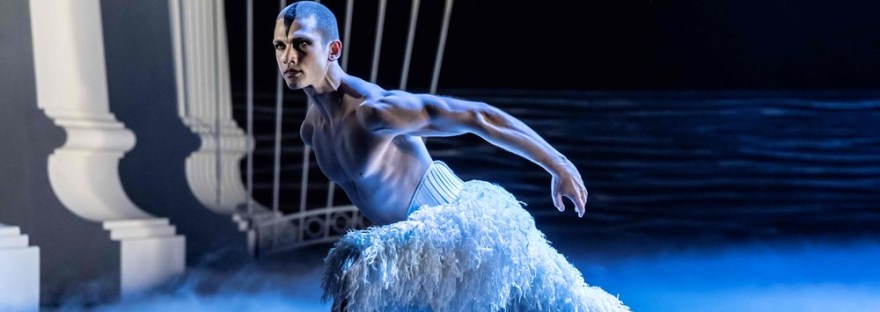
And then there are the swans… every time I see this Swan Lake, I marvel at the close attention to detail. Mute swans don’t ‘speak’ but they do grunt and snort and hiss – and here all these sounds are used to intensify the effect of their body language and behaviour. They are wild, inhuman, and dangerous – even when the cygnets appear to dance to their iconic tune, they are no sweet and fluffy little creatures but strong, boisterous, and potentially as dangerous as their elders.
The entire cast are to be applauded for their performances, their many costume- and character-changes, the astonishing accuracy of their ensemble pieces, especially in the opening scene and at the night club, and for still being standing at the end of what is an intense and challengingly physical marathon. There are many outstanding cameos, too numerous to mention.
Fronting this impressive cast were the principals. James Lovell’s Private Secretary got everywhere, did everything, and got up to who knows what when no-one was watching. Katrina Lyndon’s icily formal Queen probably deserved a lot of sympathy as she wrapped herself in a mantle of ice, but was impossible to feel for, given her behaviour towards her son. Bryony Wood’s Girlfriend was a marvel of comic timing, especially in the Royal Box at the ballet. It was hard to tell what her true feelings were, but she didn’t deserve the fate she met.
Rory Macleod’s Swan / Stranger double act was deeply impressive: athletic, strong, unexpectedly shy and gentle at times, and so endearing when he tenderly cradled the Prince in his wings. But for me the outstanding performance was from Leonardo McCorkindale as the Prince – his vulnerability, the fragility of the mask he dons during his public ‘performances’: feeling things deeply even when constrained by the formalities of his royal role and constantly yearning for the affection he craved but was always denied – until he met his Swan…
Small wonder the performance was greeted by thunderous applause and a standing ovation at the final curtain. Thirty years on, the magic is still there, and the message comes across loud and clear: love is real, and strong, and powerful, no matter who the two lovers are. Thank you, Matthew Bourne: here’s to the next thirty years of your Swan Lake.
Matthew Bourne’s Swan Lake, Festival Theatre, Edinburgh, runs until Saturday 12th April for more information and tickets go to: Matthew Bourne’s Swan Lake

 ScotsGay Arts